Best Firewood Racks for Indoor and Outdoor Storage
What's inside
As an Amazon Associate I earn from qualifying purchases. This post may contain affiliate links at no extra cost to you.
Best Firewood Racks for Indoor and Outdoor Storage
The best firewood rack depends on where it will stand: choose a compact, open steel holder for a hearth, and a longer, elevated rack with a fitted cover for outdoor seasoning. Before comparing products, measure the space, estimate how much wood you actually use, and check whether a listed capacity means a full cord or just a convenient stack.
Quick picks by situation
- Beside a fireplace or wood stove: A small steel hoop or narrow rectangular holder, roughly 18–24 inches wide, keeps a few days’ supply within reach without dominating the room.
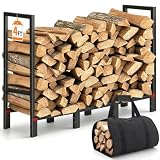
- For an uncovered yard: A 4-foot or longer raised steel rack with a cover that shields the top while leaving the sides open is a practical balance of airflow and rain protection.
- For a large seasonal supply: Use multiple modular racks or a long rack sized to the wood you buy. A full cord needs far more space than a typical hearth rack can hold.
- For tight storage: Look for a slim, rectangular rack that can sit against a wall, but leave clearance for the cover and avoid placing stored wood directly against siding.
Compare capacity, footprint, and construction
Capacities below are approximate estimates for neatly stacked, standard 16-inch firewood. Real capacity changes with log diameter, split shape, stacking gaps, and how high you load the rack. These are useful sizing comparisons, not manufacturer-certified cord measurements.
As an Amazon Associate we earn from qualifying purchases at no extra cost to you.


| Rack type | Typical footprint | Approximate stacked capacity | Common materials | Cover and weather suitability |
|---|---|---|---|---|
| Indoor hoop or small holder | 18–24 in. wide × 12–16 in. deep | About 1–3 days of hearth-side wood; usually under 0.03 cord | Powder-coated steel, wrought iron | Usually uncovered; intended for dry indoor use |
| Compact outdoor rack | 4 ft long × about 1 ft deep | About 0.1–0.2 cord | Painted or powder-coated steel | Often sold with an optional or bundled top cover; suitable for sheltered outdoor storage |
| Medium outdoor rack | 8 ft long × about 1 ft deep | About 0.25–0.4 cord | Steel rails and end frames | Cover recommended; better for regular household use |
| Heavy-duty or modular rack system | About 8–12 ft long × 1–2 ft deep | Roughly 0.4 cord to more than 0.5 cord, depending on height and depth | Heavier-gauge steel; sometimes timber supports | Choose a weather-resistant finish and a cover sized to the loaded stack |
Choose by location and use
For the hearth: prioritize footprint and a stable base
An indoor rack is a staging area, not a place to season a large wood supply. A 20-inch-wide holder can keep several logs handy, but may not accommodate long splits or an entire evening’s needs if you burn frequently. Check the usable opening and base dimensions, not just the outside width. A cradle-style hoop can be easy to load; a rectangular rack tends to stack wood more neatly and may hold kindling separately.
Steel is durable and easy to wipe down, while a decorative wrought-iron finish can suit a living space but may cost more. Whatever the style, look for a broad, level base and smooth edges. Set the rack on a floor mat if bark and wood dust would be difficult to clean from the surrounding surface, and keep the stack well away from stove or fireplace clearances specified by the appliance manufacturer.
For a patio or yard: protect the top, keep the sides breathing
Outdoor firewood needs protection from rain and ground moisture, but sealing a stack tightly can trap damp air. A rack that holds logs above the soil and a cover that sheds rain over the top are usually more useful than a full enclosure. Leave the sides open where possible so air can move through the stack. If wind-driven rain reaches the wood, position the rack in a more sheltered spot rather than wrapping the entire stack in a tarp.
A 4-foot rack is easy to fit but fills quickly. An 8-foot rack offers more capacity without taking the depth of a large wood shed. Measure the actual usable space, including room to walk around it and access the cover. Check that the cover’s dimensions match the loaded stack: a cover designed for a taller rack may sag on a short load, while a narrow cover can leave the ends exposed.
Estimate the space you need
A full cord is a stacked pile measuring 4 feet high, 4 feet deep, and 8 feet long: 128 cubic feet. A rack that is 8 feet long and 16 inches deep holds only about one-third of a cord if stacked to 4 feet high:
8 ft × 1.33 ft × 4 ft ≈ 42.6 cubic feet, or about 0.33 cord before allowing for irregular stacking and gaps.
That estimate helps avoid a common mismatch: a product described as “large capacity” may still hold only a fraction of a cord. If you buy a half cord, plan on a rack or combination of racks with enough usable volume, plus extra space for loose stacking. For short logs, the same footprint may hold more compactly; oversized splits reduce capacity.
What wears first—and how to extend rack life
- Finish and joints: Scratches and chipped coatings are common points where steel can start to rust. Touch up exposed areas with a suitable outdoor metal paint, following the product’s care guidance.
- Cover seams and fasteners: Sunlight, wind, and repeated handling can wear fabric covers before the rack fails. Inspect stitching and attachment points at the start of each season; replace a cover that has tears or no longer sheds water.
- Ground contact: Standing water and damp leaves accelerate corrosion around feet and lower rails. Set the rack on firm, drained ground and clear debris beneath it occasionally.
- Overloading: Stacking beyond the rack’s intended height can bow rails or make the pile unstable. Follow the stated load limit when available, and keep the stack even rather than piling heavy pieces at one end.
- Indoor mess: Bark and dust accumulate under hearth-side holders. A quick sweep or vacuum prevents debris from building up, especially around an appliance where its clearance rules matter.
Final choice
For occasional indoor fires, choose a stable steel holder sized to the logs you burn and the floor space you can spare. For outdoor storage, a raised 4-foot rack suits a small reserve; an 8-foot or modular rack is a better starting point for regular use. In either setting, buy for the usable footprint and actual stacked volume—not a vague capacity label—and treat a cover as rain protection, not a substitute for airflow or a dry, well-drained location.