
Our Top Picks
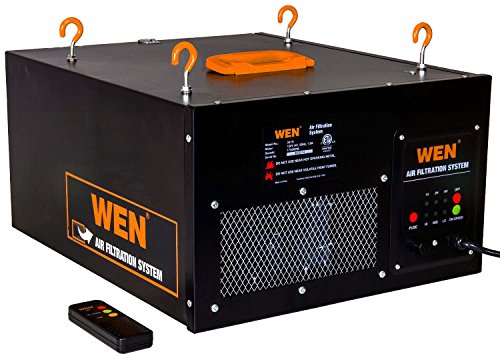 WEN 3410 3-Speed Remote-Controlled Air Filtration SystemPack17 x 20.5 x 10 inches31 PoundsCheck on Amazon
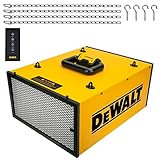
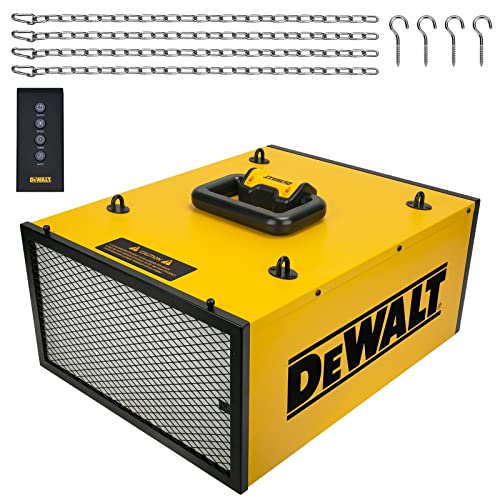 DEWALT Air Filtration System Dust Collector for WoodworkingMiddle Size20 x 15.9 x 10.2 inches20.9 poundsCheck on Amazon
 Abestorm 360 Degree Intake Air Filtration System forDecDust 1350IG9.8 x 20.5 x 9.8 inchesCheck on Amazon
 ALORAIR 360 degree Intake Air Filtration System20.5" L x 20.5" W x 9.8" H20.5 x 20.5 x 9.8 inches27 PoundsCheck on Amazon
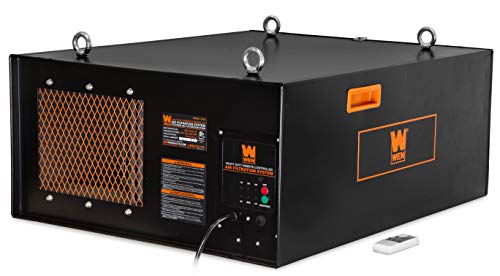 WEN 3417 3-Speed Remote-Controlled Industrial-Strength Air Filtration System30.3" L x 24" W x 12.2" H30.3 x 24 x 12.2 inches55 PoundsCheck on Amazon
 ALORAIR 360 Degree Intake Air Filtration System Woodworking20.5 x 20.5 x 9.8 Inches27 poundsCheck on Amazon
What's inside
As an Amazon Associate I earn from qualifying purchases. This post may contain affiliate links at no extra cost to you.
The fine dust that a table saw, sander, or router leaves hanging in the air is the dust that source collection never catches. It drifts after the machine stops, settles on finished surfaces, and coats everything in a small shop by the end of the day. Ceiling-hung air filtration units exist to address that second layer: they pull shop air through filters over and over, ideally lowering what floats and settles. The keyword “best air filtration systems for woodworking shops” points at that category, where the choice comes down to airflow, mounting, controls, and filter design.
This guide is written for hobbyists with a one- or two-car garage shop, small cabinet shops, and anyone who has watched a cloud of sanding dust drift across a wet finish. The listings are compared on the numbers stated in their titles, such as airflow in cubic feet per minute, number of speeds, remote controls, timers, and mounting style. An air cleaner is one layer of dust management alongside tool-mounted collection and a properly fitted respirator, and the titles make no health claims that this guide repeats. The comparison covers the 2026 lineup.
Quick Picks
As an Amazon Associate we earn from qualifying purchases at no extra cost to you.


| Product | Best for | Key spec from the title |
|---|---|---|
| WEN 3410 Air Filtration System | Small shops wanting a remote | 3 speeds, 300/350/400 CFM, RF remote |
| DEWALT DWXAF101 | Ceiling-hung use with timer modes | 3-speed, remote, 4 modes, 8H timer |
| ABESTORM 1350 CFM 360 Intake | Larger garages and workshops | 1350 CFM, 360° intake, built-in ionizer |
| ALORAIR 360 Intake 1050/1350 CFM | High airflow with hanging mode | 1050/1350 CFM, vortex fan, ionizer |
| WEN 3417 Industrial-Strength | Large shops needing more airflow | 3 speeds, 556/702/1044 CFM, remote |
| ALORAIR Hanging 580/780 CFM | Mid-sized shops, two-stage control | 580/780 CFM, 2 stage airflow, remote |
How to Choose
Size the airflow to the room
Airflow, measured in CFM, tells how much air a unit can move, and shop-sized cleaners are usually judged by how many times per hour they can turn over the room’s volume. Calculate shop volume by multiplying length, width, and ceiling height, then compare it with the CFM figure on the listing and the number of air changes the manufacturer suggests. The titles here range from 300 CFM on the low setting of the WEN 3410 to 1350 CFM on the ABESTORM and ALORAIR models, so there is a lot of room between a single-car shop and a large garage.
A quick worked example shows how to read the numbers. A shop that measures 20 feet by 20 feet with an 8 foot ceiling holds 3,200 cubic feet of air. A unit rated at 400 CFM would, in theory, move that volume in about eight minutes, while a 1,350 CFM unit would do it in under two and a half. Real-world mixing is less tidy than the math, but the ratio explains why small units struggle in big rooms and why oversized units are often run at low speed.
Think about mounting and clearance
Many units hang from the ceiling or sit on a shelf, and the title wording tells which. Hanging models save floor space but need strong anchor points in joists and a clear drop path for the intake. Check the unit’s weight and the mounting instructions, and keep the intake away from walls and tall cabinets that block airflow. A 360-degree intake, as listed on ABESTORM and ALORAIR, draws from all sides and works best near the center of the room.
Placement strategy matters as much as hardware. Position the unit so the air path crosses the main dust sources, such as the table saw and sanding station, and so that the exhaust blows across the room instead of straight at a wall. Keep it clear of spray finishing areas and any flammable vapors, and never block the intake or outlet. A unit mounted at the center of the ceiling, with room on all sides, tends to circulate better than one tucked into a corner.
Controls, timers, and noise
Remote controls appear on almost every model here, and they matter because the unit usually hangs out of reach. The DEWALT lists four modes and an eight-hour timer, which suits leaving it running after the shop closes. Multiple speeds let the user run low during quiet work and high during sanding. Noise is not stated in most titles, so consider placement and speed settings, and read the listing for decibel information.
Noise is worth a thought in attached garages and basement shops, where the hum travels. Running at a lower speed overnight, or using a timer to shut the unit off, keeps household peace, and some users prefer to run the highest speed only while sanding. Because noise ratings are usually absent from titles, the practical test is to start on the lowest setting and move up only when the shop actually needs it.
Filters and where budget units cut corners
Filter media and replacement cost are the long-term story. Many shop units use a coarse outer filter for chips and a finer inner filter for fine dust, and replacements are consumable items. Check the filter types and how often the manufacturer suggests changing them. Be cautious with listings that mention an ionizer without explaining what it does, and do not expect a ceiling unit to substitute for collecting dust at the tool. Budget models often skimp on filter area, which slows airflow as filters load.
Because several brands sell near-identical hanging units, the listings can be confusing. The ABESTORM unit appears four times with slightly different titles, and ALORAIR appears three times with the 1050/1350 and 580/780 CFM options. Those repeated listings have been merged into the entries below so that each product is covered once, and buyers should confirm which airflow option, filter set, and remote come with the exact listing they choose.
The 6 Best Options
WEN 3410 3-Speed Remote-Controlled Air Filtration System
The WEN 3410 lists three speeds at 300, 350, and 400 CFM and includes an RF remote. It is aimed at small garage shops and hobbyists who want straightforward controls.
- Strength: three speeds give flexibility between light and heavy dust work.
- Strength: an RF remote avoids reaching for a hanging unit.
- Trade-off: a 400 CFM maximum limits its usefulness in larger shops.
Skip it if the shop is large or has high ceilings.
DEWALT DWXAF101 Air Filtration System
DEWALT’s unit is a hanging ceiling model with three speeds, a remote, four modes, and an 8H timer. It suits owners who prefer a familiar tool brand and timer-based runs.
- Strength: timer modes support set-and-forget cleanup after work.
- Strength: hanging ceiling design saves floor space.
- Trade-off: the title lists no CFM figure, so airflow needs checking on the listing.
Skip it if airflow numbers are the main decision driver.
ABESTORM 1350 CFM 360° Air Filtration System
ABESTORM lists 1350 CFM, a 360 degree intake, a built-in ionizer, a strong vortex fan, and hanging use for woodshops and garages. Several listings of this model appear under slightly different wording.
- Strength: 1350 CFM is among the highest airflow figures in this guide.
- Strength: a 360° intake draws from every direction.
- Trade-off: more airflow can mean more noise and a larger unit to hang.
Skip it if the shop is small and a compact unit is enough.
ALORAIR 360 Degree Intake Air Filtration, 1050/1350 CFM
ALORAIR offers 1050 and 1350 CFM options with a strong vortex fan, a built-in ionizer, a hanging mode, and a dust collector focus for woodworking shops.
- Strength: two airflow options allow matching to shop size.
- Strength: 360° intake and vortex fan are named in the title.
- Trade-off: it overlaps closely with ABESTORM, so filters and warranty terms decide.
Skip it if a remote-controlled, timer-based model is preferred.
WEN 3417 3-Speed Industrial-Strength Air Filtration System
The WEN 3417 lists three speeds at 556, 702, and 1044 CFM with remote control. It is the bigger sibling of the 3410 for larger spaces.
- Strength: 1044 CFM on high gives serious airflow for a medium to large shop.
- Strength: three speeds and a remote keep operation simple.
- Trade-off: the unit is bulkier than the 3410, so mounting needs more planning.
Skip it if the shop is tiny.
ALORAIR Hanging Intake Air Filtration, 580/780 CFM
ALORAIR’s mid-range model lists 580 and 780 CFM, two-stage airflow, a remote, and a strong vortex fan. It suits shops that need more than a basic unit but not the maximum airflow.
- Strength: two airflow stages are easy to manage.
- Strength: remote control and a hanging design suit ceiling mounting.
- Trade-off: there are fewer speeds than three-speed competitors.
Skip it if fine speed control is wanted.
Buyers who are torn between a smaller unit and a larger one can often settle the question by thinking about speed settings instead of the maximum. A larger unit run on its low setting moves more air than a small unit at full speed, and it usually does so more quietly. If the shop might grow, or the dust sources are heavy, leaning toward the stronger unit is the safer path, as long as the ceiling and electrical supply can support it.
Which One Fits Your Situation
A one-car garage shop with occasional sanding
The WEN 3410 gives three speeds and a remote at modest airflow figures that fit a small space.
A dedicated shop with a ceiling and a timer habit
The DEWALT DWXAF101 with its 8H timer and four modes suits leaving the unit to run after work.
A large two-car garage with heavy dust
ABESTORM or ALORAIR at 1350 CFM, or the WEN 3417 at 1044 CFM, offer the highest airflow figures.
A mid-sized shop with a modest budget
ALORAIR’s 580/780 CFM unit offers a middle path with two-stage control.
A last practical point is maintenance. Pre-filters clog first and are often washable or inexpensive, so checking them monthly keeps airflow up. Main filters have a longer life but need replacement on a schedule that depends on how dusty the work is. Keep spare filters on hand if the shop runs daily, and write the installation date on the frame so replacement is not a guess.
Common Mistakes
- Choosing a unit by CFM alone without calculating room volume.
- Hanging a unit without confirming the anchor points and weight rating.
- Letting filters load without checking the replacement schedule.
- Treating an air cleaner as a substitute for tool dust collection and a respirator.
- Placing the intake against a wall, which blocks airflow.
Related guides
- Portable Power Stations For Camping Tools
- Laser Distance Measurers For Outdoor Use
- Shop Vac For Woodworking Dust Collection
Frequently Asked Questions
Do air filtration systems replace dust collectors?
No. Dust collectors capture chips and dust at the tool, while air filtration systems clean the shop air afterward. They work together.
How long should the unit run?
Many users run it during work and for a period afterward, and timer models help automate that. Check the manufacturer’s guidance on the listing.
What does an ionizer do?
It is described by manufacturers as an added feature, but its effect varies. Do not rely on it as a substitute for proper filters.
Are these units safe to leave running?
Follow the manual’s instructions on placement, power, and unattended use. Keep the unit away from flammable vapors and clear of obstructions.
Related guides
More from Amazon
Programs that pair well with the guide above. Offers and eligibility are set by Amazon and may change.
A free business account with business pricing and bulk-buying tools for work, shop or home office.
Create a business accountFree shipping on eligible items, Prime Video and more. Eligible new members can start with a free trial.
Start a Prime free trialAudiobooks and podcasts to listen to on the go. Eligible new members can start with a free trial.
Try Audible freeAd-free music streaming. Eligible new subscribers can start with a free trial.
Try Music Unlimited freeAs an Amazon Associate we earn from qualifying purchases.
Write Your Review
No reviews yet. Be the first to share your experience!