Makita 10-Inch Miter Saw: Capacity, Accuracy, and Models
What's inside
As an Amazon Associate I earn from qualifying purchases. This post may contain affiliate links at no extra cost to you.
The short answer for anyone comparing the Makita 10 inch miter saw lineup in 2026: buy the corded LS1019L if you want full sliding capacity and dual-bevel trim accuracy on a jobsite with power, the XSL06 (36V LXT) or GSL02 (40V XGT) if you’re already invested in Makita batteries, and the featherweight LS1040 only when carry weight and price matter more than crown capacity. The differences that actually matter come down to three numbers: how wide it crosscuts, how tall it cuts vertically, and how much it weighs on the walk from the truck.
As an Amazon Associate we earn from qualifying purchases at no extra cost to you.


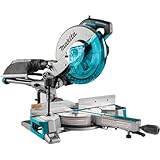

The Four 10-Inch Makitas, Spec for Spec
Makita’s 10-inch family splits cleanly into a non-sliding compound saw and three dual-bevel sliders sharing the same capacity class. Here is how they stack up on the specs that decide a purchase:
| Model | Power source | Bevel | Crosscut at 90° | Crosscut at 45° | Nested crown | Weight | Typical street price |
|---|---|---|---|---|---|---|---|
| LS1040 | Corded, 15 amp | Single (left, 45°) | ~5-1/8 in. | ~3-1/2 in. | Under 3 in. (2-3/4 in. max cut height) | 27.3 lb | $150–$250 |
| LS1019L | Corded, 15 amp | Dual (48° L/R) | 12 in. | 8-1/2 in. | 5-1/4 in. | 57.9 lb | $450–$600 |
| XSL06 | 36V (two 18V LXT packs), brushless | Dual (48° L/R) | 12 in. | 8-1/2 in. | 5-1/4 in. | ~60 lb with batteries | $500–$700 tool-only, more in kit |
| GSL02 | 40V max XGT, brushless | Dual (48° L/R) | 12 in. | 8-1/2 in. | 5-1/4 in. | ~60 lb with battery | $600–$750 tool-only |
Two things stand out immediately. First, the three sliders deliver identical published capacity — you’re choosing a power source, not a bigger cut. Second, the LS1040 costs roughly a third of the sliders and weighs less than half, but gives up almost 7 inches of crosscut width. That tradeoff defines every buying decision in this lineup.
What the Capacity Numbers Mean in Real Lumber
Spec-sheet inches translate into specific boards you can and cannot cut:
- LS1040 at ~5-1/8 in.: crosscuts a 2×4 flat or a 1×6 cleanly, but it cannot crosscut a standard 2×6 (5-1/2 in. actual) in one pass at 90° — you’d flip the board and finish the cut, losing accuracy in the process. For framing decks or cutting plank flooring, that’s a daily annoyance. Nested crown molding is essentially off the table; you’d be cutting crown flat with compound angles on a small fence.
- All three sliders at 12 in.: handle a full 2×12 (11-1/4 in. actual) flat at 90°, an 8-1/2 in. board at a 45° miter, and 5-1/4 in. crown molding standing in the nested position — which covers the most common paint-grade and stain-grade crown profiles. Baseboard up to about 4-3/4 in. cuts vertically, so typical 4-1/4 in. colonial base goes through standing up against the fence.
- A 4×4 post (3-1/2 in. actual): clears the sliders’ ~3-5/8 in. maximum cutting height with almost nothing to spare — one pass, tight fit. On the LS1040, a 4×4 requires a flip-and-finish cut.
If your work is exclusively 2×4 framing, PVC trim, and flooring, the LS1040’s capacity ceiling rarely bites. The moment crown molding, tall base, or wide shelving enters the picture, the 12-inch crosscut of the sliders stops being a luxury.
Out-of-Box Accuracy: Fences and Detents
Makita’s sliders ship with tall sliding sub-fences that support crown and tall base at bevel angles — slide them out for bevel clearance, in for maximum support. The LS1040 uses a shorter cast fence that’s square enough for framing but offers less bearing surface for tall work. Regardless of model, no saw should be trusted blind off the pallet; detent plates are stamped and set at the factory, and they’re usually close, but “close” isn’t square on a mitered casing joint.
Run this five-minute check before the first real cut:
- Unplug the saw (or pull the batteries) and raise the head fully.
- Place a reliable engineer’s square against the fence and the blade body — not the teeth — at the 0° miter detent. Look for light gaps at the top or bottom of the square.
- Make a test crosscut in scrap and check the offcut with the same square; a perfectly square fence can still produce a bevel error if the 0° bevel stop is off.
- Check the 45° bevel stop against a known-good angle gauge or drafting triangle.
- On the sliders, extend the head fully forward, grip it, and feel for lateral play. Makita’s dual steel-rail design keeps deflection low, but technique matters: slide out, plunge, then push through the cut rather than pulling toward yourself.
The 0° and 45° miter detents and both bevel stops are adjustable on all four models, so a slightly off saw is a calibration task, not a defect. Owners of the LS1019L consistently find its direct-drive gearbox produces less startup torque twist than belt-driven designs, which helps the blade stay true to the detent it was set on.
Carry Weight and Jobsite Footprint
The 27.3 lb LS1040 is a genuine one-hand carry — grip the top handle, walk it up a ladder to a deck, toss it in a car trunk. At roughly 58–60 lb, every slider in this lineup is a two-hand carry that most users end up mounting on a folding stand (Makita’s compact WST06 fits them all) rather than moving bare. Over a week of daily in-and-out moves, that 30-plus-pound gap is the single most felt difference between these saws.
The sliders do claw back one advantage: Makita’s two-rail slide system runs on a compact footprint, so the saw can sit nearly flush against a shop wall or van bulkhead where conventional sliding saws need a foot of clearance behind them. For a small garage shop or a packed work van, that’s as valuable as the weight number.
Decision Matrix: Match the Saw to the Situation
| Your situation | Best pick | Why |
|---|---|---|
| Occasional DIY — framing, flooring, fence boards, tight budget | LS1040 | ~$200 buys a real 15-amp saw you can carry one-handed; its capacity ceiling only hurts on wide boards and crown |
| Finish carpenter or remodeler cutting crown, base, and casing daily | LS1019L | 5-1/4 in. nested crown, dual bevel, corded consistency, and the lowest cost per cut in the slider group |
| Already own 18V LXT batteries; sites without reliable power | XSL06 | Same cut envelope as the corded slider, AWS dust-extraction pairing, manufacturer-rated for a few hundred 2×4 crosscuts per charge |
| Invested in or moving to the 40V XGT platform | GSL02 | Full slider capacity on a single battery with the newest electronics; makes sense only if you’re already on XGT — the packs aren’t cheap |
| Solo installer doing stair carries and frequent relocations | LS1040 | Half the weight of any slider; pair it with a stand and accept the crosscut limit, or split material handling differently |
| Small shop, saw parks against a wall | Any of the three sliders | Compact rail design needs minimal rear clearance; pick the power source you have |
A quick cost-per-use sanity check for the budget-vs-capacity question: at ~$550, an LS1019L used on 150 jobs a year for five years costs about $0.73 per job — trivial. At ~$200, an LS1040 used on six weekend projects a year costs about $6.70 per project over the same span. Both are cheap per use; the real cost of the LS1040 is the day you discover crown molding or a 2×12 on the cut list.
Ownership Realities Nobody Puts on the Box
- Blades are the biggest upgrade and the cheapest consumable. All four models share a 10-inch, 5/8-inch arbor — the most common blade spec there is, so 60- to 80-tooth fine-finish blades run roughly $30–$80 and transform trim cut quality. The factory blade is fine for framing.
- Brushes on the corded saws, none on cordless. The LS1040 and LS1019L use brushed motors with externally accessible brush sets — a cheap, expected wear item over years of service. The brushless XSL06 and GSL02 eliminate that wear point but add battery cost: two 5Ah-class LXT packs plus a charger can add $250–$400 to a bare-tool XSL06.
- What wears first: the kerf plate insert gets chewed up (replace it — a gap around the blade kills dust collection and invites tear-out), detent-plate markings fade, and slide rails need periodic cleaning with a dry lubricant. Wet grease on rails attracts sawdust and gums up the action.
- Common mistakes: trusting the factory detents without a square check; cutting nested crown without optional crown stops; carrying a slider by the slide rails or fence instead of the base handle; and hauling the saw with the head unlocked, which lets the motor assembly swing and knock fences out of alignment.
- Dust collection is mediocre with the bag. All four saws improve dramatically on a vacuum; the AWS-capable cordless models can trigger a compatible Makita extractor automatically.
Frequently Asked Questions
Is a Makita 10 inch miter saw enough, or should I buy a 12-inch?
Unless you regularly crosscut material wider than 12 inches or install crown taller than about 5-1/4 inches nested, the 10-inch covers the work — and 10-inch blades cost noticeably less than 12-inch. Stepping up to something like Makita’s LS1219L makes sense only for high-volume shops cutting big casework parts.
Do the cordless models cut as well as the corded slider?
Published capacities and bevel/miter ranges are identical across the three sliders, and the brushless cordless motors hold rated speed well under load. The real difference is runtime and workflow, not cut quality — battery saws trade unlimited duty for freedom from cords and generators.
Can the LS1040 handle crown molding at all?
Only flat-cut with compound miter-bevel settings, and only for small profiles. If crown is on your regular cut list, treat the LS1040’s price as false economy and move to a slider with real nested capacity.
Bottom line: the Makita 10 inch miter saw decision is really a two-question quiz — do you need the 12-inch crosscut and 5-1/4-inch crown capacity of the sliders, and is your power corded or battery? Answer those honestly and the right model picks itself.