Milwaukee 7-1/4″ Circular Saw: Corded vs. M18 Fuel Compared
What's inside
- The Milwaukee 7-1/4-inch lineup at a glance
- What the depth numbers actually let you cut
- Left blade vs. right blade: the spec nobody checks
- Blade brake and rafter hook: small features, daily impact
- Corded vs. cordless: the real cost math
- Which one for which situation
- Blades, and the 7-1/4 miter saw question
- The Milwaukee 7-1/4-inch lineup at a glance
- What the depth numbers actually let you cut
- Left blade vs. right blade: the spec nobody checks
- Blade brake and rafter hook: small features, daily impact
- Corded vs. cordless: the real cost math
- Which one for which situation
- Blades, and the 7-1/4 miter saw question
As an Amazon Associate I earn from qualifying purchases. This post may contain affiliate links at no extra cost to you.
For most buyers in 2026, the Milwaukee 7-1/4 circular saw to get is the M18 FUEL sidewinder (2731-20) — it matches the corded Tilt-Lok on cutting depth, adds a blade brake and rafter hook, and runs all day on one or two high-capacity M18 packs. The corded 6390-21 Tilt-Lok still wins on price-per-power and for shop work where a cord is never a problem. The detail that actually decides this for many people isn’t power at all: it’s blade side, cut depth at 45°, and whether you need the saw to stop spinning the second you release the trigger.
As an Amazon Associate we earn from qualifying purchases at no extra cost to you.
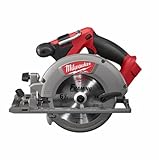
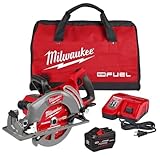


The Milwaukee 7-1/4-inch lineup at a glance
Milwaukee sells three meaningfully different 7-1/4-inch platforms. Here’s how the flagship models compare on the specs that matter for framing, sheet goods, and remodel work:
| Spec | Corded Tilt-Lok 6390-21 | M18 FUEL 2731-20 (sidewinder) | M18 FUEL 2830-20 (rear handle) |
|---|---|---|---|
| Power | 15 amp, 120V | M18 brushless | M18 brushless |
| No-load speed | ~5,800 RPM | ~5,800 RPM | ~5,800 RPM |
| Cut depth @ 90° | ~2-7/16 in. | ~2-1/2 in. | ~2-1/2 in. |
| Cut depth @ 45° | ~1-7/8 in. | ~1-7/8 in. | ~1-7/8 in. |
| Blade side | Left | Right | Left |
| Electric blade brake | No | Yes | Yes |
| Rafter hook | No | Yes | Yes |
| Weight | ~10.4 lb | ~7.5 lb bare, ~9 lb with battery | ~9–11 lb depending on pack |
| Typical price | $130–$160 | $200–$250 bare | $280–$330 bare; kits higher |
Milwaukee also still sells a corded 7-1/4-inch worm drive (the 6377 series) for crews who want the torque and narrow profile of that format, and an older brushed M18 6-1/2-inch saw for buyers on a tighter budget.
What the depth numbers actually let you cut
Both platforms sit in the 2-1/2-inch class at 90°, and that’s the number that defines the tool’s job scope:
- 2x lumber at 90°: A 2×4 is 1-1/2 inches thick — every saw here cuts it with a full inch to spare. You can even gang-cut a 2x on top of a sheet of 3/4-inch plywood.
- 2x lumber at 45°: At roughly 1-7/8 inches of depth, a beveled rip or crosscut through 1-1/2-inch stock (rafter tails, angled plates) clears fine. Cutting a bevel through doubled-up material or a 2x standing on edge is where you run out — plan a second pass from the back.
- 4x material: A 4×4 post is 3-1/2 inches. No 7-1/4-inch circular saw reaches that in one pass; it’s a two-pass cut you rotate the stock for, or a job for a miter saw.
- Sheet goods: Depth is irrelevant for plywood — the real concern is blade choice and keeping the shoe flat on the sheet.
The practical difference between 2-7/16 and 2-1/2 inches at 90° is nearly nil. Where the corded Tilt-Lok concedes ground is the 45° stops and bevel detents being less refined than the newer cordless saws.
Left blade vs. right blade: the spec nobody checks
Here’s the quirk in Milwaukee’s lineup: the corded Tilt-Lok is a left-blade saw, the M18 FUEL sidewinder puts the blade on the right, and the rear-handle model goes back to left-blade like a worm drive.
- Left blade (Tilt-Lok, rear handle): A right-handed user holds the saw in the right hand and the blade sits on the far side of the body — giving a direct, unobstructed view of the blade meeting the cut line. This is why worm drives and rear-handle saws are almost universally left-bladed.
- Right blade (M18 FUEL sidewinder): Right-handed users sight down the saw’s cut-line notch rather than watching the blade itself, or lean slightly over the tool. Left-handed users often prefer this layout, since the blade ends up on their visible side.
Milwaukee compensates on the M18 FUEL with a bright LED that lights the cut line and a well-marked notch at both 0° and 45° — but if you’re moving from a corded Milwaukee or any left-blade saw, expect a few days of adjustment. If sightline is your top priority and you’re right-handed, the rear-handle 2830 is the cordless answer, not the sidewinder.
Blade brake and rafter hook: small features, daily impact
The M18 FUEL saws include an electric brake that stops the blade in roughly a second or two after the trigger releases. The corded Tilt-Lok has no brake — the blade coasts for ten-plus seconds, which means either waiting or carefully setting the saw down while it spins. If you make dozens of interrupted cuts a day (stair stringers, blocking, punch-list work), the brake alone justifies the cordless premium and is a genuine safety upgrade.
The rafter hook tells the same story: both M18 FUEL models have an integrated hook for hanging the saw on joists, ladders, and sawhorses. The Tilt-Lok doesn’t. On a roof or deck frame, that’s the difference between a saw you hang and a saw you set down and kick.
Corded vs. cordless: the real cost math
A bare M18 FUEL saw is only part of the price. A realistic all-in comparison:
- Corded setup: Tilt-Lok at roughly $130–$160, plus a quality 25-foot 12-gauge cord if you don’t own one (~$40–$60). Total: under $220.
- Cordless setup: Bare saw ~$200–$250, plus a High Output or Forge pack for full power under load (~$130–$180 each; two is realistic for all-day work) and a charger if you’re not already on M18. Total: roughly $450–$600 starting from zero.
On runtime, plan around the work, not the marketing. A 12.0Ah-class pack delivers several hundred 2×4 crosscuts in mixed framing use — comfortably a half day for one carpenter — but continuous ripping of wet 2x or OSB drains far faster than intermittent crosscuts. If you already own M18 batteries, the cordless premium shrinks to almost nothing. If you’re a weekend user cutting sheet goods in a garage, the corded Tilt-Lok at half the price is the rational buy.
Ownership realities: On the cordless saws, what wears is consumable by design — blades, then eventually the rafter hook hardware and blade-guard spring if abused. The brushless motor has no brushes to service. On the corded saw, the common failure points are the cord’s strain relief (don’t carry the saw by the cord) and carbon brushes after heavy years of use — both cheap, easy fixes. On any of them, keep the lower guard pivot clean and lightly lubricated; a sticky guard hanging open mid-cut is the most common real-world hazard, and it’s almost always a sawdust-and-neglect problem, not a defect.
Which one for which situation
| Your situation | Best pick | Why |
|---|---|---|
| Garage/shop DIYer cutting plywood and dimensional lumber | Tilt-Lok 6390-21 | Cheapest path to full-depth cuts; cord is a non-issue indoors |
| Framer or remodeler working off ladders and joists | M18 FUEL 2731-20 | Brake + rafter hook + no cord drag |
| Right-handed user who insists on a clear blade sightline, or worm-drive convert | M18 FUEL 2830-20 | Left blade and long body handle like a worm drive without the oil and weight |
| Left-handed user | M18 FUEL 2731-20 | Right-blade layout puts the cut line on your visible side |
| Already own M18 High Output batteries | Either M18 FUEL bare tool | The premium over corded shrinks to ~$70–$90 |
| Need to cut 4x posts and rafter bevels all day | Rear handle, or reconsider a miter saw | No 7-1/4 sidewinder one-passes 4x material |
Blades, and the 7-1/4 miter saw question
Every saw here takes a standard 7-1/4 circular saw blade on a 5/8-inch diamond arbor — the most common blade size sold anywhere, which is itself a reason to buy this class of saw. Match the tooth count to the work: 24-tooth for framing and fast rips, 40-tooth as the do-everything compromise, 60-tooth for plywood and finish cuts where tear-out matters. On the cordless saws, thin-kerf blades stretch runtime noticeably and are the right default; the corded saw has power to spare either way. Whatever blade you run, set depth so the teeth protrude only about a quarter inch past the material — it’s safer, cuts faster, and leaves a cleaner edge.
A quick clarification for searchers landing here: a 7-1/4 miter saw — like Milwaukee’s M18 FUEL 7-1/4-inch sliding compound model — is a different tool that shares only the blade diameter. The miter saw makes repeatable, precise crosscuts and miters in trim and 2x stock up to about 8 inches wide; it can’t rip a sheet of plywood. If you can only buy one tool, the circular saw is the versatile first purchase. And yes, a 7-1/4-inch miter saw blade can physically fit these circular saws if the arbor matches — just verify the blade’s RPM rating meets the saw’s ~5,800 RPM and expect high-tooth-count miter blades to cut slowly in framing stock.
FAQ
Can a Milwaukee 7-1/4 circular saw cut a 4×4 in one pass? No — maximum depth is about 2-1/2 inches against 3-1/2 inches of stock. Cut one side, flip, and finish from the other face.
Does the M18 FUEL run on regular M18 batteries? Yes, it accepts any M18 pack, but High Output and Forge batteries sustain power better under heavy loads and are worth it for ripping.
Is blade-left or blade-right better? Neither is objectively better — it depends on your dominant hand and whether you prefer watching the blade or the guide notch. Right-handers usually favor left-blade saws; try before you buy if possible.