Best 10-Inch Miter Saw Blades
What's inside
- Quick picks by cutting situation
- What separates a good 10 in miter saw blade from an average one?
- Comparison of common 10-inch blade configurations
- Strong options from established blade lines
- Decision matrix: choose by your work pattern
- How to set up a 10-inch chop saw blade for cleaner cuts
- Ownership costs and signs it is time to replace the blade
- Frequently asked questions
- Related Guides
- Quick picks by cutting situation
- What separates a good 10 in miter saw blade from an average one?
- Comparison of common 10-inch blade configurations
- Strong options from established blade lines
- Decision matrix: choose by your work pattern
- How to set up a 10-inch chop saw blade for cleaner cuts
- Ownership costs and signs it is time to replace the blade
- Frequently asked questions
- Related Guides
As an Amazon Associate I earn from qualifying purchases. This post may contain affiliate links at no extra cost to you.
Best 10-Inch Miter Saw Blades
The best 10 miter saw blade for most trim and remodeling work is a 60-tooth, carbide-tipped ATB blade with a thin-to-standard kerf, while hardwood, plywood, and composite trim may need a different tooth count, blade material, and hook angle.
A 10-inch miter saw blade is not automatically interchangeable with every 10-inch chop saw blade. Before buying, confirm the blade diameter, arbor hole, maximum RPM, kerf, and whether your saw is intended for wood. Abrasive metal-cutting wheels and some steel-cutting blades are not suitable for a wood miter saw.
As an Amazon Associate we earn from qualifying purchases at no extra cost to you.
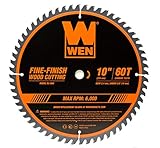

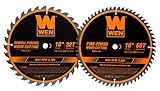

Quick picks by cutting situation
- Best all-purpose choice: 60-tooth carbide-tipped ATB blade with a 5/8-inch arbor and approximately 0.098-inch kerf.
- Best for painted trim and delicate crosscuts: 80-tooth finish blade with a high alternate-top-bevel grind.
- Best for framing and fast softwood cuts: 24-tooth or 32-tooth framing blade.
- Best for hardwood: 60-tooth or 80-tooth blade with a durable carbide grade and a low-to-moderate hook angle.
- Best for plywood and veneered panels: 80-tooth blade designed for crosscutting sheet goods.
- Best for composite trim: 80-tooth or specialized composite-material blade with a negative or near-zero hook angle.
What separates a good 10 in miter saw blade from an average one?
Tooth count
Tooth count controls the balance between speed, smoothness, chip clearance, and heat. A 24-tooth blade removes material quickly but leaves a rougher edge. A 60-tooth blade is the practical middle ground for baseboard, casing, dimensional lumber, and general crosscutting. An 80-tooth blade produces cleaner edges in plywood, hardwood, and painted trim, but it cuts more slowly and can load with resin if pushed too hard.
For a 10-inch blade, tooth count is only meaningful when combined with the tooth design. A 60-tooth ATB blade intended for crosscutting is a better trim choice than a 60-tooth blade designed mainly for ripping.
Kerf
Kerf is the width of the cut. A thin-kerf blade commonly measures about 0.087 to 0.098 inch, while a full-kerf blade is often around 0.118 to 0.125 inch. Thin kerf reduces waste and requires less motor power, which is useful on compact or cordless saws. Full kerf generally offers a stiffer plate and can track more confidently in demanding hardwood cuts.
Thin kerf is not automatically more accurate. A thin plate can deflect if the workpiece is poorly supported, the blade is dull, or the saw is forced through the cut. Match the blade to the saw’s power and the material’s thickness.
Carbide and blade material
Carbide-tipped blades are the normal choice for wood miter saws. The steel body provides structure, while carbide teeth retain an edge much longer than plain steel. Better blades use larger carbide tips that can be sharpened several times and may use a laser-cut plate or expansion slots to control vibration and heat.
For occasional softwood work, a standard carbide blade is sufficient. For frequent hardwood, plywood, or composite trim work, prioritize a blade with durable carbide, a stiff plate, and a coating or tooth geometry intended to resist resin buildup. A premium blade costs more initially but may deliver a lower cost per cut when it can be sharpened rather than discarded.
Hook angle
Hook angle describes how aggressively the teeth pull the material into the blade. A positive hook angle, often around 5 to 15 degrees on general-purpose wood blades, feeds efficiently and clears chips quickly. It is useful for ordinary lumber but can be too aggressive for thin trim or materials that tend to chip.
A low or negative hook angle, roughly 0 to -5 degrees, gives a more controlled feed. It is often preferable for composite trim, laminates, delicate moldings, and applications where grabbing is a concern. Do not confuse a negative hook angle with a dull blade: it still needs the correct tooth grind and adequate clearance.
Comparison of common 10-inch blade configurations
| Blade configuration | Typical kerf | Best material | Cut character | Typical price range |
|---|---|---|---|---|
| 24T ATB, carbide-tipped | 0.098–0.125 in | Framing lumber and fast softwood cuts | Fast, visibly rougher edge | $15–$30 |
| 32T–40T general-purpose ATB | 0.087–0.125 in | Softwood, construction lumber, occasional plywood | Balanced speed and finish | $20–$40 |
| 60T ATB crosscut blade | 0.087–0.098 in | Hardwood, softwood, baseboard, casing | Clean general-purpose cut | $25–$55 |
| 80T fine-finish ATB | 0.087–0.125 in | Plywood, veneer, painted trim, hardwood | Very clean but slower | $30–$70 |
| 80T low- or negative-hook composite blade | 0.098–0.125 in | PVC, polyurethane, laminate, composite trim | Controlled entry and reduced grabbing | $35–$80 |
Strong options from established blade lines
Freud Diablo D1060X is a widely available 60-tooth 10-inch option for general crosscutting. Its tooth count suits a miter saw used for both construction lumber and finish trim. It is a sensible upgrade from an inexpensive stock blade when you want one blade for varied work.
Freud Diablo D1080X moves to 80 teeth for finer crosscuts in trim, plywood, and hardwood. Choose it when edge quality matters more than cutting speed. It is less suitable as a single blade for repeated thick framing cuts.
DEWALT DW3106P5D60I is a 60-tooth carbide-tipped crosscut blade commonly sold for 10-inch saws. It fits the general-purpose category, making it appropriate for users who want a familiar, readily available replacement rather than a specialized material blade.
Makita A-93681 is an 80-tooth finish blade intended for clean wood crosscuts. It is a good match for a shop or trim-focused saw, particularly when the blade will spend most of its time cutting casing, baseboard, and plywood rather than framing lumber.
Exact kerf, arbor, and RPM specifications can vary by model and production version, so check the manufacturer’s current packaging before installation. A product name alone is not enough to establish compatibility.
Decision matrix: choose by your work pattern
| Your situation | Recommended specification | Why |
|---|---|---|
| Beginner with one saw for household projects | 60T ATB, 0.098 in kerf, positive or neutral hook | Handles common lumber and trim without being excessively slow |
| Frequent professional trim work | 80T finish blade plus a spare 60T blade | One blade preserves finish quality; the other handles faster utility cuts |
| Cordless or compact saw | Thin-kerf 40T–60T blade | Reduces material removed and motor load |
| Mostly hardwood | 60T–80T, stiff plate, high-quality carbide, moderate hook | Controls heat, deflection, and edge breakout |
| PVC or composite molding | 80T specialized blade, low or negative hook | Reduces grabbing, melting, and chipped edges |
| Occasional framing and deck work | 24T–40T general-purpose blade | Prioritizes speed and chip clearance over furniture-grade finish |
How to set up a 10-inch chop saw blade for cleaner cuts
- Confirm compatibility. Match the 10-inch diameter, 5/8-inch arbor where specified, RPM rating, kerf clearance, and saw type. The blade must rotate in the direction marked on the blade.
- Inspect the saw. Unplug the saw or remove its battery. Check that the arbor washer, flange, and blade guard are clean and undamaged.
- Support the stock. Long trim should be supported at the same height as the saw table. Unsupported material can shift, pinch the blade, or tear out at the exit.
- Mark the finished face. On many miter saws, placing the better face upward reduces visible breakout, but test the orientation on scrap because the result depends on the blade and material.
- Let the blade reach full speed. Lower it smoothly without forcing the cut. Excessive pressure creates heat, deflection, and a rough edge.
- Clean after use. Remove resin and dust with a blade-safe cleaner and a soft brush. Do not scrape carbide teeth with a hard steel tool.
Ownership costs and signs it is time to replace the blade
Teeth usually become ineffective before the blade body wears out. A dull blade leaves burn marks, requires more feed pressure, produces fuzzy crosscuts, or begins to wander. Missing carbide, a cracked plate, heavy warping, or damaged expansion slots calls for replacement rather than sharpening.
As a simple cost comparison, a $45 blade sharpened four times at $15 per sharpening costs $105 over its service life, or about $21 per usable blade cycle. A $25 bargain blade discarded after one cycle may cost less initially but more per clean-cut cycle if it dulls quickly or damages expensive trim. Sharpening is most worthwhile for a quality blade with substantial carbide remaining.
For most owners, the best 10 inch miter saw blade is a 60-tooth carbide ATB model with a thin or standard kerf. Add an 80-tooth low-hook blade for fine hardwood, plywood, and composite trim, and keep a coarser 24-tooth or 32-tooth blade for fast softwood and framing cuts.
Frequently asked questions
Can I use a 10 inch chop saw blade on a miter saw?
Only if it is specifically rated for the saw and the material being cut. A wood-rated 10-inch blade may work on a compatible miter saw, but an abrasive masonry or metal-cutting wheel is a different product. Check diameter, arbor, RPM, kerf, and the saw manufacturer’s instructions.
Is a 60-tooth blade or an 80-tooth blade better?
A 60-tooth blade is better for mixed work and faster cuts. An 80-tooth blade is better when minimizing splintering and improving the finished edge is the priority.
Does a higher tooth count always cut better?
No. Too many teeth for thick softwood can restrict chip clearance, increase heat, and slow the cut. Tooth geometry, hook angle, sharpness, blade stiffness, and workpiece support matter as much as the number printed on the blade.