Jigsaw Saw Pictures: Compare Styles, Features, and Sizes
What's inside
- Jigsaw Saw Pictures: Compare Styles, Features, and Sizes
- What to Look for in Labeled Jigsaw Saw Pictures
- Four Jigsaw Styles Compared Side by Side
- Image Guide: How Each Style Looks
- Capacity, Control, and Blade Access
- Choose by Situation Rather Than Appearance
- Worked Cost and Runtime Example
- Ownership Details Product Pictures Cannot Show
- Bottom Line
- Jigsaw Saw Pictures: Compare Styles, Features, and Sizes
- What to Look for in Labeled Jigsaw Saw Pictures
- Four Jigsaw Styles Compared Side by Side
- Image Guide: How Each Style Looks
- Capacity, Control, and Blade Access
- Choose by Situation Rather Than Appearance
- Worked Cost and Runtime Example
- Ownership Details Product Pictures Cannot Show
- Bottom Line
As an Amazon Associate I earn from qualifying purchases. This post may contain affiliate links at no extra cost to you.
Jigsaw Saw Pictures: Compare Styles, Features, and Sizes
Jigsaw saw pictures are most useful when they show the handle, battery or cord, blade opening, and base together: a corded top-handle model is usually the longest-running and lowest-cost option, a cordless saw is easier to move around a jobsite, a barrel-grip saw offers better control for detailed cuts, and a compact top-handle saw is often the simplest choice for occasional DIY work.
What to Look for in Labeled Jigsaw Saw Pictures
When comparing saw pictures of a jigsaw, look beyond color and styling. These five areas reveal how a tool will feel and fit your work:
As an Amazon Associate we earn from qualifying purchases at no extra cost to you.
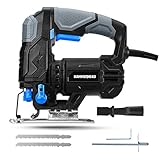
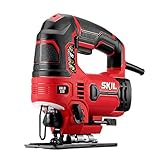


- Handle position: Top-handle tools place your hand above the motor. Barrel-grip tools put your hand closer to the blade and workpiece.
- Power source: A corded saw has a trailing cable but no battery weight or recharge time. A cordless model needs a battery and charger but is easier to position.
- Blade access: Tool-free blade clamps are faster for frequent material changes. Check whether the release is visible and reachable while wearing gloves.
- Base size: A larger steel or aluminum shoe can feel steadier on sheet goods. A smaller shoe is easier to guide around tight curves.
- Controls: Look for a variable-speed trigger or dial, orbital-action selector, lock-on button, dust-port location, and bevel adjustment.
Four Jigsaw Styles Compared Side by Side
| Style | Typical size and weight | Best use | Main advantage | Trade-off |
|---|---|---|---|---|
| Corded top-handle | 10–14 in. long; 5–7 lb | Workshop cutting and repeated jobs | Consistent power and no runtime limit | Cord can catch on the workpiece or restrict movement |
| Cordless top-handle | 9–13 in. long; 5–8 lb with battery | Remodeling, installation, and mobile work | Fast setup and unrestricted movement | Battery and charger add cost and weight |
| Cordless barrel-grip | 8–12 in. long; 4.5–7 lb with battery | Curves, cutouts, and controlled detail work | Low hand position improves blade tracking | Controls may take more practice to reach |
| Compact top-handle | 8–11 in. long; 3.5–5.5 lb | Light DIY use and small workpieces | Easy to carry and maneuver | Usually less robust for thick stock or daily use |
These are useful comparison ranges rather than universal specifications. Battery size, shoe construction, motor design, and included accessories can change the final weight. A 2.0Ah battery may make a cordless saw noticeably lighter than the same tool fitted with a 5.0Ah pack.
Image Guide: How Each Style Looks
Label 1: Corded Top-Handle Jigsaw
In a labeled picture, identify the rear power cord, tall D-shaped handle, trigger inside the handle, speed control, metal shoe, and exposed blade at the front. Models such as the Bosch JS470E and Makita 4329 represent the familiar corded format. Their visual advantage is simple: the motor and controls are easy to see, and the tool remains ready as long as an outlet is available.
Choose this shape for a permanent workshop, long cuts in plywood, or projects where you would otherwise need several batteries. A corded tool is also often the best value when the saw will be used only a few times per year.
Label 2: Cordless Top-Handle Jigsaw
A cordless picture should show the battery at the rear or underneath the motor, a top handle, a tool-free blade clamp, and often an LED aimed at the cut line. Examples include the DeWalt DCS334 and Milwaukee M18 jigsaw families. The battery shifts the balance toward the back, so compare the tool with the battery installed rather than judging the bare body.
This style suits flooring, cabinetry installation, roof work, and repairs in places where an extension cord is inconvenient. It is also a practical choice if you already own compatible batteries from the same platform.
Label 3: Barrel-Grip Jigsaw
Barrel-grip pictures show a compact cylindrical motor housing rather than a tall hand loop. The power switch, speed control, and orbital selector may sit close to the thumb or index finger. DeWalt’s DCS335 is an example of this general arrangement; other professional ranges use the same low-profile layout.
The lower grip can make it easier to keep the shoe flat and steer through a marked curve. It can also be more comfortable when cutting from underneath a workpiece or when a tall handle would hit surrounding material. The compromise is control familiarity: you may need to release and reposition your hand to change speed or stop the tool.
Label 4: Compact Top-Handle Jigsaw
Compact models have a shorter body, smaller battery or cord connection, and a relatively narrow shoe. In saw pictures, they are easiest to recognize by their reduced height and lighter construction. They are convenient for trim, thin plywood, craft panels, and occasional household repairs.
Do not confuse compact size with suitability for every material. Check the manufacturer’s stated cutting capacity before using one on thick hardwood or countertop material. A small body may also transmit more vibration if the shoe or blade is poorly supported.
Capacity, Control, and Blade Access
| Feature | Useful range to compare | Why it matters |
|---|---|---|
| Wood cutting capacity | 2.5–5.5 in. at 90 degrees | Determines whether the saw can cut your thickest board in one pass |
| Stroke length | 18–26 mm | Longer strokes can cut faster; shorter strokes may feel smoother on thin stock |
| Strokes per minute | 500–3,500 SPM | Lower speeds help with plastics and clean edges; higher speeds suit many woods |
| Bevel range | 0–45 degrees, commonly left and right | Allows angled cuts without tilting the workpiece |
| Battery runtime | Roughly 20–60 minutes of trigger time on a 4.0Ah pack | Actual runtime depends heavily on material, blade, pressure, and orbital setting |
Blade access is especially important in visual comparisons. Look for a lever or clamp that can be operated without tools, a blade guide roller behind the blade, and enough clearance to remove a hot blade safely. A quick-release clamp saves time, but it does not eliminate the need to check that the blade is fully seated before cutting.
Choose by Situation Rather Than Appearance
- Lowest total cost for occasional use: Choose a corded top-handle jigsaw if you have a nearby outlet and do not need jobsite mobility.
- Frequent mobile work: Choose a cordless top-handle model, especially if you already own its battery platform.
- Curved cuts and close control: Choose a barrel-grip tool if you are comfortable operating its lower-positioned controls.
- Small storage space or light materials: Choose a compact model with a shoe that still covers the workpiece securely.
- Thick hardwood or countertop cutouts: Prioritize cutting capacity, a rigid shoe, a strong blade guide, and a reliable speed-control system over minimum weight.
- Clean cuts in finished panels: Look for orbital adjustment, low-speed control, dust extraction, and fine-tooth blades rather than relying on motor power alone.
Worked Cost and Runtime Example
Suppose a cordless saw costs $150–$300 as a bare tool, while a corded equivalent commonly falls around $70–$180. If you already own two compatible batteries, the cordless tool may add no battery cost. If not, allow roughly $80–$220 for a battery and charger, depending on voltage and capacity.
For a project requiring 12 minutes of actual cutting, a 4.0Ah battery rated for approximately 30 minutes of comparable work would provide about 2.5 projects per charge: 30 divided by 12 equals 2.5. In practice, keep a margin because dense hardwood, a dull blade, and repeated starts consume more energy. Battery runtime should be treated as a planning estimate, not a guaranteed cutting time.
Ownership Details Product Pictures Cannot Show
The blade is normally the first consumable to wear. Dull teeth increase heat, wandering, vibration, and battery drain. Replace the blade when the cut begins pulling sideways, the motor sounds strained, or the workpiece shows excessive burning. Use fine-tooth blades for clean plywood and metal-cutting blades for steel; a general-purpose wood blade is not a safe substitute for either task.
After use, brush or blow dust away from the shoe, blade guide, and ventilation openings. Do not pack a dusty saw immediately into a closed case, especially after cutting MDF or other fine materials. Check the shoe for looseness, inspect the cord or battery contacts, and confirm that the blade clamp still holds the blade vertically.
Common mistakes include forcing the saw through the cut, using orbital action on a delicate finished edge, starting with the blade touching the material, and lifting the tool before the blade stops. Clamp the workpiece, mark the cut on the waste side, select the blade for the material, and let the teeth do the cutting.
Bottom Line
The best jigsaw saw pictures are decision tools: compare where the hand sits, how the blade is released, how much room the shoe needs, and whether the power source suits your workspace. Pick corded for dependable workshop use, cordless top-handle for mobility, barrel-grip for controlled curves, and compact top-handle for light, occasional cutting. The right style is the one whose size, controls, capacity, and ownership costs match the material you cut most often.