What Is the Standard Circular Saw Blade Size?
What's inside
- Quick answer: which blade size should you buy?
- Common circular saw blade sizes compared
- 6-1/2-inch blades: compact and easy to control
- 7-1/4-inch blades: the all-purpose standard
- 8-1/4-inch blades: more capacity, more tool
- Arbor fit matters as much as diameter
- Kerf: choosing full-kerf or thin-kerf blades
- Choose by situation, not just by diameter
- Blade tooth count and material selection
- Ownership realities: what wears out first?
- Bottom line
- Related Guides
- Quick answer: which blade size should you buy?
- Common circular saw blade sizes compared
- 6-1/2-inch blades: compact and easy to control
- 7-1/4-inch blades: the all-purpose standard
- 8-1/4-inch blades: more capacity, more tool
- Arbor fit matters as much as diameter
- Kerf: choosing full-kerf or thin-kerf blades
- Choose by situation, not just by diameter
- Blade tooth count and material selection
- Ownership realities: what wears out first?
- Bottom line
- Related Guides
As an Amazon Associate I earn from qualifying purchases. This post may contain affiliate links at no extra cost to you.
The standard circular saw blade size is 7-1/4 inches, but 6-1/2-inch and 8-1/4-inch blades are also common, and the best choice depends on cutting depth, saw compatibility, and the material you plan to cut.
As an Amazon Associate we earn from qualifying purchases at no extra cost to you.


Quick answer: which blade size should you buy?
For general construction, remodeling, and DIY work, choose a 7-1/4-inch blade if your saw accepts it. It is the most widely supported size, offers enough capacity for typical dimensional lumber, and has the broadest selection of framing, finish, plywood, and specialty blades.
- 6-1/2 inches: Best for compact cordless saws, lighter handling, shelving, trim work, and typical sheet goods.
- 7-1/4 inches: The best all-purpose size for most homeowners, carpenters, and jobsite users.
- 8-1/4 inches: Useful when you need extra cutting depth, especially for thicker stock, framing, and some bevel cuts.
Blade diameter alone does not determine whether a blade will fit. Before buying, match the blade diameter, arbor-hole size, maximum revolutions per minute, and kerf to the saw manufacturer’s specifications.
Common circular saw blade sizes compared
| Blade diameter | Typical 90-degree cut depth | Typical 45-degree cut depth | Common arbor sizes | Best suited to |
|---|---|---|---|---|
| 6-1/2 in. | About 2-1/8 to 2-3/16 in. | About 1-1/2 in. | Usually 5/8 in.; some compact saws use manufacturer-specific fittings | Compact cordless saws, plywood, boards, light framing |
| 7-1/4 in. | About 2-1/2 in. | About 1-3/4 to 1-7/8 in. | Usually 5/8 in. | General construction, lumber, sheet goods, remodeling |
| 8-1/4 in. | About 2-15/16 to 3-1/8 in. | About 2-1/8 in. | Usually 5/8 in.; verify the saw manual | Thicker lumber, deeper bevel cuts, higher-capacity saws |
These are typical capacities, not universal measurements. A saw’s blade guard, shoe design, arbor position, and bevel mechanism can change the actual maximum. Always use the capacity printed on the tool or in its manual.
6-1/2-inch blades: compact and easy to control
A 6-1/2-inch blade is common on compact cordless circular saws. Its smaller diameter reduces overall tool weight and makes the saw easier to maneuver overhead or in confined spaces. It is usually capable of cutting standard 2-by material in a single 90-degree pass, although the available depth may be close to the material’s full thickness.
This size is a practical choice for installing cabinets, cutting plywood, building shelves, trimming decking, and handling occasional framing. It may also be the standard skill saw blade size on compact SKIL saws and similar lightweight tools, but “SKIL saw” is often used informally for any circular saw. Check the exact model rather than assuming every saw associated with that nickname uses a 6-1/2-inch blade.
The main limitation is reduced clearance for bevel cuts and thicker stock. If you regularly cut 2-by lumber at 45 degrees, a 6-1/2-inch saw may not provide enough depth in one pass.
7-1/4-inch blades: the all-purpose standard
The 7-1/4-inch blade is the standard size circular saw blade for the widest range of full-size sidewinders and worm-drive-style saws. With roughly 2-1/2 inches of capacity at 90 degrees, it can normally cut 2-by lumber in one pass and handle many common framing and remodeling tasks.
It is also the easiest size to shop for. You can find blades with coarse tooth counts for fast framing cuts, fine tooth counts for plywood and finish work, carbide teeth for longer service life, and specialty tooth patterns for laminates, plastics, or nonferrous metals. The larger blade generally costs more than a compact blade, but its availability and versatility often make it the most economical long-term choice.
A 7-1/4-inch saw is usually the right recommendation for a first circular saw unless low weight or compact storage is the top priority. It balances capacity, control, replacement-blade availability, and tool selection.
8-1/4-inch blades: more capacity, more tool
An 8-1/4-inch blade provides nearly 3 inches of cutting depth on many compatible saws. That extra capacity helps with thicker lumber, stacked sheet goods, heavy framing members, and bevel cuts where the blade loses effective depth.
The tradeoff is a larger and often heavier saw, greater blade cost, and less convenience for small work. Do not install an 8-1/4-inch blade on a 7-1/4-inch saw simply because the arbor appears to match. The blade may contact the guard or shoe, exceed the tool’s rated size, or reduce safe clearance at full depth.
Arbor fit matters as much as diameter
The arbor is the shaft and mounting hole at the center of the blade. Many full-size circular saw blades use a 5/8-inch arbor hole, but compact cordless models can use different arrangements, including saw-specific blade mounting systems. Some tools include diamond-shaped or alternate arbor openings, while others require a round hole.
Before purchasing, verify all of the following:
- Diameter: The blade must be within the saw’s approved size range.
- Arbor hole: The hole must seat correctly on the saw’s arbor without excessive play.
- RPM rating: The blade’s maximum rated speed must meet or exceed the saw’s no-load speed.
- Rotation direction: Install the blade so its teeth follow the arrow on the guard or tool.
- Kerf compatibility: The blade thickness must suit the saw’s riving knife or splitter when fitted.
For a DeWalt circular saw blade size, do not rely on the brand name alone. DeWalt makes saws using several blade diameters, including 6-1/2-inch cordless models, 7-1/4-inch saws, and larger specialty or high-capacity tools. Find the model number on the saw and check its listed blade diameter and arbor specification.
Kerf: choosing full-kerf or thin-kerf blades
Kerf is the width of the cut made by the blade. A typical full-kerf circular saw blade removes about 1/8 inch of material, while a thin-kerf blade may remove roughly 3/32 inch or less. Actual dimensions vary by blade design.
Thin-kerf blades require less motor power and remove less material, which can improve battery runtime on cordless saws and reduce resistance in dense wood. They are especially useful on compact saws. Full-kerf blades are often more rigid and can produce a stable cut in demanding construction work, but they require more power.
Do not assume a thin-kerf blade is automatically compatible with every saw. If the saw has a riving knife, the knife must be aligned with and slightly thinner than the blade body while remaining thick enough to prevent the kerf from closing onto it. Follow the tool and blade instructions.
Choose by situation, not just by diameter
| Your situation | Recommended size | Why |
|---|---|---|
| Occasional DIY projects and limited storage | 6-1/2 in. cordless | Light, compact, and adequate for plywood and most small projects |
| One saw for repairs, framing, and remodeling | 7-1/4 in. | Best balance of depth, versatility, and blade availability |
| Frequent construction or deck work | 7-1/4 in. or 8-1/4 in. | 7-1/4 in. is more maneuverable; 8-1/4 in. adds depth for heavy stock |
| Repeated bevel cuts through thick lumber | 8-1/4 in., if the saw supports it | Extra diameter preserves cutting depth at an angle |
| Weak or compact battery saw | 6-1/2 in. thin-kerf | Lower cutting resistance can make better use of limited power |
Blade tooth count and material selection
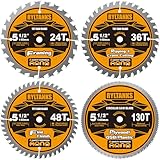
Diameter determines capacity, but tooth design determines the cut. A 24-tooth carbide blade is commonly used for fast framing cuts. A blade with around 40 to 60 teeth is better suited to plywood, crosscuts, and cleaner general-purpose work. Blades with 80 or more teeth can produce cleaner cuts in some sheet goods and trim materials, although they cut more slowly.
Carbide-tipped teeth are the normal choice for wood because they retain an edge far longer than plain steel. Even a high-quality blade will dull faster when cutting dirty reclaimed lumber, pressure-treated wood, or material containing hidden nails. For metal, masonry, or plastic, use a blade specifically rated for that material rather than adapting a wood blade.
Ownership realities: what wears out first?
Teeth usually become the first noticeable wear point. A dull blade makes the saw work harder, leaves burn marks, wanders from the cut line, or requires excessive force. On cordless tools, the added resistance can also reduce useful runtime. Replace or professionally sharpen a blade when cleaning the teeth no longer restores performance.
Keep blades dry and brush away pitch and resin with a cleaner approved for carbide blades. Store them so the teeth cannot strike other tools. Inspect the blade for missing carbide, cracks, warping, and excessive vibration before every important cut. Never straighten a bent blade or continue using one with damaged teeth.
A common mistake is setting the blade far deeper than necessary. Set the depth so the teeth extend only slightly below the workpiece—roughly 1/8 to 1/4 inch for many wood cuts. This can reduce exposed tooth area, improve control, and limit damage if the saw kicks back. Secure the workpiece, keep both hands in the intended grip areas, and let the blade reach full speed before entering the cut.
Bottom line
Choose a 7-1/4-inch blade for the broadest compatibility and general-purpose capability. Pick 6-1/2 inches when low weight, compact storage, or a cordless saw’s efficiency matters most. Choose 8-1/4 inches only when your compatible saw and projects justify the added capacity. In every case, confirm the tool’s approved diameter, arbor, RPM, kerf, and cutting depth before installing the blade.