Best Carbide-Tipped Circular Saw Blades for Clean, Long-Lasting Cuts
What's inside
As an Amazon Associate I earn from qualifying purchases. This post may contain affiliate links at no extra cost to you.
The best carbide tipped circular saw blade for most general woodworking is a 40-tooth, thin-kerf blade with tungsten-carbide teeth, a 5/8-inch arbor, and a neutral-to-moderate hook angle; choose a 24-tooth blade for fast lumber cuts and an 80-tooth blade for clean laminate or plywood edges.
A carbide tip circular saw blade lasts considerably longer than a plain steel blade because its cutting edges resist abrasion and heat. However, “carbide-tipped” does not describe one performance level. Carbide grade, tooth geometry, kerf width, tooth count, hook angle, and arbor fit determine whether a blade cuts quickly, leaves a clean edge, or survives abrasive composite sheet goods.
As an Amazon Associate we earn from qualifying purchases at no extra cost to you.


Quick picks by cutting situation
| Primary job | Recommended specification | Why it fits | Typical market range |
|---|---|---|---|
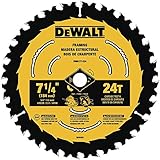
| Framing and dimensional lumber | 7-1/4 in, 24 teeth, 0.059-0.098 in kerf, 15°-20° hook | Fast feed rate and good chip clearance | $12-$30 |
| General-purpose lumber and plywood | 7-1/4 or 10 in, 40 teeth, thin or standard kerf, 10°-15° hook | Balances speed, edge quality, and blade life | $20-$45 |
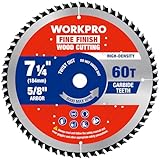
| Fine plywood, veneered panels, and melamine | 7-1/4 in, 60-80 teeth, 0°-10° hook, ATB or modified ATB | Reduces splintering and breakout | $25-$60 |
| Laminate flooring and abrasive composites | 7-1/4 in, 60-80 teeth, high-density carbide, low hook | More wear resistance and controlled cutting | $30-$70 |
| Portable battery saw | Blade diameter specified by saw, thin kerf, 24-40 teeth | Uses less motor power and preserves runtime | $15-$45 |
What separates one carbide blade from another?
Carbide grade and tooth construction
Most woodworking blades use tungsten carbide brazed onto a steel plate. A finer, tougher carbide formulation can hold a sharp edge longer, while a harder formulation can resist abrasion from glue, laminate, cement-bonded board, and other hostile materials. Manufacturers do not use one universal grading system, so a printed carbide grade is useful only when the manufacturer explains it.
For ordinary pine, spruce, oak, and plywood, a standard carbide tip is sufficient. For laminate flooring, MDF, melamine, and composite panels, prioritize a blade advertised for abrasive materials or one with larger, denser carbide teeth. Large teeth also provide more material for future sharpening. A blade that costs $45 but can be professionally sharpened several times may cost less per cut than a $20 blade that is discarded after its first damaged tooth.
Tooth count: speed versus finish
Tooth count is measured on the complete blade, not along a particular inch of cutting edge. A 24-tooth blade removes material quickly and clears chips effectively, but it can leave cross-grain edges rough. A 40-tooth blade is the useful middle ground for many circular saws. Sixty- and 80-tooth blades produce cleaner edges in plywood, veneer, laminate, and melamine, but they cut more slowly and generate more heat if pushed too hard.
Tooth count must also be matched to material thickness. As a practical target, keep at least two to four teeth engaged in the workpiece during the cut. For example, a 3/4-inch plywood sheet with a 60-tooth, 7-1/4-inch blade typically has enough engagement for a controlled finish cut. A very high tooth-count blade in thick hardwood can struggle because too little gulley space is available for chips.
Kerf width and motor load
Kerf is the width of the slot cut by the blade. A full-kerf 7-1/4-inch blade commonly removes about 0.098 inch of material, while a thin-kerf version may remove approximately 0.059-0.079 inch. Thin kerf reduces waste and generally requires less power, making it valuable on compact or battery-powered saws.
Thin kerf is not automatically better. The narrower plate can deflect when forced through dense stock, and a blade that wanders produces a worse result than the small amount of wood saved. Use the kerf size recommended for the saw, particularly on high-powered worm-drive models or saws with a riving knife. The riving knife must be compatible with the blade’s kerf; a knife that is thicker than the kerf can pinch the workpiece.
Hook angle and tooth pattern
Hook angle describes how aggressively a tooth enters the material. A positive 15°-20° hook pulls the blade into lumber and is efficient for ripping. It also increases the risk of grabbing thin sheet goods or climbing into the cut if the saw is poorly controlled.
A 0° to 10° hook is more forgiving for plywood, laminate, melamine, and non-wood composites. It limits self-feeding and improves control. Alternate top bevel (ATB) teeth are versatile for crosscutting and sheet goods. A modified ATB or triple-chip grind usually handles laminated and abrasive panels better because the tooth alternates between scoring and clearing material.
Head-to-head: the main blade choices
24-tooth framing blade versus 40-tooth general-purpose blade
Choose the 24-tooth option when speed matters more than a furniture-quality edge: framing walls, cutting blocking, trimming rough lumber, or making repeated rip cuts. It clears sawdust quickly and places less demand on the motor. Choose the 40-tooth blade for cabinet parts, shelving, trim stock, and projects where one blade must handle both crosscuts and plywood.
40-tooth general-purpose blade versus 80-tooth finish blade
The 40-tooth blade normally wins for mixed work because it cuts faster and is less likely to burn. An 80-tooth blade is preferable when replacing a chipped veneer edge would be difficult or when the cut will be visible. It is not a substitute for correct support: even the finest carbide blade can splinter the underside of plywood if the sheet is unsupported.
Thin-kerf versus full-kerf
Thin kerf is the better match for a lower-powered cordless saw or a user making long cuts in sheet goods. Full kerf offers greater plate stability and is often the safer choice for powerful corded saws, thick hardwood, or demanding rip cuts. Confirm the manufacturer’s permitted kerf before fitting either type.
Arbor compatibility and sizing checklist
- Diameter: Use the diameter specified on the saw guard, commonly 6-1/2, 7-1/4, 8-1/4, or 10 inches. Never install a larger blade because it may contact the guard or exceed the saw’s rated speed.
- Arbor: Many 7-1/4-inch blades use a 5/8-inch arbor, while some compact saws use a smaller arbor. A diamond knockout or reducer configuration must match the saw exactly and must seat flat.
- Rotation: Install the blade so the printed tooth-direction arrow agrees with the saw’s rotation arrow. The teeth should enter the material at the front or underside as designed by the tool.
- RPM: The blade’s maximum rated RPM must equal or exceed the saw’s no-load RPM.
- Kerf and riving knife: The blade plate and kerf must be compatible with the saw’s riving knife or splitter.
- Cut depth: Set the blade only slightly deeper than the workpiece, usually about 1/8 to 1/4 inch beyond it. Excess exposure increases tear-out and injury risk.
Decision matrix for choosing with your budget and experience
| Your situation | Best starting choice | Reason |
|---|---|---|
| Occasional homeowner projects and one saw | 40-tooth general-purpose blade | Handles lumber, plywood, and basic trim without requiring frequent changes |
| Frequent framing or construction work | 24-tooth framing blade plus a separate 40-tooth blade | Preserves speed while providing a cleaner option when needed |
| Cabinet, furniture, or visible plywood work | 60-tooth ATB blade | Prioritizes edge quality and controlled breakout |
| Mostly cordless work | Thin-kerf 24- or 40-tooth blade | Reduces power demand and can extend battery runtime per charge |
| Frequent laminate, melamine, or composite cutting | 60-80-tooth low-hook blade with high-density carbide | Better wear resistance and less aggressive engagement |
Maintenance, lifespan, and cost per use
The teeth usually wear before the steel plate does. Resin buildup, pitch, adhesive, and fine composite dust increase friction and make a sharp blade appear dull. Remove the blade, use a cleaner approved for carbide blades, brush deposits away without striking the teeth, and dry it before storage. Do not use a file or abrasive wheel on carbide teeth; incorrect sharpening can alter tooth geometry.
Inspect for missing carbide, cracked gullets, warped plates, and excessive vibration. A blade with a missing tooth should be removed from service rather than “used carefully.” Sharpening is worthwhile when the plate is sound and the blade is used often. As an example, a $40 blade sharpened for $20 after 400 cuts costs $0.15 per cut across its first two service periods. A $20 disposable blade lasting 150 cuts costs about $0.13 per cut, but the sharpenable blade may deliver a more consistent edge and less downtime.
Common mistakes include forcing a high-tooth-count blade through lumber, using a positive-hook framing blade on delicate laminate, cutting with a dirty blade, and failing to support both sides of a plywood sheet. Let the blade reach full speed, advance at a steady rate, and stop if the motor labors or the blade begins to burn the material.
Bottom line
For a single versatile purchase, select a 40-tooth carbide tipped circular saw blade that matches your saw’s diameter, arbor, RPM, and riving-knife requirements. Add a 24-tooth blade for fast lumber work and a 60- or 80-tooth low-hook blade for clean plywood, laminate, and composite cuts. The best choice is not the blade with the most teeth or the thickest carbide; it is the combination whose tooth geometry, kerf, and arbor fit match the material and the saw.