Best Jigsaws for Woodworking: Top Picks for Clean, Controlled Cuts
What's inside
As an Amazon Associate I earn from qualifying purchases. This post may contain affiliate links at no extra cost to you.
Best Jigsaws for Woodworking: Top Picks for Clean, Controlled Cuts
The best jig saws for woodworking are the Bosch JS572EBK for precise corded work, the Festool CARVEX PS 420 EBQ-Plus for controlled premium cutting, and the Makita XVJ03Z for cordless value. Choose by how often you cut, how much control your projects need, and whether dust collection or portability matters more than price.
Quick picks by woodworking situation
- Best overall for accuracy: Bosch JS572EBK. A corded, variable-speed jigsaw with a tool-free blade-change system and a precision-focused guide design. It suits repeat cuts, curves, and careful fitting without requiring a battery platform.
- Best premium option: Festool CARVEX PS 420 EBQ-Plus. A compact corded saw with an emphasis on low-vibration handling, accurate tracking, and dust extraction. Consider it if you make frequent, detail-oriented cuts and already value Festool’s system accessories.
- Best cordless value: Makita XVJ03Z. A 18V LXT brushless jigsaw with variable speed and orbital action. It’s a practical choice for shops already using Makita 18V batteries; the bare-tool price does not include a battery or charger.
- Best for a tight budget: a basic variable-speed corded jigsaw from a reputable tool brand. Spend for reliable blade alignment and a secure, tool-free clamp before paying extra for advanced electronics. Expect fewer refinement features and more vibration than on premium models.
What matters for woodworking cuts
A jigsaw’s cut quality depends on more than its advertised cutting capacity. The blade deflects as it turns, especially in thick stock or tight curves, so a powerful motor cannot compensate for poor blade choice, excessive feed pressure, or a loose workpiece.
As an Amazon Associate we earn from qualifying purchases at no extra cost to you.

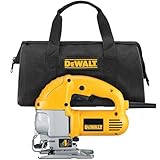

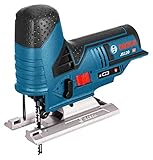
- Accuracy and control: Look for a stable base, a blade clamp that holds the blade square, variable speed, and a clear view of the cut line. A fine-tooth blade and a guide or template often improve results more than a higher top speed.
- Orbital settings: Orbital action moves the blade forward on the upstroke to cut faster. Low or zero orbit gives a cleaner edge and better control in plywood, veneer, and tight curves. Higher orbit is useful for fast rough cuts in thicker solid wood, but usually leaves a rougher edge.
- Vibration: Less vibration makes it easier to follow a line and reduces fatigue during long sessions. It matters most for intricate curves and repeated cuts, but proper support and a sharp blade remain essential.
- Blade changes: Tool-free clamps save time when switching between fine-finish, scrolling, and rough-cut blades. Check that the clamp accepts common T-shank blades and holds them securely without noticeable play.
- Dust control: A vacuum port can reduce airborne dust and keep the line visible, though extraction depends on the saw, hose, and cut. Use a compatible extractor and keep the base plate clear; a blower that clears the line may also send dust into the air.
Feature comparison
The figures below are manufacturer-listed specifications; versions and included accessories can vary by market. Weight is approximate tool-only weight, and maximum cutting depth is not a promise of a clean, square cut in every material.
| Model | Power | Stroke rate | Maximum wood capacity | Orbital settings | Approx. tool weight | Best fit |
|---|---|---|---|---|---|---|
| Bosch JS572EBK | 7.2 A corded | 800–3,000 strokes/min | 5⅞ in. | 4 positions | 5.8 lb | Accurate, frequent shop work |
| Festool CARVEX PS 420 EBQ-Plus | 550 W corded | 1,000–3,800 strokes/min | 4¾ in. | 4 positions | 4.2 lb | Fine control and extraction-focused work |
| Makita XVJ03Z | 18V LXT battery | 0–2,600 strokes/min | 5⅛ in. | 3 positions plus straight cutting | 5.8 lb | Cordless work on a Makita platform |
Choose by project and working style
| Your situation | What to prioritize | Practical choice |
|---|---|---|
| Occasional homeowner projects, limited budget | Variable speed, a dependable clamp, and common T-shank compatibility | Basic corded variable-speed model |
| Weekly cabinet or furniture work | Low vibration, accurate tracking, easy blade changes, and dust extraction | Bosch JS572EBK or Festool CARVEX |
| On-site work or frequent moves around a shop | Battery compatibility and manageable weight | Makita XVJ03Z if you own LXT batteries |
| Curves, templates, and detailed cutouts | Low-orbit or straight action, a narrow blade, and good line visibility | Any well-aligned variable-speed saw; favor refined control over maximum capacity |
| Deep cuts in thick stock | Blade length, blade stiffness, and capacity with room to spare | Choose a model rated above your stock thickness; make the cut in controlled passes if needed |
Set up the saw for cleaner cuts
- Match the blade to the job. Use a fine-tooth, clean-cut blade for plywood and finish work; use a narrower scrolling blade for tight curves. A wide blade tracks straighter on broad cuts but resists turning.
- Support the workpiece close to the cut. Clamp it securely and support both sides where practical. Unsupported stock can chatter, pinch the blade, or break out at the edge.
- Set speed and orbit before cutting. Start with low or no orbital action for a clean edge or a tight curve. Increase orbit and feed only for rougher, faster cuts in solid wood.
- Make a test cut in scrap. Check the edge for splintering and whether the blade is wandering off square. Adjust the blade, speed, or feed pressure before cutting finished material.
- Let the blade do the work. Keep the base flat and guide the saw steadily. For a tight turn, slow down and use a relief cut rather than twisting the blade sideways.
Ownership costs and common wear points
Blade quality and replacement frequency have a bigger effect on long-term cutting performance than most add-on features. Teeth dull fastest when a blade is forced through knots, metal, dirty reclaimed wood, or stock thicker than its useful cutting length. Replace a blade when it burns the wood, needs increasing pressure, or starts wandering despite a sound setup.
Keep the blade clamp, vents, and base area free of packed sawdust. Dust buildup can interfere with visibility and cooling, while a damaged or loose clamp can compromise tracking. Check the base plate for damage after drops, and make sure its bevel setting is locked before a straight cut. A corded saw avoids battery replacement and runtime limits; a cordless model adds convenience but means budgeting for a compatible battery and charger if you do not already own them.
Typical market pricing varies by kit and region: basic corded models generally fall around $50–$150, capable midrange saws around $150–$300, and premium systems often cost $300 or more. Compare the included case, dust adapters, and batteries—not just the bare-tool price.
Bottom line
For most woodworkers seeking one dependable corded saw, start with the Bosch JS572EBK. Choose the Festool CARVEX if refined handling and extraction integration justify a premium, or the Makita XVJ03Z if cordless convenience fits your battery collection. For clean joinery and controlled curves, prioritize blade choice, low-orbit settings, secure workholding, and a test cut over maximum speed or cutting depth.