Best Jigsaw Wood Cutting Tools for Clean, Controlled Cuts
What's inside
As an Amazon Associate I earn from qualifying purchases. This post may contain affiliate links at no extra cost to you.
The best jigsaw wood cutting tool for most users is a cordless 18V/20V brushless jigsaw with orbital action, a tool-free T-shank blade clamp, and a cut depth of at least 4 inches in softwood — models like the DeWalt DCS334B or Makita XVJ03Z cover plywood, hardwood, and trim work for under $180 as a bare tool. Which specific setup is right for you depends on what you cut most often, so this guide compares top options by power, orbital action, blade compatibility, cut depth, vibration, and material suitability.
As an Amazon Associate we earn from qualifying purchases at no extra cost to you.
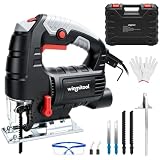


What Actually Determines a Clean Cut in Wood
Marketing emphasizes voltage and speed, but four specifications decide whether a jigsaw cutting wood leaves a finished edge or a splintered one:
- Orbital action (pendulum settings): Moving the blade forward on the upstroke clears chips faster and speeds cuts dramatically. Settings 1–3 for rough softwood cuts; orbital OFF for trim, laminate, and veneered plywood where tear-out matters.
- Blade stroke length: 1 inch is standard on premium saws; 3/4-inch strokes are slower and run hotter in hardwoods.
- Stroke rate: 3,000–3,500 SPM is the useful ceiling. Cutting wood above ~2,500 SPM on dense hardwoods burns edges unless you keep the feed rate very slow.
- Cutting capacity: 4-3/8 to 5-1/8 inches in softwood is typical for top-handle saws; realistic clean-cut depth in hardwood is about half the rated figure.
Comparison: Top Jigsaws for Wood Cutting in 2026
| Model | Type | Power Source | Max SPM | Orbital Settings | Cut Depth (wood) | Weight | Bare-Tool Price Range |
|---|---|---|---|---|---|---|---|
| Bosch JS470E | Corded, top-handle | 7.0A | 3,100 | 4 | 5-7/8 in | 5.6 lb | $150–$190 |
| DeWalt DCS334B | Cordless, top-handle | 20V MAX brushless | 3,200 | 4 | 4-3/8 in | 4.2 lb | $130–$180 |
| Makita XVJ03Z | Cordless, top-handle | 18V LXT brushless | 3,500 | 3 + soft-start | 5-5/16 in | 5.8 lb | $170–$220 |
| Milwaukee 2737-20 | Cordless, barrel-grip | M18 Fuel brushless | 3,500 | 4 | 5-1/4 in | 5.7 lb | $200–$250 |
| Skil JS314901 | Corded, top-handle | 6.0A | 3,200 | 4 | 4-3/4 in | 5.0 lb | $45–$65 |
All five accept T-shank blades — now the de facto standard for any jigsaw for cutting wood, offering tool-free changes and far better blade retention under side load than older U-shank clamps.
Top-handle vs. barrel-grip
Top-handle saws are easier to steer with one hand and dominate the market. Barrel-grip designs like the Milwaukee 2737-20 put your hand lower and closer to the blade line, which reduces felt vibration and improves control on long straight rips in thick stock — but requires two hands and a different muscle memory. If most of your work is countertop cutouts and curved trim, top-handle wins; for long rips in 2x lumber, barrel-grip is worth the learning curve.
Decision Matrix: Match the Saw to Your Situation
| Your Situation | Recommended Pick | Why |
|---|---|---|
| Occasional DIY, budget under $75, outlets nearby | Skil JS314901 (corded) | 90% of the performance at a third of the cost; no batteries to buy |
| Already own DeWalt 20V or Makita 18V batteries | Same-platform bare tool | Saves $60–$100; battery platform matters more than brand |
| Job-site use, thick hardwoods, daily cuts | Milwaukee 2737-20 or Makita XVJ03Z | Deepest cut capacity, lowest vibration, best blade guidance |
| Trim, laminate, and veneered plywood only | Bosch JS470E | Smoothest orbital-off mode and best splinter control with a down-cut blade |
| Remote site or cabinet installation | Any cordless brushless with 5Ah+ battery | Expect 30–50 linear feet of 3/4″ plywood per Ah of battery |
Blade Selection: The Half of the Setup Listings Ignore
The saw is only half of a jigsaw wood cutting tool — the blade determines the finish. A $200 saw with a 6-TPI fast-cut blade will tear out veneer worse than a $50 saw with the right blade:
- 6–8 TPI, aggressive ground teeth: Fast rip cuts in softwood and 2x lumber; heavy tear-out.
- 10–12 TPI, HCS: General hardwood and plywood work; the default blade for most shops.
- 14–20 TPI or down-cut (reverse-tooth): Laminate, melamine, veneered plywood — teeth cut on the downstroke so the visible face stays clean.
- Scrolling blades (narrow): Tight curves in trim; they flex less and track truer.
Rule of thumb: at least three teeth should remain in the material at all times. In 3/4-inch plywood, that means nothing coarser than about 8 TPI if you want a controlled edge.
Setup for Tear-Out-Free Cuts
- Apply painter’s tape along the cut line on veneered or laminated faces — it holds fibers down during the cut.
- Set orbital action to 0 for finish cuts; 2–3 only for rough dimensioning.
- Start the cut at reduced speed, ramp to full once the blade is engaged.
- Let the shoe sit flat; tilting the saw forward is the most common cause of beveled, wandering cuts.
- Cut from the back face when possible — tear-out happens where the blade exits.
Ownership Realities
What wears first: the blade clamp mechanism (cheap saws lose grip under side load within a year of heavy use) and the base plate, which loosens and introduces bevel drift. Blades are the ongoing consumable — budget roughly $1–$3 per blade, and replace at the first sign of burning or wandering rather than pushing a dull blade, which overheats the motor and scorches hardwood edges.
Battery math for cordless: a 5.0Ah pack on a brushless saw delivers roughly 150–250 linear feet of 3/4-inch plywood per charge — a full day of cabinet work, but only an hour or two of continuous 2x ripping. If thick stock is your primary use, corded still wins on power-per-dollar.
FAQ
Can a jigsaw replace a circular saw for wood?
Partially. A jigsaw cutting wood excels at curves, cutouts, and plunge cuts, but it’s slower and less accurate on long straight rips. Keep the circular saw for sheet goods breakdown.
Why does my jigsaw blade bend or cut at an angle?
Usually feeding too fast, a dull blade, or side pressure while steering curves. Reduce feed pressure and use a thicker “progressor” blade for straight cuts in thick material.
Is brushless worth it for a wood jigsaw?
Yes for cordless — brushless motors deliver 30–50% more runtime and maintain speed under load in hardwoods. For corded saws it’s irrelevant.