The Best Jig Saws for Curves, Cutouts and Finish Cuts
What's inside
As an Amazon Associate I earn from qualifying purchases. This post may contain affiliate links at no extra cost to you.
The Best Jig Saws for Curves, Cutouts and Finish Cuts
The best jig saw for most woodworking is a variable-speed, 6-amp corded model with a four-position orbital selector, tool-free T-shank blade clamp, and an effective splinter-control shoe; choose a 18V cordless version instead if you make frequent cuts away from an outlet. For clean plywood and laminate edges, orbital action matters less than a sharp fine-tooth blade, a stable shoe, and a splinter insert or backing board.
Choose by the work, not the biggest spec
Stroke length and orbital action solve different problems. A longer stroke moves more blade through the material per cycle, which can help speed in thicker stock. Orbital action pushes the blade forward on the upstroke, cutting faster but leaving a rougher edge. Set it to zero for laminate, visible plywood edges, and tight curves; try a low setting for hardwood; reserve higher settings for fast rough cuts.
As an Amazon Associate we earn from qualifying purchases at no extra cost to you.

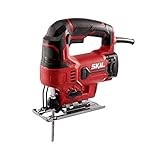
Capacity figures are maximums, not promises of clean cuts. A saw may be rated for several inches of wood, but a narrow blade can wander in thick stock, especially on a curve. For furniture parts and cabinetry, prioritize control and blade choice over maximum depth.
| Situation | Suitable saw type | Useful specs and features | Trade-off |
|---|---|---|---|
| Occasional cutouts, tight budget | Entry-level corded, such as a Bosch JS260 | 6.0 amps; up to 3/4-inch stroke; 3 orbital settings; tool-free T-shank clamp | Basic dust handling and fewer convenience features |
| Frequent shop work, mixed materials | Midrange corded, such as a Bosch JS572EK | 7.2 amps; 1-inch stroke; 4 orbital settings; up to 5-7/8-inch wood capacity | More saw than occasional users may need |
| Jobsite or outdoor cuts | 18V cordless, such as a Milwaukee M18 FUEL D-handle jigsaw | 18V platform; 4 orbital settings; tool-free blade change; wood capacity varies by model | Battery and charger add cost and weight |
| Curves and frequent blade changes | Barrel-grip or compact cordless body | Variable speed, low-vibration design, accessible blade release | Grip preference is personal; check balance before buying |
Specifications can vary by exact model and regional version; confirm the manufacturer’s current listing before purchase. Capacities in the table are manufacturer figures, not a guarantee of finish quality.
Which type fits your situation?
- Choose corded if the saw mostly stays in a workshop, you cut for long stretches, or you want lower upfront cost without managing batteries. A 6- to 7.2-amp tool is a practical range for common woodworking.
- Choose cordless if you work on installations, move around a large site, or already own compatible batteries. An 18V platform offers a useful balance of portability and cutting power. A battery is not a runtime guarantee: thick hardwood, high orbital action, and a small-capacity pack use charge faster.
- Choose a simpler model if you make occasional sink openings or rough shapes. Spend extra only for features you will use, such as a more effective dust blower, low-vibration handling, or a quick blade clamp.
- Choose a better-controlled model if you cut curves often or leave edges visible. A steady shoe, accurate blade alignment, and dependable speed control are more useful than a high top-speed number.
Common corded choices include the Bosch JS260 and JS572EK; established cordless options include Milwaukee’s M18 FUEL jigsaws and DeWalt’s 20V MAX jigsaw range. These are examples of product lines to compare, not a claim that one model is best for every user. Check the exact model’s current features, included accessories, and battery compatibility.
Blade and setup choices that make the cut
T-shank blades are widely available and fit many current jig saws, but check the saw’s manual before buying. Match the blade to the material and cut: use a fine-tooth wood blade for clean plywood edges, a down-cut blade when the top face must stay especially clean, and a laminate or fine-tooth blade intended for plastic-coated panels. A down-cut blade can splinter the underside instead, so test on scrap or use a backing board.
For hardwood, use a sharp, longer blade with suitable tooth spacing and reduce feed pressure if the saw slows or the blade bends. A narrow blade turns more readily, but forcing it through a curve can twist the cut and damage the edge. Let the blade follow the line; for a tight radius, make relief cuts rather than steering aggressively.
Before switching on, set the shoe flat and secure the workpiece close to the cut. Keep the blade clear of clamps and the bench beneath the work. For a clean top face, place the finished face upward with a conventional up-cut blade; use a splinter insert or sacrificial backing when the underside also matters. Check that the insert suits the blade and does not rub against it.
A practical cut-setting sequence
- Mark and support. Draw the line clearly, clamp the panel, and support both sides so the waste cannot sag or pinch the blade.
- Choose the blade. Fit a sharp T-shank blade rated for the material and thickness. Unplug a corded saw or remove the battery before changing it.
- Set orbital action. Start at zero for laminate, finish cuts, and tight curves. Move to a low setting for moderate hardwood cuts; increase it only when speed matters more than edge quality.
- Set speed and test. Start at a moderate speed on scrap. Reduce speed if laminate chips, the blade heats, or the cut wanders; do not compensate for a dull blade by pushing harder.
- Cut steadily. Keep the shoe against the work and feed at a pace the blade can maintain. For interior openings, drill a starter hole large enough to admit the blade, then cut to the line.
Ownership costs and wear points
The saw body is only part of the cost. General market pricing varies with promotions and included accessories: basic corded models often fall around $50–$100, more capable corded tools around $150–$300, and cordless bare tools around $150–$300 before batteries and chargers. Platform batteries can make cordless the better value if you already own compatible packs; buying a full kit for one occasional tool can change that calculation.
Blades are the main consumable. Dull teeth increase heat, tear-out, and wandering, so replace a blade when it cuts slowly or needs extra pressure. Keep the shoe clean and check that it remains square to the blade; dust buildup and a tilted shoe can spoil accuracy. After use, clear dust from vents and the blade clamp with a brush or suitable vacuum, following the manual. Avoid using compressed air in a way that drives debris deeper into the housing.
For a single jig saw that balances price, control, and uninterrupted shop use, start with a midrange corded model. Pick cordless when mobility is a daily advantage, not just a convenience you might use once. In either case, a sharp material-matched blade, zero orbital action for finish cuts, and well-supported work will matter more to the result than choosing the most powerful tool.