Best Jigsaw Saws for Curves, Cutouts, and Precise Cuts
What's inside
As an Amazon Associate I earn from qualifying purchases. This post may contain affiliate links at no extra cost to you.
Best Jigsaw Saws for Curves, Cutouts, and Precise Cuts
The best jigsaw saw depends on the job: choose a variable-speed, low-vibration barrel- or D-handle model with orbital action for frequent curves and general carpentry; prioritize a stiff shoe, accurate blade guidance, and a splinter-control feature for countertop cutouts; and use a compact, low-orbit model with a narrow blade for detail work.
For most buyers, the useful comparison is not simply cordless versus corded or the highest advertised stroke rate. Check the saw’s cutting capacity in your material, how its orbital settings affect the edge, which blade shanks it accepts, and whether you can steer and see the cut comfortably. Specifications vary by model and generation, so confirm them in the manufacturer’s current manual before buying.
As an Amazon Associate we earn from qualifying purchases at no extra cost to you.

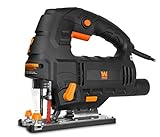
Jigsaw saw comparison: capacity, action, and control
These representative figures show the scale of common workshop models, not a guarantee that every saw in a product family has identical specifications. Cutting capacity is typically stated for wood and steel; the blade, material, and technique affect practical results.
| Example model | Power | Wood capacity | Stroke rate | Blade interface | Best fit |
|---|---|---|---|---|---|
| Bosch JS470E | 7.0 A corded | Up to 5 7/8 in. | 500–3,100 strokes/min | T-shank | Shop work and thick stock |
| Makita 4350FCT | 6.3 A corded | Up to 5 5/16 in. | 800–2,800 strokes/min | T-shank | Controlled cuts and frequent use |
| DEWALT DCS334 | 20V MAX cordless | Up to 3 1/2 in. | 0–3,200 strokes/min | T-shank | Portable jobsite and household work |
| Milwaukee M18 FUEL 2737-20 | 18V cordless | Up to 5 in. | 0–3,500 strokes/min | T-shank | Cordless cutting in thicker stock |
Capacities and control features above are manufacturer-published specifications for the named models; check the exact version and manual for details. A higher maximum capacity does not mean a saw will make a clean, square cut at that depth without the right blade and steady feed.
Choose by the cut you need to make
For curves and general woodworking
Look for variable speed, a comfortable grip, and adjustable orbital action. Orbital action moves the blade slightly forward on the upstroke, helping it clear chips and cut faster. That can be useful in framing lumber or rough curves, but it tends to leave a rougher edge and makes tight turns harder. Use a lower orbital setting—or switch it off—for cleaner curves, thin material, and finish work.
A corded saw such as the Bosch JS470E suits a bench or workshop where uninterrupted power matters. If you already own compatible batteries, a cordless model such as the DEWALT DCS334 or Milwaukee M18 FUEL 2737-20 avoids managing a cord around a large panel. Battery runtime depends heavily on battery capacity, material thickness, blade sharpness, and orbital setting; there is no single runtime figure that applies to every cut.
For countertop and sink cutouts
Prioritize a firm, flat shoe, a clear view of the cut line, and a way to limit chipping. A no-orbit setting and a fine-tooth blade designed for laminate or clean wood cuts usually give better edge quality than maximum-speed, aggressive cutting. A splinter guard or zero-clearance insert can help, but it must match the saw and blade; test the setup on scrap first.
For a countertop opening, drill a starter hole large enough to admit the blade without forcing it, then follow the marked line from the waste side. Support the cutout so it cannot sag and pinch the blade as the final section separates. If the visible top surface is prone to chipping, follow the blade maker’s guidance on tooth direction and consider masking the line or using a reverse-tooth blade. A reverse-tooth blade cuts on the downstroke, so it can reduce top-surface tear-out but may lift the saw; keep the shoe pressed flat and work at a controlled pace.
For detail work and tight turns
Choose a saw that is easy to steer, offers a low speed range, and accepts narrow scroll-cutting blades. Turn off orbital action for tighter curves, use a blade suited to the curve radius, and let the saw advance without twisting the blade sideways. For intricate patterns or repeated small-radius cuts, a scroll saw may be more suitable than a handheld jigsaw.
Blade compatibility matters as much as the saw
Most current jigsaws accept T-shank blades, but some older or budget saws use U-shank blades, and blade systems are not universally interchangeable. Check the saw’s manual and the blade packaging before purchase. A tool-free clamp is convenient for blade changes; it does not mean every shank style will fit.
- Clean wood cuts: Use a sharp blade intended for wood, with tooth spacing appropriate to the material thickness. Finer teeth generally leave a cleaner edge but cut more slowly.
- Fast rough cuts: A coarser, longer blade clears chips quickly in thicker stock, but may wander more easily.
- Metal: Fit a fine-tooth blade specified for the metal type and thickness. Reduce speed as recommended by the blade maker, and clamp the work securely.
- Tight curves: Use a narrow blade designed for curves. Forcing a wide blade around a small radius can bend it and produce a cut that is not square underneath.
A practical decision matrix
| Your situation | What to prioritize | Good match |
|---|---|---|
| Occasional home repairs, limited budget | Variable speed, dependable blade clamp, basic dust extraction | A corded midrange T-shank saw; fewer batteries to buy |
| Frequent cuts away from an outlet | Battery platform you already own, manageable weight, runtime | A cordless model from that platform |
| Countertops or visible finish edges | Low-vibration control, no-orbit option, compatible splinter guard | A controlled saw paired with a finish blade |
| Thick stock or repeated shop cuts | Published capacity, stable shoe, appropriate long blades | A higher-capacity corded or cordless model |
| Small patterns and tight curves | Narrow scroll blade, low speed, easy steering | A compact jigsaw; a scroll saw for extensive intricate work |
Setup choices that improve accuracy
- Match the blade to the material and curve. A sharp, suitable blade reduces wandering and the temptation to push too hard.
- Set orbital action for the edge you want. Start at zero for finish work and tight curves; increase it only when faster, rougher cutting is acceptable.
- Secure the work and support the offcut. Vibration can pull a line off course, while a dropping offcut can pinch the blade.
- Keep the shoe flat and follow the line at a steady pace. Forcing the saw can deflect the blade, leaving an angled edge even when the shoe is level.
- Make a test cut. Check both faces and the underside. If the cut is out of square, inspect blade deflection, blade condition, shoe position, and feed pressure before changing the marked line.
Ownership costs and wear
Blades are the recurring cost, and the wrong or dull blade can waste more material than its replacement costs. Teeth dull faster in abrasive materials, and metal cutting may require more frequent blade changes than ordinary softwood work. Keep blades dry and separated so their teeth do not strike one another. After use, clear dust from the shoe and vents with a brush or the method allowed by the manual; packed dust can obscure the cut line and impede cooling.
Before buying, compare the bare tool and kit versions. A cordless tool may be economical if you already own its battery platform, but a first-time buyer should include the battery and charger in the budget. General market prices vary by retailer, kit contents, and promotions: entry-level corded saws often fall around $40–$100, capable corded or bare-tool cordless models around $100–$250, and premium kits can cost more. Treat those as broad ranges, not fixed prices.
In short, choose for the work rather than the biggest number on the box: orbital action and capacity help with speed and thickness, while a compatible blade, stable shoe, and controlled feed determine whether a jigsaw saw can make the curve or cutout cleanly.