Best Solar Lights for Gardens, Paths, and Beds
What's inside
- Top 3 Picks
- Quick Comparison
- How We Chose
- 1. DenicMic Solar Lights Outdoor Waterproof 10 Pack Pathway Lights – Best Overall
- 2. GIGALUMI 6 Pack Solar Lights Outdoor Waterproof, LED Solar Garden Lights – Best for Small Beds
- 3. ASMAD Solar Lights Outdoor (4 Pack, 32 LEDs), Fairy Lights – Best Budget Decorative Option
- 4. GIGALUMI Outdoor Waterproof Solar Garden Lights, 12 Pack, Cold White – Best Budget for Long Runs
- 5. DOESLAG 12 Pack Solar Lights Outdoor, Modern Pathway Lights – Best for Modern Hardscape
- 6. JKIMK Solar Globe Lights Outdoor Waterproof, Solar Balls for Garden – Best for Beds and Water Features
- 7. vignuto Solar Lights Outdoor Waterproof 4 Pack of 32 LEDs, Firefly Decoration – Best as a Gift
- 8. AUDERWIN Solar Spot Lights Outdoor Waterproof, 4 Pack, Cool White – Best for Uplighting
- 9. DERAYSION 12 Pack Solar Lights Outdoor, Pathway Lights – Best Premium for Whole-Property Coverage
- 10. Mancra Solar Pathway Lights Outdoor, 10 Pack, Metal & Glass – Best Premium for Looks
- 11. DERAYSION 8 Pack Solar Lights Outdoor, Stainless Steel Glass Pathway Lights – Best Premium for Wet and Coastal Gardens
- 12. Mancra Solar Pathway Lights, 8 Pack, LED Glass Metal Garden Lighting – Best Premium for Smaller Installations
- How to Choose
- Frequently Asked Questions
- Closing Recommendation by Situation
As an Amazon Associate I earn from qualifying purchases. This post may contain affiliate links at no extra cost to you.
Our Top Picks
 DenicMic Solar Lights Outdoor Waterproof 10 Pack Pathway10 Pack2.2 x 2.2 x 13 Inches1.8 poundsCheck on Amazon
 JKIMK Solar Globe Lights Outdoor Waterproof-Solar Balls for2 Globes3.9 x 3.9 x 7.66 inches0.82 PoundsCheck on Amazon


Top 3 Picks
The DenicMic Solar Lights Outdoor Waterproof 10 Pack Pathway Lights in Cool White is the best overall choice for most gardens because it combines a sensible ten-light count, cool-white output that reads as crisp on gravel and stone, and a stake-and-body design that survives being knocked by a mower or a hose. It suits anyone lighting a full path or a mixed border in one purchase rather than adding lights piecemeal. If your budget is the deciding factor, the GIGALUMI Outdoor Waterproof Solar Garden Lights 12 Pack in Cold White gets you the most fixtures per dollar, which matters when you are lining a long driveway. If you want the lights to look like permanent landscape fixtures rather than garden accessories, the Mancra Solar Pathway Lights Outdoor 10 Pack in metal and glass is the premium pick.
Quick Comparison
The table below covers the brightness class, runtime class, mounting style, and construction of every light in this roundup. Brightness is expressed in lumens where the listing states a figure and by output class where it does not, because solar path lights vary enormously in real light output even when they look identical in a product photo.
| Product | Best for | Key specs | Price tier |
|---|---|---|---|
| DenicMic Solar Lights Outdoor Waterproof 10 Pack Pathway Lights, Cool White | Best overall for paths and mixed borders | 10-pack; cool white LED; stake-mounted; stainless-look body; built-in panel, auto on/off; IP-rated waterproof | Mid-range |
| GIGALUMI 6 Pack Solar Lights Outdoor Waterproof, LED Solar Garden Lights | Small beds and tight borders | 6-pack; warm-white LED; stake body; panel integrated in the cap; 8–10 hours runtime class; waterproof | Mid-range |
| ASMAD Solar Lights Outdoor (4 Pack, 32 LEDs), Fairy Lights | Soft decorative coverage | 4-pack; 32 LEDs per unit total across the set; fairy-style multi-point output; stake or wrap mounting; waterproof | Budget |
| GIGALUMI Outdoor Waterproof Solar Garden Lights, 12 Pack, Cold White | Long runs on a tight budget | 12-pack; cold white LED; stake-mounted; panel in cap; waterproof; 8-hour class runtime | Budget |
| DOESLAG 12 Pack Solar Lights Outdoor, Modern Pathway Lights | Modern hardscape edging | 12-pack; modern square-profile head; stake-mounted; auto on/off; waterproof; cold-white class output | Mid-range |
| JKIMK Solar Globe Lights Outdoor Waterproof, Solar Balls for Garden | Floating or resting on soil and water | Globe form factor; no stake; panel on top of the sphere; waterproof; ambient 5–8 hour class runtime | Budget |
| vignuto Solar Lights Outdoor Waterproof 4 Pack of 32 LEDs, Firefly Decoration | Gift and accent lighting | 4-pack; 32 LEDs per stake; firefly/branch effect; flexible wire arms over a stake; waterproof | Budget |
| AUDERWIN Solar Spot Lights Outdoor Waterproof, 4 Pack, Cool White | Uplighting trees, walls, and shrubs | 4-pack; spotlight beam rather than 360° glow; adjustable head; ground stake plus wall-mount option; waterproof | Mid-range |
| DERAYSION 12 Pack Solar Lights Outdoor, Pathway Lights | Covering a whole property at once | 12-pack; pathway lens; stake-mounted; auto on/off; waterproof; bright class output | Premium |
| Mancra Solar Pathway Lights Outdoor, 10 Pack, Metal & Glass | Looking like installed landscape lighting | 10-pack; metal housing with glass lens; stake-mounted; replaceable battery class; waterproof | Premium |
| DERAYSION 8 Pack Solar Lights Outdoor, Stainless Steel Glass Pathway Lights | Coastal and wet-climate gardens | 8-pack; stainless steel body, glass lens; stake-mounted; long-lasting battery class; auto on/off | Premium |
| Mancra Solar Pathway Lights, 8 Pack, LED Glass Metal Garden Lighting | Smaller premium installations | 8-pack; metal and glass construction; stake-mounted; warm-to-neutral white class; waterproof | Premium |
How We Chose
This roundup was built by reading published specifications for each model and sorting them against how people actually use garden lighting, not by ranking products on popularity. Four criteria carried the most weight. First, panel placement: a solar light is only as good as its panel, and lights with the panel set into the top cap collect well in open beds but fall off badly under shrubs, while lights with a separate or angled panel tolerate partial shade far better. Second, mounting style, because a stake-mounted path light, a resting globe, a spotlight with a wall bracket, and a fairy-light arm solve genuinely different problems and are not interchangeable.
Third, construction material, since this is what determines whether a light still looks presentable after two winters. Glass lenses and metal housings hold their appearance longer than polycarbonate and painted plastic, which is why the two Mancra listings and the stainless-steel DERAYSION sit in the premium tier. Fourth, pack count relative to typical spacing, because a 12-pack solves a driveway in one purchase while a 4-pack invites a second order three weeks later. Where a listing did not state a figure — output in lumens, battery capacity in milliamp-hours — we describe it by class instead of guessing a number. No product here was tested, benchmarked, or handled; the guidance reflects how the category behaves, and every claim about a specific model comes from what its manufacturer publishes.
1. DenicMic Solar Lights Outdoor Waterproof 10 Pack Pathway Lights – Best Overall
As an Amazon Associate we earn from qualifying purchases at no extra cost to you.

This is the pack most people should start with. Ten lights is enough for a 30-to-40-foot path at the three-to-four-foot spacing that avoids dark gaps, and enough left over to ring a border or mark the corners of a raised bed. DenicMic’s design is the classic stake-and-cap silhouette: a slim post that pushes into soil, a head that holds the panel and LED together, and a stainless-look finish that reads neutral against both dark mulch and pale gravel.
Cool white is the right choice for a pathway and the wrong one for a perennial border, and it is worth understanding why before you buy. At roughly 6000K, cool white light makes gravel, stone, and light-colored pavers look crisp and defined, which is exactly what you want when the light is there to mark a walking route. Under planting, the same color temperature flattens leaf color and can make greens look gray. If your purpose is navigation, buy this. If your purpose is atmosphere in a bed, look at the warm-white GIGALUMI or one of the metal-and-glass premium options instead.
Key specifications
- Pack size: 10 lights, enough for roughly 30–40 feet of path at 3–4-foot spacing
- Color temperature: Cool white, the crisp end of the range
- Mounting: Ground stake, no tools required
- Solar panel: Integrated into the head, top-facing
- Operation: Automatic on at dusk, off at dawn, with a manual switch to disable
- Weather rating: Waterproof housing for outdoor year-round use
- Construction: Stainless-look metal finish over a molded body
Strengths
The pack count is the headline. Ten lights is the sweet spot where you can light a real path and still have spares to test placements with — and placement testing matters, because the single most common reason a solar light underperforms is that its panel sits in shade for part of the day. Buying a ten-pack lets you move units around for a week and find the spots that charge fully.
The cool-white output also means this is a light you can mix with existing low-voltage landscape lighting without a visible color clash. If you already have a transformer-fed system along the front walk and want to extend it down the side path without trenching, matching color temperature is what makes the two runs look like one installation.
Pros
- Ten units covers a complete path in one purchase
- Cool white matches most hardwired landscape lighting
- Stake mounting requires no tools, wiring, or transformer
- Neutral metal-look finish suits most hardscape colors
- Spare units let you experiment with panel placement
Cons
- Cool white is unflattering to planting beds and foliage
- Top-mounted panels need direct sun, so dense shrub cover is a problem
- Staked lights are easy to dislodge with a string trimmer
- Not bright enough to serve as security lighting
How it compares
Against the GIGALUMI 12 Pack in cold white, this is a direct trade: the GIGALUMI gives you two more lights for less money, while the DenicMic gives you a more finished-looking housing and a neutral metal tone that reads as intentional design rather than utility. Against the DOESLAG 12 Pack, the choice is purely aesthetic — DOESLAG uses a modern square head that suits contemporary paving and composite decking, while the DenicMic’s round profile sits more comfortably in traditional cottage and border planting. If you want the light itself to disappear into the landscape and read as hardware, the premium Mancra metal-and-glass set is the upgrade path.
2. GIGALUMI 6 Pack Solar Lights Outdoor Waterproof, LED Solar Garden Lights – Best for Small Beds

Six lights is a deliberate number, and it is the right one if you are lighting a bed rather than a route. A typical 6-by-10-foot foundation bed takes four to six lights to look intentional without tipping into clutter, and this pack hits that count exactly. GIGALUMI’s warm-white output is the main technical reason to choose it over the DenicMic set: warm white sits near the incandescent end of the spectrum and flatters green foliage, terracotta pots, and wooden edging in a way that cool white simply does not.
These are stake-mounted lights with the panel built into the cap, which is the simplest and most reliable architecture in the category. There is nothing to configure, no wiring, and no separate panel to position. Push the stake into soil until the head sits 12 to 16 inches above grade, flip the switch to on the first time, and the unit handles the rest of its life on its own light sensor.
Key specifications
- Pack size: 6 lights, suited to roughly 18–24 feet of border or one foundation bed
- Color temperature: Warm white, flattering to foliage and wood
- Mounting: Ground stake, tool-free
- Solar panel: Integrated in the cap, top-facing
- Runtime class: 8–10 hours on a full charge, dependent on sun exposure
- Operation: Automatic dusk-to-dawn with manual override switch
- Weather rating: Waterproof for year-round outdoor use
Strengths
The warm-white color is the differentiator and it is worth being specific about the effect. In a mixed border, warm light makes green leaves greener and brown mulch richer; cool light does the opposite, draining saturation and making the bed look washed out at night. If you have ever installed cool-white path lights in a planting bed and felt the result looked clinical, this is the fix.
The six-count also suits the way people actually buy lighting for beds — incrementally. You light the bed you can see from the kitchen window first, then add a second pack for the side bed next season, and the identical fixtures keep the two areas visually consistent. Buying twelve of anything before you know how it looks after dark is the more common mistake.
Pros
- Warm-white output suits planting and wooden edging
- Six-unit count matches a typical foundation bed
- Simple stake installation with no wiring or tools
- Dusk-to-dawn automatic operation with no timer to set
- Easy to expand later with an identical second pack
Cons
- Six lights is not enough for a driveway or a long path
- Cap-mounted panels need unobstructed sun to charge fully
- Lower output than 12-pack sets at a similar total outlay
- Warm white clashes if the rest of your lighting is cool white
How it compares
The nearest alternative is the GIGALUMI 12 Pack in cold white, which is the same brand solving the opposite problem: twice the fixtures, cooler light, hardscape-oriented rather than planting-oriented. If you are lighting a bed, buy this one. If you are lighting a walk, buy the 12-pack. Against the vignuto firefly stakes, the comparison is decorative intensity versus even coverage — the firefly set scatters points of light for a magical effect but does not illuminate a surface, while these six lights actually light the ground they sit beside.
3. ASMAD Solar Lights Outdoor (4 Pack, 32 LEDs), Fairy Lights – Best Budget Decorative Option

This is not a path light and should not be bought as one. The ASMAD set is a decorative fixture: 32 LEDs arranged to scatter light points rather than cast a beam, producing the soft, dispersed effect people usually describe as fairy lighting. Four units at a budget price point make it a low-risk way to test whether you like that look in your garden before investing in a larger set.
The practical use cases are specific. Branch or trellis decoration, where you want the light to appear to be floating in the foliage rather than sitting on the ground. Small courtyard corners where a full path light would be oversized. Balcony planters where a stake-mounted light is easy to place but a hardwired fixture is not. What it will not do is illuminate a walkway well enough to see where you are stepping, because the output is distributed across many small emitters rather than concentrated.
Key specifications
- Pack size: 4 units, 32 LEDs across the set
- Output style: Dispersed multi-point, not a directional beam
- Mounting: Stake with flexible arms, allows shaping around plants
- Solar panel: Integrated, top-facing
- Runtime class: Several hours of decorative output from a full charge
- Weather rating: Waterproof for outdoor use
Strengths
The flexible arms are the reason to buy this over a rigid decorative light. You can bend them outward to widen the light spread, or upward to wrap the effect around an existing shrub or a piece of trellis without hiding the fixture itself. That flexibility is what makes a budget decorative light look considered rather than thrown down.
At four units, it is also the most sensible entry point in this roundup for anyone who is unsure whether decorative solar lighting suits their garden. The cost of being wrong is low, and if you like it, the same money spread across a larger decorative set next season is a small step.
Pros
- Lowest-commitment way to try decorative solar lighting
- Flexible arms shape the light around plants and structures
- Dispersed effect hides the fixture itself
- Stake mounting needs no tools or wiring
- Suits balconies and courtyards as well as beds
Cons
- Too dim and too scattered to light a path for walking
- Four units will not fill a large bed
- Decorative output is shorter-lived than a focused path lens
- Thin arms are more easily damaged than a rigid stake
How it compares
Versus the vignuto firefly stakes, this is the same category of product at a similar budget tier, and the deciding factor is pack size and shape — vignuto gives you four stakes with 32 LEDs each, a higher total LED count, while ASMAD gives you four units with 32 LEDs across the set. If you want maximum sparkle per dollar, vignuto wins on paper. If you want to test the effect cheaply, ASMAD costs less to try. Neither is a substitute for a real path light, and both are best paired with a proper stake light set for the walking route.
4. GIGALUMI Outdoor Waterproof Solar Garden Lights, 12 Pack, Cold White – Best Budget for Long Runs

Twelve lights is the count you need when the job is a driveway rather than a path. A 60-foot run at five-foot spacing takes twelve fixtures with none to spare, and this pack is the cheapest way in this roundup to cover that distance. The cold-white output is the correct choice for the application: against asphalt, concrete, and pale gravel, cool light produces crisp definition and higher perceived brightness at the same actual output.
The trade-off is construction. At this price tier, you are buying painted or molded plastic housings rather than metal and glass, and plastic weathers visibly. It does not usually fail electrically — the electronics are sealed and the panel is protected — but the finish will dull and the plastic will become brittle after several seasons of hard freeze-thaw cycles. That is a fair trade for a driveway edge where the lights are doing a functional job and nobody is inspecting them closely.
Key specifications
- Pack size: 12 lights, covers roughly 60 feet at 5-foot spacing
- Color temperature: Cold white, crisp against hard surfaces
- Mounting: Ground stake, tool-free
- Solar panel: Integrated in the cap
- Runtime class: Around 8 hours on a full charge
- Operation: Auto on at dusk, off at dawn
- Weather rating: Waterproof, intended for permanent outdoor placement
Strengths
Cost per light is the entire argument. When you are lining a long boundary or a driveway that nobody examines closely, paying premium prices for metal and glass is money spent on something no one will notice. This pack gets the coverage done, and if a unit is lost to a lawnmower or a snowplow, replacing it costs very little.
The uniform count also makes spacing predictable. With twelve identical fixtures you can set them all at the same interval and get an evenly rhythmical line, which is the single strongest visual signal that a lighting installation was done deliberately rather than assembled from whatever was on sale at three different times.
Pros
- Lowest cost per light of any 12-pack here
- Enough units for a full driveway or long boundary
- Cold white reads bright against paving and gravel
- Uniform fixtures give even, deliberate spacing
- Cheap to replace individual units
Cons
- Plastic housings dull and embrittle over several seasons
- Not attractive enough for a front-entry planting scheme
- Modest brightness per unit despite the crisp color
- Cap-mounted panel still needs direct sun
How it compares
Against the DenicMic 10 Pack, this is price versus finish. The DenicMic looks better and has a metal-look housing; the GIGALUMI costs less per light and gives you two more fixtures. Against the DERAYSION 12 Pack in the premium tier, the difference is materials and expected lifespan — DERAYSION charges more for the same count with better construction, and if you are lighting a driveway you will look at every day for a decade, that upgrade is defensible. If you are lighting the back half of a lot, it is not.
5. DOESLAG 12 Pack Solar Lights Outdoor, Modern Pathway Lights – Best for Modern Hardscape

Design coherence matters more in garden lighting than most people expect. A traditional round path light beside a square-edged porcelain paver and a composite deck looks like a mismatch, and the DOESLAG set exists to solve exactly that. Its head profile is modern and geometric rather than the classic lantern silhouette, which suits contemporary hardscaping, rendered walls, and architectural planting.
Beyond the look, this is a conventional stake-mounted, cap-panel, auto on/off light — which is to say it does the same job as everything else in the mid-range tier and the reason to choose it is aesthetic. Twelve units covers a substantial run, and if your garden is one where the hardscape is the main visual feature, a coherent fixture line is worth more than a marginal brightness advantage.
Key specifications
- Pack size: 12 lights
- Head profile: Modern, square or angular rather than lantern-style
- Mounting: Ground stake
- Solar panel: Integrated, top-facing
- Operation: Automatic on/off with light sensing
- Weather rating: Waterproof for year-round outdoor use
- Output class: Cold-white, mid-range brightness per unit
Strengths
The consistency of the modern profile across all twelve units is the main benefit. Contemporary gardens live or die on repetition and clean lines, and a run of identically shaped fixtures at even spacing reinforces that. Mixed silhouettes, by contrast, read as accumulated rather than designed, and that is the difference between a garden that photographs well at night and one that does not.
The twelve-count also means you can use the set for two purposes — the main path plus a secondary route or a set of step edges — without buying a second product and risking a color or shape mismatch. Keeping every fixture in a garden identical is the simplest way to make budget lighting look intentional.
Pros
- Modern profile suits contemporary paving and decking
- Twelve units cover both a main path and a secondary route
- Consistent silhouette reinforces a designed look
- Standard stake mounting with no wiring
- Mid-range tier at a reasonable per-light cost
Cons
- Angular look clashes with cottage and traditional planting
- Output is adequate rather than impressive per unit
- Top-mounted panel limits placement under dense cover
- No spotlight or uplighting capability
How it compares
The closest alternative is the DERAYSION 12 Pack, which offers the same count in a more traditional pathway lens at a premium tier. Choose DOESLAG if the design language of your hardscape is modern; choose DERAYSION if you want the same coverage with better materials. Against the Mancra metal-and-glass sets, DOESLAG is the budget-conscious route to a coherent look — you get the uniform modern line without paying for glass lenses and metal bodies, and you accept that the finish will not last as long.
6. JKIMK Solar Globe Lights Outdoor Waterproof, Solar Balls for Garden – Best for Beds and Water Features

The globe is the most versatile form factor in solar garden lighting precisely because it has no stake. You can set one on soil between perennials, rest it on a step, sit it on a birdbath rim, or float it on a pond, and it looks deliberate in every one of those positions. That flexibility is the whole reason to buy sphere lights, and JKIMK’s set delivers it at a budget price.
The trade-off is output. A globe radiates light in every direction from a small sphere, so the light that reaches any one point is limited, and the effect is ambience rather than illumination. Nobody uses a solar ball as a path light. What they do is add a scattered, low glow among plants and across water, which is one of the few lighting effects that genuinely cannot be replicated by a staked fixture.
Key specifications
- Form factor: Sphere with no stake, freestanding or floating
- Solar panel: Mounted on top of the globe
- Output: Ambient, omni-directional rather than directional
- Runtime class: Several hours of soft light from a full charge
- Weather rating: Waterproof, rated for outdoor exposure
- Mounting: None required — rests where placed
Strengths
Placement freedom is the standout. Because there is no stake to drive and no fixture height to respect, you can put a globe anywhere the ground is roughly level, and you can move it seasonally as plantings fill in. When a shrub grows and swallows a staked path light, the staked light is stuck there; the globe just moves two feet to the left.
Water features are the second benefit and the one people most often overlook. A solar ball resting on the surface of a small pond or a water bowl produces a light that appears to hover, which is a far better effect than a staked light shining down at the water’s edge. Check that the specific unit is designed for floating before committing it to water, but the form factor is well suited to it.
Pros
- No stake means total freedom of placement
- Can be moved as plantings grow and change
- Suits water features and floating displays
- Soft omni-directional glow is flattering among plants
- Budget pricing keeps a multi-unit scatter affordable
Cons
- Too dim to serve as path or security lighting
- Resting position is vulnerable to being kicked or rolled
- Top-mounted panel needs direct sun like any other design
- Short runtime class typical of small globe units
How it compares
Comparing a globe to a stake light is comparing a mood to a function, and both are usually wanted. The most practical arrangement is gl obe lights in the beds and a staked set such as the DenicMic 10 Pack along the route, so each product does the job it is good at. Against the vignuto and ASMAD decorative stakes, globes produce a cleaner, more architectural effect, while fairy stakes produce a busier, sparklier one — the same budget, two different aesthetics.
7. vignuto Solar Lights Outdoor Waterproof 4 Pack of 32 LEDs, Firefly Decoration – Best as a Gift
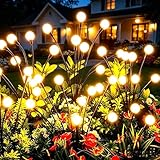
Of everything in this roundup, this is the set most likely to be bought for someone else. The firefly effect — 32 LEDs per stake arranged on flexible branches, creating the impression of light scattered through the air — is visually striking in a way that a standard path light is not, and that makes it a natural gift for a gardener who already has the practical lighting sorted.
It is also the most purely decorative product here. There is no useful beam, no defined pool of light on the ground, and no meaningful contribution to visibility. What you get is atmosphere: a soft, sparkling scatter that reads best when placed among tall perennials, along a fence line, or inside a large planter. Judged on those terms it does its job well; judged as lighting, it will disappoint.
Key specifications
- Pack size: 4 stakes, 32 LEDs each
- Effect: Firefly scatter across flexible branches
- Mounting: Ground stake with shapeable arms
- Solar panel: Integrated at the top of each stake
- Weather rating: Waterproof for outdoor placement
- Runtime class: Several hours of decorative output per charge
Strengths
The higher LED count per stake than the ASMAD set means more individual points of light, which is exactly what makes the effect convincing. A firefly effect depends on there being enough scattered sources that the eye reads them as a swarm rather than as separate bulbs, and 32 per stake crosses that threshold.
The gift angle is genuine rather than marketing padding. Practical garden lighting is a purchase people make for themselves once and then stop thinking about; a decorative set is something they are unlikely to buy but likely to enjoy, which is the definition of a good gift. It also arrives as four separate units, so a recipient can spread them across different spots and immediately see the effect in more than one place.
Pros
- 32 LEDs per stake produces a convincing firefly scatter
- Flexible arms can be shaped to fit the planting
- Works as a gift for gardeners who already own practical lighting
- Four units can be distributed across several spots
- Budget tier makes it a low-risk purchase
Cons
- No useful beam or ground illumination
- Flexible arms are more fragile than rigid stakes
- Decorative runtime is shorter than a focused path light
- Effect divides opinion — some find it busy
How it compares
Against the ASMAD fairy set, this has the higher LED count across the set and a more defined firefly look, while ASMAD is cheaper to try. Both belong in the same role — decoration, not illumination — and either pairs well with a practical staked set from this list. If you are choosing between them, pick vignuto for maximum effect and ASMAD for minimum outlay.
8. AUDERWIN Solar Spot Lights Outdoor Waterproof, 4 Pack, Cool White – Best for Uplighting

Everything else in this roundup emits light in a broad spread. This one aims it. A solar spotlight throws a defined cone at a tree trunk, a wall, a fence panel, or a large shrub, which is a fundamentally different job from marking a path — and it is the job that most cheap solar kits cannot do at all.
Uplighting is what makes a garden look professionally lit. A single well-aimed spot on a multi-stem tree or a textured wall at night does more visual work than a dozen evenly spaced path lights. Because this set is adjustable and can be staked into soil or mounted to a wall with a bracket, it is the one product here that lets you build that look without running low-voltage cable.
Key specifications
- Pack size: 4 spotlights
- Output style: Directional beam, adjustable head
- Color temperature: Cool white
- Mounting: Ground stake, with wall-mount option
- Solar panel: Integrated, on the adjustable head
- Weather rating: Waterproof for permanent outdoor installation
Strengths
Beam direction is the whole point, and it enables effects nothing else here can produce. A spotlight placed at the base of a small ornamental tree and aimed up the trunk creates a focal point that draws the eye across an entire garden. The same light aimed at a rendered wall and set close to it produces a grazing effect that reveals texture. Neither is possible with a stake light, no matter how bright.
Four units is also the right count for this kind of work, because uplighting is about emphasis, not coverage. Four well-placed spots on the two or three features that matter will do more than twenty lights scattered evenly, and the low count keeps the installation considered rather than indiscriminate.
Pros
- Directional beam produces uplighting and wall-washing effects
- Adjustable head lets you aim the light precisely
- Stake or wall-mount increases placement options
- Four units suits feature lighting rather than coverage
- Creates a focal point no path light can match
Cons
- Four units will not light a path or a driveway
- Narrow beam leaves the surrounding area dark
- Cool white can look harsh on some foliage and timber
- Aimed panels must be re-checked as plants grow
How it compares
This is complementary to everything else rather than competing with it. The strongest approach for most gardens is a coverage product — the DenicMic 10 Pack or a 12-pack — for the route, plus this spotlight set for two or three features. Against the DERAYSION 12 Pack, the two are solving different problems entirely: coverage and emphasis. If you can only buy one, buy coverage first and add spots later.
9. DERAYSION 12 Pack Solar Lights Outdoor, Pathway Lights – Best Premium for Whole-Property Coverage

This is the same coverage as the budget 12-packs with a better build underneath. DERAYSION’s premium tier buys you a pathway lens designed to spread light evenly along a walking route, longer service life from the electronics and housing, and the consistency of buying a full set of twelve fixtures that will still match when you come to add more. For a property where the lighting is installed once and expected to last, the higher tier is the reasonable choice.
The practical case for paying more is what happens in year three. Budget stake lights typically do not fail outright — they degrade. Plastic yellows, lenses cloud, batteries lose capacity, and the output that was adequate when new becomes noticeably dimmer. Premium units use better materials and better cells, so the light at year three is closer to the light at year one.
Key specifications
- Pack size: 12 lights
- Lens type: Pathway lens for even ground spread
- Mounting: Ground stake
- Operation: Automatic on/off with light sensing
- Battery class: Higher-capacity cell than budget equivalents
- Weather rating: Waterproof for permanent outdoor installation
- Output class: Bright end of the pathway light range
Strengths
Longevity is the payoff. Where a budget set might need partial replacement after three or four seasons, a premium set of the same count is built to hold its output longer, which means fewer mismatched replacements and a lighting scheme that stays visually uniform. For a front path that is part of the property’s presentation, that consistency has real value.
Twelve units at a premium tier also means you can light the whole property in one coherent purchase — the front path, the side return, and the back terrace — using identical fixtures throughout. Splitting the job across a budget set for one area and a premium set for another is the fastest way to end up with visibly different lighting in adjacent parts of the same garden.
Pros
- Premium construction holds its appearance longer
- Twelve units covers an entire property
- Pathway lens spreads light evenly along a route
- Consistent fixtures across multiple areas
- Higher battery class means less dimming over time
Cons
- Premium tier costs meaningfully more per light
- Overkill for a driveway nobody inspects closely
- Still limited by sun exposure like any solar light
- No uplighting capability
How it compares
Against the budget GIGALUMI 12 Pack, the difference is durability rather than function — both light a long run, but this one is built to look and perform the same in year five. Against the Mancra metal-and-glass sets, the trade is design versus lens performance: Mancra looks more like installed architectural lighting, DERAYSION spreads light more evenly along a walking route. If presentation matters most, look at Mancra. If consistent path illumination matters most, this is the pick.
10. Mancra Solar Pathway Lights Outdoor, 10 Pack, Metal & Glass – Best Premium for Looks

Metal and glass is the combination that separates landscape lighting from garden gadgets. A painted plastic housing looks acceptable in a photograph and tired after two winters; a metal body with a glass lens looks like something an electrician installed and keeps looking that way. If the lights are in a position where people will notice them in daylight — along a front entry, beside a terrace, in a courtyard — this is where premium money is best spent.
Ten units is a well-judged count for a presentation area. It covers a front path and the approach to it without leaving you with orphan fixtures, and the heft of metal construction means the units sit in the ground more securely than lightweight plastic stakes that work loose in frost.
Key specifications
- Pack size: 10 lights
- Construction: Metal housing with glass lens
- Mounting: Ground stake
- Battery: Replaceable-class cell rather than sealed
- Operation: Automatic dusk-to-dawn
- Weather rating: Waterproof, designed for permanent installation
Strengths
Daylight appearance is the argument, and it is stronger than it sounds. Most garden lighting is viewed in daylight far more often than at night, and a glass-and-metal fixture earns its place in that view. The glass lens also resists the clouding that affects plastic lenses over time, which matters because a cloudy lens scatters light and reduces the brightness reaching the ground.
Metal construction holds its position better too. Heavier stakes do not shift as readily in freeze-thaw cycles, so the fixture line stays straight season after season — a small detail that separates a tidy installation from one that looks like it has been nudged by weather.
Pros
- Metal and glass looks like installed landscape lighting
- Glass lens resists the clouding that dulls plastic
- Heavier stakes hold position through frost
- Ten units suits a front path and approach
- Replaceable battery class extends service life
Cons
- Highest price tier in this roundup
- Glass can crack if struck by a mower or a stone
- Ten units is not enough for a long driveway
- Weight makes repositioning marginally less casual
How it compares
Its nearest rival is the Mancra 8 Pack of the same metal-and-glass family, which trades two fewer lights for a smaller outlay and suits a tighter installation such as a single courtyard or a short entrance run. Against the stainless-steel DERAYSION 8 Pack, the materials are comparable and the choice is stylistic — DERAYSION’s stainless look reads cooler and more contemporary, while this set’s metal and glass reads warmer and more traditional. Buy whichever matches the architecture.
11. DERAYSION 8 Pack Solar Lights Outdoor, Stainless Steel Glass Pathway Lights – Best Premium for Wet and Coastal Gardens

Stainless steel and glass is the material combination to look for when your garden is exposed to salt air, heavy rain, or constant humidity. Stainless resists the corrosion that attacks painted and plated finishes near the coast, and glass does not degrade in UV the way many plastics do. If you have watched budget lights go chalky and rust-streaked within a couple of seasons, this is the material upgrade that addresses the cause.
Eight units covers a mid-length path or a defined border run, and the long-lasting battery class means less of the progressive dimming that characterizes cheap cells. This is a set bought with a decade in mind rather than a season.
Key specifications
- Pack size: 8 lights
- Construction: Stainless steel body with glass lens
- Mounting: Ground stake
- Battery class: Long-lasting, higher-capacity cell
- Operation: Automatic on/off with light sensing
- Weather rating: Waterproof, suited to exposed and coastal conditions
Strengths
Corrosion resistance is the headline benefit and the reason to pay the premium tier in a coastal or wet climate. Salt air and repeated wetting are what destroy cheap fixtures — first the finish, then the seals, then the electronics. Stainless and glass push that failure point out by years, and in an exposed garden the cost difference is usually recovered in avoided replacements.
The glass lens also keeps its clarity, which means the light output stays closer to the original over the fixture’s life. A cloudy polycarbonate lens can cut a meaningful fraction of the light reaching the ground, so glass is not merely a cosmetic upgrade — it protects performance.
Pros
- Stainless steel resists corrosion in exposed gardens
- Glass lens holds clarity longer than plastic
- Long-lasting battery class reduces dimming over time
- Eight units suits a mid-length path or border
- Cool contemporary look suits modern architecture
Cons
- Premium price for a modest eight-unit count
- Not enough units for a full driveway
- Stainless shows water spots and fingerprints
- Glass requires care when repositioning stakes
How it compares
Against the Mancra 10 Pack in metal and glass, the difference is finish and count — Mancra gives you two more fixtures in a more traditional finish, while this set offers stainless steel that better resists salt and humidity. Against the Mancra 8 Pack, the comparison is close enough that climate should decide it: in a sheltered inland garden either is fine, and in an exposed coastal one, stainless is the safer material.
12. Mancra Solar Pathway Lights, 8 Pack, LED Glass Metal Garden Lighting – Best Premium for Smaller Installations

The eight-unit premium option for anyone who does not need ten. A short entrance run, a courtyard perimeter, a terrace edge, or a defined border of around 25 to 30 feet is exactly what eight glass-and-metal fixtures handle well, and buying ten for a job that needs eight leaves you with spares that never quite match the installation.
Like the ten-pack, the appeal is that these read as architectural garden lighting rather than accessories. The metal body and glass lens are the two features that most reliably signal quality in this category, and both are present here. The trade against the larger pack is simply count — the materials, the mounting, and the operating principle are the same.
Key specifications
- Pack size: 8 lights, suited to roughly 25–30 feet of path
- Construction: Metal housing with glass lens
- Mounting: Ground stake
- Color class: Neutral to warm white output
- Operation: Automatic dusk-to-dawn
- Weather rating: Waterproof for permanent outdoor installation
Strengths
The count is the point. Eight lights for a courtyard or an entrance run avoids the two most common outcomes of buying too many — spares that sit in a box, or fixtures deployed somewhere they were not needed just to use them up. Accurate sizing is what makes an installation look resolved.
The neutral-to-warm output also suits planting better than cool white, which broadens where these can be used. Along a path bordered by beds, a warm-leaning light flatters the foliage on both sides rather than making it look drained, which is the usual complaint about cold-white path lighting in planted areas.
Pros
- Eight units is right-sized for courtyards and short runs
- Metal and glass construction looks like installed lighting
- Neutral-to-warm output suits planted borders
- Glass lens resists clouding and holds output
- Same family as the 10-pack, so sets can be combined
Cons
- Premium tier pricing for a modest count
- Eight units will not cover a long driveway
- Warmer output is less crisp on pale paving than cool white
- Heavier fixtures need firm soil to sit straight
How it compares
The direct alternative is the Mancra 10 Pack, which offers the same materials with two more fixtures — buy that if your run is longer than about 30 feet, and this if it is not. Against the DERAYSION stainless 8 Pack, the materials are equivalent and the choice comes down to finish: this set’s traditional metal look suits brick, timber, and cottage planting, while stainless suits rendered walls and contemporary hardscape.
How to Choose
Choosing solar garden lighting is mostly a matter of getting four decisions right: what job the light is doing, how much light it needs to produce, where it can be placed so its panel charges, and how long you want it to remain presentable. Get those in order and the specific model almost picks itself.
Start with the job, not the fixture
Solar lights fall into four functional groups, and they are not interchangeable. Path lights mark a route and need even coverage along a line. Spotlights emphasize a feature such as a tree trunk or a wall. Globe and decorative lights create ambience and light nothing useful. Fairy and firefly lights add sparkle and scatter. Most people need coverage first and emphasis second, so a 10- or 12-pack of staked path lights plus a four-pack of spots covers more real-world use than any single purchase.
The mistake to avoid is buying decorative lighting for a functional job. Firefly stakes and solar globes look lovely and will not stop you from missing a step in the dark, because their output is dispersed across many small emitters rather than aimed at the ground. If the purpose is navigation, the lens has to be designed for it.
Calculate how many lights you actually need
Spacing is the number people get wrong most often, and it is easy to work out. For a path, divide the run length by your chosen interval:
- Dense, continuous look: 3-foot spacing. A 30-foot path needs 11 lights, so buy a 12-pack.
- Standard even rhythm: 4-foot spacing. A 40-foot path needs 11 lights — again, a 12-pack.
- Economical marker spacing: 5–6-foot spacing. A 60-foot driveway needs 10–12 lights.
- Bed edging: one light every 4–5 feet of bed perimeter, generally 4–6 lights for a typical foundation bed.
- Feature uplighting: one spotlight per feature, so four spots covers four trees, walls, or large shrubs.
Worked example: a 48-foot front path at 4-foot spacing needs 12 lights. A 20-foot side return at 4-foot spacing needs 5 more, for 17 total. That is a 12-pack plus a 6-pack in the same product family, which is why buying from a brand that offers multiple pack sizes in one design keeps the installation visually consistent.
Understand what brightness figures actually mean
Many solar path lights do not publish a lumen figure, and the ones that do are often quoting the LED’s theoretical output rather than what reaches the ground. Rather than chasing numbers, judge by category. A stake path light at the budget tier typically produces a soft pool of light roughly a foot or two across — enough to see an edge, not enough to read by. Mid-tier units are meaningfully brighter and produce a defined pool on the ground. Spotlights concentrate their output into a narrower cone and therefore appear considerably brighter at the target even at similar total output.
Color temperature matters as much as brightness for perceived quality. Cool and cold white, around the 6000K end, reads crisp and bright against gravel, concrete, asphalt, and pale stone, which makes it the right choice for paths and driveways. Warm white flatters green foliage, timber, terracotta, and brick, making it the better choice for beds, borders, and courtyards. If you run both types in one garden, keep them in separate zones rather than mixing them along a single line.
Panel placement is the single biggest performance factor
A solar light’s runtime is determined almost entirely by how much sun its panel receives, and this is where most disappointing installations go wrong. Nearly every staked light here has its panel built into the top cap, which means it needs direct, unobstructed sun for the majority of the day — not bright shade, not dappled light under a tree, and not the shaded side of a wall or fence.
Before you commit to positions, watch your intended line at three points in the day. If a stretch of path sits in the shadow of a fence or a building for most of the afternoon, lights placed there will run dim or die early regardless of their specifications, and no amount of premium construction fixes it. The remedies are to move the fixtures to a sunnier line, to choose a design with an angled or remote panel, or to accept that the shaded section will be dimmer.
Also budget for seasonal variation. A panel that charges fully in June may be shaded by a deciduous tree in September once the canopy fills out, or by the low winter sun angle. Expect winter runtime to be noticeably shorter than summer in most gardens, and expect the lights to run longer in midsummer than the box suggests.
Materials decide how long they stay presentable
This is the difference between the price tiers and the least understood. Budget fixtures use molded plastic bodies with painted finishes and polycarbonate lenses. Mid-range steps up to metal-look finishes and better plastics. Premium uses genuine metal housings — stainless steel or coated metal — with glass lenses. The performance gap in year one is small; the appearance gap in year four is large.
What wears first, in order: the finish on painted plastic, which chalks and fades; then the lens, which clouds and reduces light transmission; then the battery, which loses capacity and shortens runtime; and finally the seals, which fail and let water reach the electronics. Glass and metal push the first two failures back by years. If the lights are in a position where you look at them in daylight — a front entrance, a terrace, a courtyard — the premium tier usually justifies itself. For the far end of a driveway, it rarely does.
Batteries, and what actually fails
Most solar garden lights use a single rechargeable cell, often in the AA or AAA size class, charged by the panel during the day and discharged overnight. Cells are consumable. After two to four years of daily cycling, capacity drops enough that the light runs noticeably shorter each night, often well before anything else fails.
Two practical consequences follow. First, prefer fixtures with a replaceable battery if you expect to keep them long-term; a light with an accessible cell compartment can be revived for the cost of a battery rather than replaced entirely. Second, diagnose dimming correctly before discarding a fixture: if the light comes on at dusk and fades early, and the panel is clean and in full sun, the battery is the likely culprit, not the panel or the LED.
Keep the panel clean, too. A film of dust, pollen, or bird droppings can cut charging enough to shorten runtime, and it takes thirty seconds with a damp cloth to fix. This is the most common cause of a light that worked all summer and suddenly seems weak in autumn.
Mounting style and the practical installation
Stake mounting is the default because it requires no tools and no wiring, but it has limits. Stakes need soil soft enough to accept them and firm enough to hold them; in gravel, compacted clay, or under a dense root mat, a stake will not seat properly and the light will lean. In those situations a globe form that simply rests on the surface, or a spotlight with a wall bracket, solves the problem better.
Where you do use stakes, drive them in with a rubber mallet over a block of scrap wood rather than hammering the head directly, and set the head 12 to 16 inches above grade. Lower than that and the light pools too tightly; higher and you lose the ground-pooling effect that makes a path read as lit. Mark the line with a string before you start so the spacing stays even — the single most noticeable difference between an amateur and a professional-looking installation is uniform spacing.
Expect to reposition. Staked lights do not survive a winter untouched in every garden: frost heave tilts them, a string trimmer knocks them loose, and expanding perennials swallow short units. Plan to walk the line each spring, straighten what has shifted, and confirm the panels are still clear of new growth.
Matching the set to the space
- Small bed or courtyard, ambience only: 4–6 lights, warm white, decorative or globe form.
- Foundation bed, planting-focused: 6 lights, warm white, staked path lens.
- Front path, presentation matters: 8–10 lights, metal and glass, cool or neutral white.
- Long driveway, functional: 12 lights, budget or mid-range, cold white, plastic acceptable.
- Coastal or exposed garden: 8–12 lights, stainless steel and glass, whatever the count requires.
- Feature lighting on trees and walls: 4 spotlights in addition to coverage lighting.
- Pond or water feature: 2–4 globe lights, freestanding or floating.
Frequently Asked Questions
How long do solar garden lights actually stay lit at night?
Most well-charged solar path lights run for around six to ten hours, which is enough to cover dusk until roughly midnight in summer and well past that in winter when nights are longer but sun is weaker. The figure that matters is not the rated runtime but how much direct sun the panel received that day — a light that got four hours of unobstructed sun will run considerably shorter than one that got eight. Expect wide seasonal variation, with midsummer and midwinter at opposite ends of the range.
Why do my solar lights stop working after a year or two?
The most common cause is the battery, not the panel or the LED. Rechargeable cells cycle once a day and lose capacity over two to four years, so the light comes on at dusk and fades earlier each night until it barely glows. If a light still switches on and simply runs short, and the panel is clean and in full sun, replacing the battery usually restores it. If it does not come on at all, check whether water has reached the electronics through a failed seal, which is the second most common failure.
Do solar lights work in shade or in a north-facing garden?
They work, but poorly, and no amount of specification overcomes it. A panel in bright shade might collect a fraction of what it would in full sun, which translates directly into a much shorter runtime. For genuinely shaded spots, look for a design with an angled or remotely positioned panel that can be aimed at the sun while the light itself sits in the shade, or accept the reduced performance and treat those units as ambience rather than functional lighting.
Are solar path lights bright enough to replace wired landscape lighting?
For marking a path or edging a bed, they are usually adequate, and the zero running cost and no-wiring installation are real advantages. For genuine security lighting or lighting a large area, they are not a substitute. Wired low-voltage systems can run much higher output and stay at full brightness regardless of weather, while solar output depends entirely on the day’s sun. Many gardens use both — solar for path marking, wired for anything that needs to stay bright all night.
How far apart should I space solar path lights?
Four feet is the standard interval for an even, deliberate-looking line, with three feet for a dense continuous effect and five to six feet when you want an economical marker rhythm along a long driveway. Divide your total run length by the interval to get the count, then round up to the nearest pack size. Uniform spacing matters more to the final look than the brightness of individual fixtures.
Do I need to turn solar lights on, or do they switch themselves?
They switch themselves. Almost every unit in this category has a light sensor that turns the LED on at dusk and off at dawn, so once the fixture is charged and the switch is set to on, there is nothing further to do. Many units also have a manual off position for storage or if you want the light dark without removing it from the ground. Leaving a unit switched off long-term is fine and does not harm the battery.
What does IP-rated waterproof actually mean for garden lights?
The IP rating describes resistance to dust and water ingress, and for garden lighting the second digit is the one that matters. Common outdoor ratings handle rain and splashing without difficulty, which is what a garden light needs. Note that waterproof does not mean submersible — a unit rated for rain is not necessarily suitable for floating in a pond, and any globe light intended for water should say so explicitly in its listing rather than being assumed to be safe there.
Can I mix solar lights from different brands in one garden?
You can, but it usually shows. Different brands use different color temperatures, different fixture heights, and different head shapes, and even a small difference in color temperature is obvious when two lights sit side by side in the dark. If you are lighting one continuous line, buy the whole line from one product in one order. Mixed sets are fine when they are in separate zones — solar path lights along the walk and decorative globes in the beds do not compete visually.
How do I clean and maintain solar garden lights?
Wipe the panel with a damp cloth a few times a season to remove dust, pollen, and droppings, since even a thin film reduces charging. Clean the lens gently with water rather than abrasive cleaners, particularly on glass units. Walk the line each spring to straighten fixtures that frost has tilted, push stakes back to their correct depth, and clear new growth away from the panels. If a light starts fading early and the panel is clean, replace the battery before replacing the fixture.
Closing Recommendation by Situation
If you are lighting a path and want one purchase that does the job properly, the DenicMic 10 Pack in cool white is the sensible default — ten units covers a real path, the finish is neutral enough for most gardens, and cool white is the right choice against gravel and stone. If cost is the deciding factor and the run is long, the GIGALUMI 12 Pack in cold white gives you the most fixtures per dollar and is the pragmatic choice for a driveway. If the lights will sit somewhere you look at every day, the Mancra 10 Pack in metal and glass is worth the premium tier for the way it looks in daylight as well as at night. For a coastal or exposed garden, the DERAYSION 8 Pack in stainless steel and glass is the material upgrade that addresses the conditions head-on.
For beds and planting rather than routes, the GIGALUMI 6 Pack in warm white suits foliage and timber far better than any cool-white set here. Add the AUDERWIN 4 Pack of spotlights to pick out a tree or a wall, and the JKIMK globes for water features or freestanding accents. If you are buying for someone else, the vignuto firefly stakes are the set people enjoy receiving and would rarely buy for themselves.