Best Circular Saw Blades for Cutting 2×4 Lumber
What's inside
As an Amazon Associate I earn from qualifying purchases. This post may contain affiliate links at no extra cost to you.
Best Circular Saw Blades for Cutting 2×4 Lumber
The best circular saw blade for cutting 2×4 lumber is usually a sharp, carbide-tipped 7¼-inch blade with 24 teeth for fast framing cuts or 40–60 teeth for cleaner crosscuts. Match the blade’s diameter, arbor, and maximum RPM to your saw; choose kerf based on the saw’s power and the cut quality you need.
Quick picks by cut and saw
- Fast framing and rough crosscuts: A 7¼-inch, 24-tooth carbide framing blade. Its wide gullets clear chips quickly, making it a practical everyday choice for construction lumber.
- Cleaner crosscuts in visible 2x4s: A 7¼-inch, 40-tooth or 50-tooth finish blade. It leaves a smoother edge, though it cuts more slowly and can heat up if pushed hard.
- Frequent ripping: A 7¼-inch, 18–24-tooth blade designed for ripping, with deep gullets to remove long chips. For occasional ripping, a general-purpose 24-tooth blade is usually adequate.
- Compact saw: Use the diameter specified for that saw—often 6½ inches—and verify that the blade’s arbor and speed rating are compatible. A 7¼-inch blade is not a substitute if it exceeds the saw’s permitted size.
What matters when choosing a blade
Diameter and cutting capacity
Most standard circular saws use 7¼-inch blades; compact models commonly use smaller diameters. A nominal 2×4 actually measures about 1½ by 3½ inches, so a properly equipped 7¼-inch saw has ample depth for a crosscut through its 1½-inch thickness. Check the saw’s manual for maximum blade diameter and cutting depth, and never remove a guard or use an oversized blade to gain capacity.
As an Amazon Associate we earn from qualifying purchases at no extra cost to you.

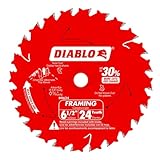
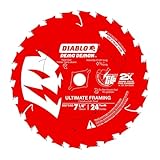

Tooth count: speed versus finish
Fewer teeth generally cut faster and clear waste more readily, which suits framing lumber and rough ripping. More teeth make smaller bites and can reduce tear-out on crosscuts, but they demand a steadier feed and can burn wood if the blade is dull or the cut is forced. Tooth count alone does not determine finish: tooth geometry, sharpness, material, and feed rate matter too.
Kerf: full or thin
Full-kerf blades are commonly around ⅛ inch wide; thin-kerf blades are often about 3/32 inch, though dimensions vary by model. A thin kerf removes less material and can help a lower-powered or cordless saw maintain speed. Full kerf can feel more stable on a powerful saw, but the saw must be able to drive it comfortably. Use a blade compatible with the saw’s guard, riving knife (if fitted), and manufacturer guidance.
| Blade type | Typical diameter | Typical teeth | Typical kerf | Best use on 2x4s |
|---|---|---|---|---|
| Framing | 7¼ in | 24 | About ⅛ in | Fast crosscuts and rough ripping |
| Thin-kerf framing | 7¼ in | 24 | About 3/32 in | Framing with a compact or lower-powered saw, if approved |
| General-purpose | 7¼ in | 40 | About ⅛ in | Mixed crosscuts and occasional ripping |
| Fine-finish | 7¼ in | 50–60 | About ⅛ in | Cleaner crosscuts where edge appearance matters |
These are common ranges, not universal specifications. Confirm exact dimensions and compatibility on the blade and saw.
Choose by the job, not just the lumber
For everyday construction: Choose a 24-tooth carbide blade. It is the sensible balance for cutting multiple studs quickly, where a perfectly smooth edge is rarely necessary.
For neat, exposed crosscuts: Move to a 40-tooth blade, or a 50–60-tooth blade if the finish matters more than speed. Support the offcut so it does not break away at the end of the cut. A fine-tooth blade cannot compensate for a dull edge or an unsupported board.
For a tight budget or infrequent use: A reputable general-purpose carbide blade around 40 teeth can cover 2×4 crosscuts and occasional sheet-goods work. If most cuts are framing cuts, a 24-tooth blade is typically faster and may be the better single-purpose purchase.
For cordless or compact saws: Consider a compatible thin-kerf blade when the saw struggles to maintain speed. Do not assume thin kerf is automatically better: if the saw’s manual requires a particular blade type or thickness, follow that specification.
When the material changes
- MDF: Use a sharp, high-tooth-count carbide blade intended for sheet goods—often 60 teeth on a 7¼-inch blade—and manage dust with suitable extraction and respiratory protection. MDF is abrasive, so expect faster edge wear than with ordinary framing lumber.
- Oak: A sharp 40-tooth blade is a useful starting point for crosscuts; choose more teeth for a cleaner finish. Feed steadily rather than forcing the saw, since dense hardwood can burn with a dull blade or an overly slow cut.
- Trim: Use a fine-finish blade, commonly 40–60 teeth for a 7¼-inch saw. Backing the cut with scrap wood and cutting with the finished face oriented to reduce visible tear-out can improve results; confirm the correct orientation for your saw.
- Plywood: A 40–60-tooth blade designed for plywood or finish work reduces splintering compared with a framing blade. A zero-clearance support or sacrificial backing can further support the veneer fibers.
- Laminate: Use a sharp, high-tooth-count blade specified for laminate or sheet goods, and support the surface to limit chipping. Check the product’s material limits because “laminate” can refer to different constructions.
- Aluminum: Do not use a wood blade by default. Use a blade explicitly designed and rated for nonferrous metal, and follow the saw and blade makers’ instructions for RPM, workholding, and cutting setup. Some circular saws are not suitable for metal cutting.
Compatibility and safe setup checklist
- Read the saw label and manual. Match diameter, arbor size, rotation direction, and rated RPM. A blade’s maximum RPM must meet or exceed the saw’s no-load speed.
- Check the kerf and body thickness. The blade must work with the saw’s guard and any riving knife. Do not fit a blade that conflicts with the saw’s specified setup.
- Inspect before cutting. Look for cracked carbide tips, missing teeth, warping, or heavy resin buildup. Unplug a corded saw or remove the battery before handling the blade.
- Support and secure the stock. Clamp the 2×4 when appropriate, keep the offcut from pinching the blade, and set blade depth just beyond the workpiece. Keep hands out of the cut path and let the blade reach speed before entering the wood.
Ownership: when to clean or replace
Carbide teeth usually outlast the blade body, but sharpness declines with use. More burning, increased effort, rough edges, and a tendency for the saw to slow are practical signs to inspect the blade. Pitch and resin can also make a sound blade cut poorly; clean it with a product intended for saw blades and follow its directions. Avoid scraping carbide tips with hard tools.
For frequent work, a professionally sharpenable blade may be worth keeping; inexpensive blades can make more sense for occasional rough framing. Compare the expected sharpening or replacement cost with how often you cut—not just the purchase price. The right choice for most 2×4 work remains simple: 24 teeth for speed, 40 or more for a cleaner crosscut, and a size and kerf the saw is designed to use.