Best Circular Saw Blades for Cutting Wood
What's inside
- Best Circular Saw Blade for Wood: Quick Answer
- How Tooth Count Changes the Cut
- Kerf, Carbide, and Diameter: The Other Three Variables
- Top Picks by Situation
- Decision Matrix: Which Blade for Your Work?
- The Math on Cheap vs. Premium Blades
- How to Change a Circular Saw Blade (Sidewinder and Worm Drive)
- Ownership Realities: What Wears, What Kills Blades
- FAQ
- Related Guides
- Best Circular Saw Blade for Wood: Quick Answer
- How Tooth Count Changes the Cut
- Kerf, Carbide, and Diameter: The Other Three Variables
- Top Picks by Situation
- Decision Matrix: Which Blade for Your Work?
- The Math on Cheap vs. Premium Blades
- How to Change a Circular Saw Blade (Sidewinder and Worm Drive)
- Ownership Realities: What Wears, What Kills Blades
- FAQ
- Related Guides
As an Amazon Associate I earn from qualifying purchases. This post may contain affiliate links at no extra cost to you.
Best Circular Saw Blade for Wood: Quick Answer
The best circular saw blade for wood depends on what you’re cutting: a 24-tooth framing blade for ripping construction lumber, a 40-tooth combination blade for all-around work, and a 60-tooth finish blade for plywood and hardwood. For most DIYers with a standard 7-1/4″ sidewinder saw, the Diablo D0740X (40T, thin kerf) is the strongest single choice; if your work skews toward sheet goods and visible edges, step up to a 60T blade like the Freud LU79R007.
How Tooth Count Changes the Cut
Tooth count is the single biggest variable in blade performance. More teeth means each tooth removes less material per revolution, producing a cleaner edge but slower feed rate and more heat.
As an Amazon Associate we earn from qualifying purchases at no extra cost to you.
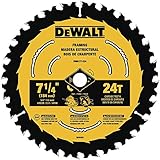


- 24T ripping/framing: Aggressive gullets clear chips fast. Cuts quickly through 2x lumber but leaves rough edges that show tear-out on plywood veneer.
- 40T combination: Alternating gullet and tooth geometry lets it rip acceptably and crosscut cleanly. The “one blade on the saw” answer.
- 60T crosscut/finish: Clean edges on oak, maple, plywood, and trim. Feeds slower and can burn in thick ripping if you push too fast.
- 80T+ ultra-finish: Melamine, veneered plywood, and laminate where any chip is visible. Almost exclusively for dedicated finish work.
Tooth geometry matters too: ATB (alternate top bevel) teeth shear wood fibers cleanly for crosscutting; flat-top (FTG) teeth are better for ripping; triple-chip grind (TCG) handles abrasive materials like melamine and MDF without dulling as fast.
Kerf, Carbide, and Diameter: The Other Three Variables
Kerf width
Full-kerf blades cut about 1/8″ (0.125″); thin-kerf blades run 0.059″–0.091″. Thin kerf removes roughly a third less material per pass, which matters if you run a cordless saw (longer battery runtime, less motor strain) or a lower-powered sidewinder. The trade-off: thin-kerf plates flex more, so they’re more prone to wobble on heavy rip cuts and binding if your fence work is sloppy. Full kerf tracks straighter but demands a saw with real power — think worm-drive or corded sidewinder.
Carbide quality
Premium blades use micro-grain or C3/C4-grade carbide brazed onto laser-cut plates. Freud’s TiCo carbide and Diablo’s formulation can be resharpened 3–5 times before the tips wear past serviceable size. Budget blades use softer carbide that dulls within weeks on MDF or construction lumber full of embedded grit — a $10 blade resharpened zero times is worse economics than a $50 blade resharpened four times.
Diameter
7-1/4″ is the standard for sidewinders and worm drives; compact saws take 6-1/2″ or 5-1/2″, and some framers run 8-1/4″ or 10-1/4″ for deeper cuts. Never run a smaller blade than your saw’s rating to “fit” — the arbor and guard are engineered around the rated diameter. Match the arbor bore (typically 5/8″ on 7-1/4″ saws; many blades ship with a diamond knockout for worm-drive saws).
Top Picks by Situation
| Blade | Teeth | Kerf | Best for | Typical price range |
|---|---|---|---|---|
| Diablo D0724A Framing | 24 | 0.059″ (thin) | Ripping 2x lumber, demolition-adjacent framing | $15–20 |
| DeWalt DWA171460 | 60 | 0.063″ | Budget finish cuts, plywood | $20–30 |
| Diablo D0740X Combination | 40 | 0.059″ | One-blade general use, cordless saws | $25–35 |
| Freud LU79R007 Thin Kerf Ultimate Plywood | 60 | 0.079″ | Plywood, melamine, visible edges | $40–55 |
| Forrest Woodworker II | 40 | 0.100″ | Hardwood, precision work, resharpenable long-term | $100–140 |
| IRWIN Marathon 14030 | 40 | 0.063″ | Occasional users, tight budgets | $10–15 |
Decision Matrix: Which Blade for Your Work?
| Your situation | Recommended setup |
|---|---|
| Framing a deck or shed, mostly 2×6/2×8 ripping | 24T thin-kerf framing blade |
| Breaking down plywood sheets for cabinets | 60T thin-kerf plywood/finish blade |
| Weekend DIYer who does a bit of everything | 40T combination; add a 60T later |
| Cordless saw, battery life matters | Thin kerf, whatever tooth count fits the task |
| Hardwood furniture parts, visible edges | 60–80T ATB; Forrest/CMT tier if budget allows |
| Cutting reclaimed or dirty lumber | Cheap 24T — expect embedded nails to kill the blade |
The Math on Cheap vs. Premium Blades
A $12 budget blade typically survives 100–200 linear feet of MDF or plywood before edges get fuzzy, and the thin soft carbide isn’t worth resharpening (resharpening runs roughly $15–25 per blade). A $45 Freud or a $120 Forrest handles 5+ times that footage before dulling, then comes back from the sharpener nearly new — up to 4 or 5 cycles on a Forrest. Worked out: premium blade at $45 + three resharpenings at $60 total = ~$105 across four effective lifespans, versus four budget blades plus degraded cut quality = ~$48 but with worse edges throughout. Premium wins on cut quality; budget wins only if you hit a nail or cut rarely.
How to Change a Circular Saw Blade (Sidewinder and Worm Drive)
Changing the blade on a circular saw — whether it’s a Skill saw, a DeWalt, or a Makita — takes under two minutes once you know the sequence:
- Unplug the saw or pull the battery. Non-negotiable.
- Press the arbor lock (a button on the motor housing) to stop the blade from spinning. If your saw lacks one, wedge the blade against scrap wood — never hold it by hand.
- Loosen the arbor nut. Critical detail most people get wrong: on most sidewinders the blade spins counterclockwise, so the nut loosens in the direction the blade rotates — turn it clockwise to remove. The nut is self-tightening during operation, which is why it never needs to be gorilla-tight.
- Retract the lower guard, remove the outer flange washer and old blade.
- Mount the new blade with the arrow pointing in the rotation direction — teeth at the front of the saw point up toward the shoe.
- Reinstall flange and nut, snug it firm — about a quarter-turn past finger-tight. Spin the blade by hand to confirm it clears the guard.
Ownership Realities: What Wears, What Kills Blades
- Pitch and resin buildup dulls blades faster than wear does. Soak in a blade-cleaning solution (or diluted citrus degreaser) every few months; a “dull” blade often just needs cleaning.
- Burn marks mean a dull blade, a dirty blade, or feeding too slowly. Don’t push harder — that overheats carbide and can crack the brazing.
- Missing teeth after a nail strike mean retire the blade. A blade that lost a tooth also throws off balance and can grab.
- Store blades flat or hung — leaning them on edge against a wall warps thin-kerf plates over time.
FAQ
Can I use a 60T blade for everything?
You can, but ripping thick lumber with 60T feeds slowly and builds heat. It’s fine for occasional rips in 3/4″ stock; for 2x material, switch to 24T.
Is thin kerf always better on cordless saws?
Generally yes — it extends runtime noticeably and reduces motor strain. The exception is heavy framing work where plate stiffness matters more.
How do I know when a blade needs replacing vs. cleaning?
Clean it first. If cuts still burn or tear out on fresh stock after cleaning, the carbide is dull — resharpen (premium blades) or replace (budget blades).