Best Miter Saw Roller Stands for Long Stock
What's inside
As an Amazon Associate I earn from qualifying purchases. This post may contain affiliate links at no extra cost to you.
The best miter saw roller stand for long stock is one with at least a 44-inch height range, 200 lbs or more of capacity, and a roller that mounts in line with your saw’s fence — and for most workshops in 2026, that means picking between a single adjustable roller stand (like the DEWALT DWX723-style rolling stands or the WEN MSA200T), a dedicated material support arm for a saw stand, or a mobile stand with an integrated support kit. Below is a full breakdown by the criteria that actually matter: height range, capacity, roller vs. ball-stop design, folded size, and saw-table compatibility.
As an Amazon Associate we earn from qualifying purchases at no extra cost to you.

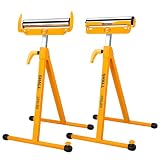


What Actually Matters in a Miter Saw Roller Stand
Listings all claim “heavy duty” and “adjustable.” What determines whether your 12-foot board cuts square is narrower:
- Height range: Most miter saw tables sit 34–42 inches off the floor. You want a stand that adjusts at least from about 25 to 44 inches so it can serve multiple saws, planers, and table saws as an outfeed support.
- Weight capacity: A 16-foot wet 4×10 or a bundle of hardwood adds up fast. 150 lbs is the floor; 200–300 lbs gives margin for steel tube or stacked material.
- Roller vs. ball-stop: A cylindrical roller feeds stock smoothly but lets it drift sideways. A ball-stop or flip-stop version catches material and doubles as a repeatable length stop — worth it if you batch-cut studs or trim.
- Folded storage: In a two-car garage, the difference between a stand that folds to 4 inches thick and one that stays 12 inches deep is the difference between hanging it on the wall and tripping over it.
- Compatibility: Some supports bolt only to their own brand’s saw stand; universal stands sit anywhere. Mixing brands is fine — clamping pressure and height match are all that matter.
Spec Comparison: Roller Stands Worth Buying in 2026
| Stand | Height Range | Capacity | Head Type | Folded Size | Price Range |
|---|---|---|---|---|---|
| DEWALT DWX726 rolling miter saw stand support arms (pair) | Matches stand table (~38 in) | ~300 lbs (stand system) | Roller + convertible flat top | Integrated into stand | $60–$80 for arms |
| Bora Portamate PM-5090 pedestal roller | 26–42 in | 300 lbs | Roller | ~5 in thick folded | $50–$70 |
| WEN MSA200T universal roller stand | 27–43 in | 150 lbs | Roller | Compact fold | $40–$55 |
| Evolution universal roller stand | 25–46 in | 132 lbs | Roller | Folds flat | $35–$50 |
| King-Stop / multi-ball transfer head stands (generic type) | 24–40 in | 200 lbs | Ball-transfer head | Folds flat | $45–$80 |
Note that integrated arms (like the DEWALT system) inherit the stand’s capacity, while freestanding rollers carry their own rating. Two freestanding rollers supporting a long board effectively share the load.
Pick by Situation
| Your situation | Best choice | Why |
|---|---|---|
| Occasional DIY, tight budget | One budget universal roller stand (~$40) | Single support point is enough for 8–10 ft boards |
| Regular trim/framing work, 12–16 ft stock | Two mid-capacity stands (200+ lbs each) | Supports at ~5 ft and ~11 ft prevent droop-induced angle error |
| Mobile jobsite | Rolling saw stand (DEWALT, Bosch, Makita style) with support arms | Everything folds and wheels together; setup in under a minute |
| Batch cutting to repeat lengths | Roller stand with flip/ball stop | Stop gives repeatable cuts without measuring each piece |
| Small garage, wall storage | Flat-folding pedestal stand under ~5 in folded | Hangs on peg hooks between uses |
Roller Stands vs. a Miter Saw With Stand Combo
If you don’t own a saw stand yet, buying a miter saw with stand combo often beats assembling pieces. The Makita miter saw with stand bundles (typically a 10″ or 12″ sliding compound saw paired with Makita’s folding WST-style stand) and similar DEWALT DWS780/DWX723 or Bosch GCM12SD/T4B combos sell in the $600–$900 range depending on the saw — usually $50–$100 less than buying the same saw and stand separately.
The trade-off: combo stands include their own material supports, but those arms typically reach only to the sides of the stand, giving roughly 8–10 feet of total support width. For stock longer than about 12 feet, you still want one extra freestanding roller stand at the far end. So the combo isn’t a substitute for a roller stand — it’s the foundation, and the roller stand handles the overhang.
Compatibility check before mixing: measure your saw table height (or the combo stand’s table height) and confirm the roller’s max height exceeds it by at least an inch. Most universal stands top out around 42–46 inches, which covers nearly every stand sold today — but compact benchtop saws sitting on a workbench can exceed that, in which case you need the roller raised on blocking or a taller pedestal model.
Setup That Prevents Sag and Bad Cuts
- Set the roller height so stock sits dead level with the saw table — check with a straightedge spanning both surfaces. Even 1/8 inch of droop at the far end opens the cut angle measurably on a 12-foot board.
- Position supports at roughly 1/3 and 2/3 of the board’s unsupported length, not just at the tip.
- Align the roller parallel to the saw fence so the board feeds square, not diagonally.
- If using a flip stop, calibrate it once against a tape measure, then trust it for the batch.
- On smooth floors, chock or weight the stand legs — a stand that walks backward under a heavy board ruins the cut.
Durability and Ownership Realities
What wears first is almost always the same: the roller bearing seizes from sawdust, the height-lock knob threads strip if overtightened, and the folding-leg hinge loosens. Maintenance is cheap — blow out the roller bearing with compressed air monthly, keep the height column lightly waxed so it slides instead of galling, and check hinge bolts each season. Common mistakes: overloading a 150-lb stand with a steel bundle, setting the roller slightly high so stock rides up onto the blade, and storing the stand outdoors where the zinc column rusts and sticks.
FAQ
Do I need two roller stands for long stock?
Over about 10 feet, yes. One stand under a 16-footer leaves a long lever that flexes, which shows up as a gap in your miter joint.
Will a universal roller stand work with a Makita or Bosch saw stand?
Yes — freestanding stands don’t attach to anything, so brand doesn’t matter. Just match the height.
Roller or ball-transfer head?
Roller for feeding lumber toward the blade; ball transfer if you also use the stand as lateral sheet-goods support, since material can move in any direction.
What’s a fair price?
$35–$55 buys a capable budget stand, $60–$100 buys heavier capacity and better locks. Beyond that, you’re paying for integrated saw-stand systems rather than standalone rollers.