Best Cordless Drill for a First Tool Kit
What's inside
- Best first-tool-kit choices by situation
- My overall pick: a compact brushless 18V or 20V drill/driver
- What specifications matter most
- 12V versus 18V/20V: which should a beginner buy?
- Starter accessories worth buying
- Worked ownership calculation: is a second battery worthwhile?
- How to set up and use your first drill
- Durability and maintenance realities
- Final buying recommendation
- Related Guides
- Best first-tool-kit choices by situation
- My overall pick: a compact brushless 18V or 20V drill/driver
- What specifications matter most
- 12V versus 18V/20V: which should a beginner buy?
- Starter accessories worth buying
- Worked ownership calculation: is a second battery worthwhile?
- How to set up and use your first drill
- Durability and maintenance realities
- Final buying recommendation
- Related Guides
As an Amazon Associate I earn from qualifying purchases. This post may contain affiliate links at no extra cost to you.
The best cordless drill for a first tool kit is a compact 18V/20V-class brushless drill with a 1/2-inch chuck, two speed ranges, at least 15 clutch settings, and a battery platform you can keep using for future tools.
For most beginners, a compact drill/driver kit from DeWalt, Makita, Milwaukee, Bosch, or Ryobi is a better starting point than the most powerful hammer drill available. You want enough torque for furniture assembly, household repairs, pilot holes, and basic woodworking without ending up with a heavy tool that is unpleasant to control.
As an Amazon Associate we earn from qualifying purchases at no extra cost to you.


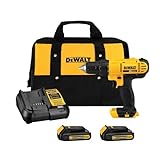

Best first-tool-kit choices by situation
| Situation | Best fit | Why it makes sense | Typical kit price range |
|---|---|---|---|
| Lowest long-term cost | Ryobi ONE+ HP compact brushless drill/driver | Large 18V tool platform and generally affordable batteries and accessories | $100–$180 |
| Frequent repairs and furniture work | DeWalt 20V MAX compact brushless drill/driver, such as the DCD794 class | Good balance of size, torque, controls, and widely available 20V tools | $130–$220 |
| Small hands or limited storage | Milwaukee M12 FUEL compact drill/driver, such as the 3404 class | Very compact and light while still offering a metal chuck and brushless motor | $130–$220 |
| Basic woodworking and general DIY | Makita 18V LXT compact brushless drill/driver, such as the XFD15 class | Smooth speed control, refined clutch behavior, and a mature battery system | $150–$250 |
| Driving screws in tight spaces | Bosch 12V Flexiclick drill/driver kit | Interchangeable right-angle and offset attachments add versatility in cabinets and corners | $170–$280 |
Prices are broad 2026 market ranges for a drill kit with at least one battery and a charger. Promotions, battery capacity, and included attachments can change the total substantially.
My overall pick: a compact brushless 18V or 20V drill/driver
A compact DeWalt 20V MAX, Makita 18V LXT, or Ryobi ONE+ HP brushless drill/driver is the safest recommendation for a first tool kit. These drills typically weigh about 2.5 to 3.5 pounds with a compact battery, use a 1/2-inch chuck, and provide enough capacity for common home projects.
Brushless motors are not essential for occasional use, but they are worthwhile when the price difference is reasonable. They usually provide better efficiency, require no motor brushes to replace, and tend to be paired with improved electronic controls. A brushed drill can still assemble furniture and drill wood; it simply may offer less runtime and a shorter expected service life under demanding use.
Why not start with the most powerful model?
High-torque hammer drills are useful for large holes, masonry, and construction work, but they are often longer and heavier. Extra torque also makes it easier for a beginner to strip a screw, split a board, or twist a small bit. A compact drill with a properly adjusted clutch teaches better control and covers more first-tool-kit jobs.
What specifications matter most
Weight and length
Look for a bare tool under roughly 3 pounds and a head length near 7 inches or less. With a small 1.5Ah or 2.0Ah battery, the drill remains easier to hold at shoulder height or in a cabinet. Larger 4.0Ah and 5.0Ah batteries extend runtime but make the tool noticeably heavier.
Two speed ranges
Two mechanical speeds are more useful than a very high advertised RPM. Low gear, usually around 0–500 RPM, gives control for driving screws and drilling large holes. High gear, often around 0–1,700 or 0–2,000 RPM, is better for small drill bits and faster work in wood or metal.
Clutch positions
A useful beginner drill has approximately 15 to 24 clutch settings, plus a separate drill position. Start with a low clutch setting when driving screws into softwood. Increase it only until the screw reaches the desired depth. The clutch will slip before the drill continues applying full torque, reducing stripped screw heads and damaged workpieces.
Chuck and accessory compatibility
A 1/2-inch keyless chuck accepts both small driver bits and larger drill bits. A 3/8-inch chuck is adequate for light assembly but gives you less flexibility as your projects grow. A ratcheting metal chuck generally grips more securely and may withstand more abuse than a basic plastic-sleeved chuck.
Battery platform
The battery platform matters more than a small difference in drill torque. Choose a system that includes the other tools you may realistically buy: an impact driver, oscillating multitool, jigsaw, light, sander, or compact vacuum. Staying within one platform lets you share batteries and chargers.
A 12V platform is excellent for furniture, shelves, hardware, and light repair. An 18V or 20V platform is more versatile for larger spade bits, long screws, deck repairs, and woodworking. The voltage labels are nominal system ratings; they do not by themselves prove that one drill is stronger than another.
12V versus 18V/20V: which should a beginner buy?
| Characteristic | 12V compact drill | 18V/20V compact drill |
|---|---|---|
| Typical tool-only weight | 1.5–2.2 lb | 2.2–3.2 lb |
| Typical battery capacity in starter kit | 1.5–2.0Ah | 1.5–2.0Ah |
| Best work | Assembly, hardware, small pilot holes | General repairs, woodworking, larger holes |
| Typical chuck size | 3/8 or 1/2 inch | 1/2 inch |
| Main limitation | Less reserve for large bits and long screws | More weight and bulk |
Choose 12V if storage space and comfort matter most, or if your projects are mainly flat-pack furniture, curtain hardware, cabinet pulls, and small repairs. Choose 18V/20V if you want one drill to remain useful for several years of home maintenance and basic woodworking.
Starter accessories worth buying
- A quality 1/4-inch hex driver-bit set with Phillips, square, Torx, and slotted bits.
- A brad-point wood drill-bit set, preferably from 1/8 to 1/2 inch.
- A countersink bit for flush screws in woodworking.
- A magnetic bit holder and a short selection of longer bits for recessed fasteners.
- Eye protection and hearing protection for drilling and cutting operations.
- A second battery if you regularly work away from an outlet.
Do not assume the bit set bundled with a drill is durable. Starter kits often include enough bits to begin, but inexpensive driver bits can round over quickly. Replace worn bits rather than increasing drill pressure.
Worked ownership calculation: is a second battery worthwhile?
Suppose a compact drill kit includes one 2.0Ah battery and your typical job uses approximately half its charge. If a project takes two battery-loads, you will either wait for charging or buy a second battery. A second 2.0Ah battery commonly adds roughly $40–$90, depending on the platform and promotion.
For occasional use, waiting may be the sensible choice. For repeated projects, the second battery effectively doubles your available charge and lets one battery cool while the other is in use. A larger 4.0Ah battery may provide roughly twice the stored energy of a 2.0Ah pack, but it also adds weight. For a first drill, two small batteries are often more comfortable than one large pack.
How to set up and use your first drill
- Charge the battery fully. Inspect the contacts and do not use a pack with a cracked case, swelling, or heat damage.
- Install the correct bit. Open the chuck, seat the bit straight, and tighten it firmly by hand. Remove the battery while changing bits if you are still learning the controls.
- Select low gear for screws. Set the clutch to a low or middle number and test on scrap material.
- Mark the workpiece. A small pilot hole helps prevent wandering, splitting, and inaccurate fastener placement.
- Keep the drill aligned. Push in line with the bit instead of leaning the tool sideways, which can bend or break bits.
- Release the trigger before the bit exits. This reduces tear-out when drilling through wood.
Durability and maintenance realities
The first parts to wear are usually driver bits, drill bits, chuck jaws, trigger switches, and batteries—not the motor. A chuck that begins slipping may need cleaning or replacement; do not compensate by overtightening it with pliers. Keep sawdust out of the ventilation slots, brush dust from the chuck, and store batteries indoors away from extreme heat and moisture.
Common beginner mistakes include using a drill bit to drive screws, running a wood bit at excessive speed, forcing a dull bit, and leaving the clutch on the drill symbol when driving small screws. Also avoid holding the workpiece in your hand while drilling. Clamp it securely, keep both hands clear of the bit, and remove the battery before clearing a jam.
Final buying recommendation
For most first tool kits, buy a compact brushless 18V/20V drill/driver with a 1/2-inch chuck, two speeds, at least 15 clutch settings, one small battery, and a charger. Pick the battery platform whose future tools and replacement batteries fit your budget. Choose a 12V drill instead if minimum size and weight are more important than large-hole capability. The best cordless drill for a first tool kit is the one you can control comfortably and keep supplied with compatible batteries for the next project.