Best Broadcast Spreaders for Even, Accurate Coverage
What's inside
- What separates the best broadcast spreaders?
- Best broadcast spreaders by situation
- Head-to-head comparison
- Hopper capacity: fewer refills versus easier handling
- Spread width and pattern control
- Calibration is the difference between coverage and waste
- Decision matrix for choosing a spreader
- Durability and ownership costs
- Common mistakes to avoid
- Bottom line
- What separates the best broadcast spreaders?
- Best broadcast spreaders by situation
- Head-to-head comparison
- Hopper capacity: fewer refills versus easier handling
- Spread width and pattern control
- Calibration is the difference between coverage and waste
- Decision matrix for choosing a spreader
- Durability and ownership costs
- Common mistakes to avoid
- Bottom line
As an Amazon Associate I earn from qualifying purchases. This post may contain affiliate links at no extra cost to you.
The best broadcast spreaders for most homeowners are a mid-size push model with a 40–50 lb hopper, roughly 10–12 feet of effective spread, a positive-rate calibration dial, and pneumatic or semi-pneumatic wheels; choose a compact 15,000-square-foot spreader for small lawns and a tow-behind model for large properties.
As an Amazon Associate we earn from qualifying purchases at no extra cost to you.
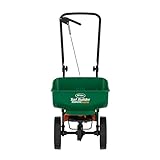


What separates the best broadcast spreaders?
A broadcast spreader throws granules in a fan-shaped pattern, allowing you to cover a lawn faster than with a drop spreader. The important comparison is not simply hopper size. A large hopper reduces refills, but it also adds weight and can be harder to maneuver. Spread width affects productivity, while calibration determines whether the lawn receives an even application instead of alternating dark and pale stripes.
Wheel design matters more than many product listings suggest. Narrow, hard plastic wheels can sink into soft soil or bounce across uneven ground, changing the application rate. Wider pneumatic or semi-pneumatic wheels roll more consistently and are easier to push when the hopper is full.
Best broadcast spreaders by situation
- Best compact choice for small lawns: Scotts EdgeGuard DLX. Its roughly 15,000-square-foot rated capacity is convenient for typical suburban lawns, and the EdgeGuard feature helps keep material off driveways and planting beds.
- Best manual spreader for frequent lawn care: EarthWay 2600A. Its approximately 40 lb hopper, large pneumatic tires, and commercial-style broadcast mechanism suit homeowners who fertilize, seed, and apply ice-melt products regularly.
- Best high-capacity push spreader: Chapin 8201A-style 80 lb spreaders. The larger hopper reduces interruptions on big lawns, although the loaded unit requires more pushing effort and more room to store.
- Best for very large properties: Agri-Fab 45-0463-style tow-behind spreaders. A roughly 130 lb hopper and tractor or riding-mower connection make them practical where a push spreader would require too many passes.
Head-to-head comparison
| Spreader type or example | Approximate hopper capacity | Typical effective spread | Wheel design | Best fit |
|---|---|---|---|---|
| Scotts EdgeGuard DLX | Rated for about 15,000 sq. ft. of lawn treatment | About 5–8 ft., depending on material | Compact molded wheels | Small to medium lawns and occasional use |
| EarthWay 2600A | About 40 lb | About 10–12 ft. | Large pneumatic tires | Frequent fertilizer or seed application |
| Chapin 8201A-style push spreader | About 80 lb | About 10–12 ft. | Large pneumatic or semi-pneumatic tires | Large lawns where fewer refills matter |
| Agri-Fab 45-0463 | About 130 lb | About 10–12 ft. | Wide pneumatic tires | Riding-mower and lawn-tractor owners |
These figures are useful for comparing scale, not for assuming identical coverage. Granule size, density, moisture, walking speed, and the selected application rate can change the real spread width. A fine grass seed may travel differently from dense fertilizer pellets, even on the same spreader.
Hopper capacity: fewer refills versus easier handling
Capacity should match the area you maintain and the material you apply. A 40 lb hopper is a useful middle ground: it is large enough for many residential applications but still manageable when loaded. An 80 lb spreader can save several trips to the bag, but its filled weight may exceed what some users can comfortably push up a slope or across damp grass.
Calculate the required material before buying. If a product is applied at 4 lb per 1,000 square feet and your lawn is 8,000 square feet, the application requires:
8 × 4 lb = 32 lb of material.
A 40 lb spreader can carry that amount in one load, while a smaller spreader may need two fills. However, do not automatically fill the hopper to its maximum rating. A lighter load is easier to control, and the spreader should remain stable when turning.
Spread width and pattern control
A wider pattern reduces walking time, but only if the edges of adjacent passes overlap correctly. If a spreader throws 10 feet, you should not assume that the full 10 feet receives an identical dose. The center often receives more product than the outer edge. Follow the manufacturer’s suggested wheel-track spacing and use visual landmarks to keep passes parallel.
Edge-control systems are valuable on smaller properties. Scotts EdgeGuard, for example, restricts material on one side so you can work near sidewalks, garden borders, or neighboring property without broadcasting product beyond the lawn. For open acreage, a symmetrical pattern is usually more useful than an edge-control lever.
Calibration is the difference between coverage and waste
A numbered dial is not a universal application rate. Settings vary by material, and two bags labeled for the same lawn area can flow differently because their granules differ in size and density.
Use this calibration method
- Measure a test area. Mark 1,000 square feet, such as a 20-by-50-foot rectangle.
- Weigh the material. If the label calls for 4 lb per 1,000 square feet, place exactly 4 lb in the hopper rather than filling it by eye.
- Set a conservative opening. Begin at the lower end of the recommended dial range.
- Walk at a steady pace. Use the same pace you expect to use on the lawn, keeping the spreader moving before opening the shutoff.
- Check the remainder. If more than the intended amount remains after covering the test area, open the setting slightly. If the hopper empties early, reduce the opening.
- Record the setting. Write down the product, rate, dial position, and walking pace for next time.
This process takes longer than trusting a dial, but it prevents the most expensive mistake: applying twice the intended material to part of the lawn and then trying to compensate elsewhere.
Decision matrix for choosing a spreader
| Your situation | Recommended capacity | Features to prioritize | Trade-off |
|---|---|---|---|
| Under 5,000 sq. ft.; occasional use | Compact, roughly 15,000 sq.-ft. rating | Simple calibration, edge control, small storage footprint | More refills and narrower coverage |
| 5,000–15,000 sq. ft.; seasonal use | 30–50 lb | Large wheels, corrosion-resistant hopper, positive shutoff | Heavier when full |
| 15,000–30,000 sq. ft.; frequent use | 50–80 lb | Pneumatic tires, sturdy frame, replaceable gearbox parts | Requires more storage and pushing effort |
| More than 30,000 sq. ft.; riding mower available | 100–130 lb tow-behind | Hitch compatibility, wide tires, accessible calibration lever | Less convenient around trees, beds, and tight corners |
Durability and ownership costs
The agitator, spinner shaft, shutoff plate, and gearbox are the parts most likely to wear first. Fertilizer is often hygroscopic, meaning it attracts moisture and can harden inside the hopper. Hardened granules can restrict flow and strain the drive mechanism. Avoid leaving product in the spreader overnight.
After every use, empty the hopper completely, brush out trapped granules, and rinse the unit with clean water if the manufacturer permits it. Dry it thoroughly before storage. Do not direct a high-pressure spray at bearings, bushings, or the gearbox. Lightly lubricate moving metal points according to the manual, but keep oil away from the metering opening, where it can collect dust and change the flow.
Pneumatic tires provide a smoother ride but can lose air or develop punctures. Check pressure before a large application because a low tire changes the spreader’s level and can alter the pattern. Solid wheels eliminate flats but may transmit more bouncing on rough ground.
Common mistakes to avoid
- Starting or stopping with the shutoff open, which creates heavy piles at the ends of passes.
- Walking at different speeds, causing inconsistent application rates.
- Overlapping by guesswork instead of following a measured wheel-track spacing.
- Using a fertilizer setting as a seed setting without recalibration.
- Filling beyond the hopper’s rated weight.
- Storing leftover fertilizer in the hopper, where moisture can create clumps.
Bottom line
Choose a compact Scotts EdgeGuard DLX-style spreader when storage and edge control matter most. Move up to an EarthWay 2600A-style 40 lb spreader when you want better wheels and more consistent use across a medium lawn. Select an 80 lb push model only when fewer refills justify the added weight, and choose an Agri-Fab 45-0463-style tow-behind spreader for extensive open lawns maintained with a riding mower. Whatever the size, careful calibration and steady wheel-track spacing contribute more to even coverage than the largest hopper or widest advertised spread.