Best Body Pillows for Side Sleeping and Support
What's inside
- Best body pillow types by sleeping situation
- Shape comparison: straight, C-shaped, J-shaped, or U-shaped?
- Fill materials: what feels different over time?
- Firmness and height: how to choose without guessing
- Cover care and ownership costs
- Bed-size fit: the decision most listings leave out
- Situation-based picks
- Common buying mistakes
- Bottom line
- Best body pillow types by sleeping situation
- Shape comparison: straight, C-shaped, J-shaped, or U-shaped?
- Fill materials: what feels different over time?
- Firmness and height: how to choose without guessing
- Cover care and ownership costs
- Bed-size fit: the decision most listings leave out
- Situation-based picks
- Common buying mistakes
- Bottom line
As an Amazon Associate I earn from qualifying purchases. This post may contain affiliate links at no extra cost to you.
The best body pillows for side sleeping are usually a supportive C-shaped or straight pillow with a washable cover, a fill you can adjust, and enough length to support both your knees and upper body without crowding the bed.
Shape matters more than branding. A straight pillow is the most versatile and easiest to fit in a standard bed; a C-shaped pillow offers more wraparound support; and a U-shaped pillow gives the most enclosure but uses substantially more space. The right choice depends on your sleeping position, bed size, preferred firmness, and willingness to manage a bulky cover.
As an Amazon Associate we earn from qualifying purchases at no extra cost to you.
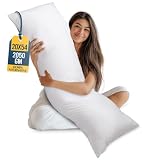


Best body pillow types by sleeping situation
| Situation | Best shape | Useful size | Typical fill | Why it fits |
|---|---|---|---|---|
| Regular side sleeper on a twin or full bed | Straight | 48–54 inches long, 18–20 inches wide | Shredded memory foam or polyester fiber | Supports the legs without taking over the mattress |
| Side sleeper who changes position | Long straight or J-shaped | 54–60 inches long | Adjustable shredded foam | Can be hugged, tucked between the knees, or used as a back bolster |
| Person wanting front-and-back support | C-shaped | 54–65 inches long | Polyester fiber or shredded foam | Curves around the torso and legs while leaving one side more open |
| Maximum enclosure on a queen or king bed | U-shaped | 55–65 inches long, 30–40 inches wide | Polyester fiber or mixed fill | Provides support on both sides, but occupies significant bed space |
| Cooler, lower-profile support | Straight | 48–54 inches long, 16–18 inches wide | Latex or fiber fill | Usually has more airflow and less heat retention than dense foam |
These are practical buying ranges rather than universal standards. Actual dimensions vary by maker, and a pillow’s usable support area is smaller than its outside measurements when the fill is soft or compressed.
Shape comparison: straight, C-shaped, J-shaped, or U-shaped?
Straight body pillows
A straight pillow is the safest starting point for most shoppers. It works between the thighs and knees, can be hugged against the chest, and doubles as a reading or lounging cushion. It also fits standard pillowcases more easily than curved designs. Choose one at least as long as the distance from your shoulder to your ankles if you want full-body coverage; otherwise, a 48-inch model is often enough for torso-and-knee support.
The limitation is that it can slide away during the night. A textured cover, slightly heavier fill, or a narrow end tucked beneath the mattress can reduce movement.
C-shaped and J-shaped pillows
A C-shaped pillow curves around the upper body and legs, making it useful when you want support in front and behind you. A J-shaped design generally has one long side and a hooked head or shoulder section. These designs can be more stable than a straight pillow, but their curves make fitted covers more expensive and laundering less convenient.
Check the internal opening before buying. A wide curve may feel spacious but provide little contact at the lower back, while a narrow curve can feel restrictive to larger sleepers.
U-shaped pillows
U-shaped pillows surround the torso with two long arms. They are the most substantial option for people who want to hug one side while resting against the other. The trade-off is bed space: a 35-inch-wide U-shaped pillow can leave only about 19.5 inches of width on each side of a 74-inch-wide king mattress, before accounting for your own body.
For a twin or full bed, a U-shaped pillow can leave too little room for comfortable movement. It is usually better suited to a queen or king mattress, or to use as a dedicated lounging pillow.
Fill materials: what feels different over time?
- Polyester fiber: Soft, lightweight, and usually the least expensive option, commonly about $25–$60. It compresses sooner than foam and may need regular fluffing, but many fiber-filled pillows are machine washable.
- Shredded memory foam: More moldable and supportive than loose fiber. It typically costs about $45–$100 and can feel dense or warm. Removable fill is valuable because it lets you tune the height.
- Solid memory foam: Holds its shape well and offers consistent resistance, but a solid body pillow can be heavy and difficult to wash. It is less convenient if you frequently change positions.
- Latex: Buoyant and springy, with less of a sinking sensation than memory foam. It is often more expensive, commonly $70–$140, and may have a noticeable rubber odor when new.
- Down or down alternative: Compressible and plush, but down requires careful cleaning and may not provide enough height between the knees. Down alternative is easier to maintain and usually costs less.
For side sleeping, medium to medium-firm fill is generally the most adaptable. Very soft fiber can flatten under the upper leg, while a very firm foam pillow can force the hip or shoulder into an uncomfortable position. If you are unsure, adjustable shredded foam is the most forgiving choice because you can remove material rather than replacing the entire pillow.
Firmness and height: how to choose without guessing
Start with the gap you want to fill. Measure the distance between your knees when lying on your side in a relaxed position. A pillow that is compressed to roughly that height should keep the upper leg from dropping sharply toward the mattress. For many adults, this means an uncompressed pillow around 5–8 inches thick, depending on fill density and body proportions.
Do not judge thickness from the product photo alone. A 7-inch fiber pillow may compress to 3–4 inches under the legs, while a similarly labeled foam pillow may retain most of its height. Look for compressed thickness, fill weight, or an adjustable insert design. A removable inner cover is also helpful because it allows you to redistribute clumps after washing the outer cover.
Cover care and ownership costs
The outer cover usually wears before the internal fill. Friction from pajamas and repeated washing can thin the fabric, while zippers and seams are common failure points on curved pillows. Prefer a removable cover with a full-length zipper and a fabric such as cotton, polyester knit, or a blend that can be washed separately.
| Care feature | Recommended specification | Ownership benefit |
|---|---|---|
| Outer cover | Machine washable at 30–40°C | Makes regular cleaning practical |
| Closure | Covered zipper with reinforced stitching | Reduces snagging and fill leakage |
| Inner liner | Sealed, tightly woven fabric | Keeps shredded foam contained during adjustment |
| Drying | Low heat or air dry, according to the label | Helps prevent fiber clumping and cover shrinkage |
Many foam-filled body pillows should not be machine washed. Wash the removable cover, spot-clean the inner liner, and air out the fill instead. Never store foam while damp. For a frequently used pillow, buying a second washable cover can be more economical than replacing the whole pillow after a spill.
A simple cost calculation illustrates the difference. If a $45 polyester pillow lasts two years, its purchase cost is about $1.88 per month. A $90 adjustable foam pillow lasting four years costs the same $1.88 per month before cover replacement. Durability and care convenience can matter more than the initial price.
Bed-size fit: the decision most listings leave out
- Twin: Choose a straight pillow no wider than about 18–20 inches. Avoid U-shaped designs unless the pillow is for occasional lounging.
- Full: A 48–54-inch straight pillow is usually manageable. A compact C-shaped model can work, but measure its total width first.
- Queen: Most shapes are viable. A 54–60-inch straight, C-shaped, or J-shaped pillow offers a good balance of support and usable mattress space.
- King: There is room for a large C- or U-shaped pillow, or two straight pillows for partners with different firmness preferences.
For shared beds, consider whether the pillow will cross the center line. Two narrower straight pillows often create fewer disputes than one extra-wide U-shaped pillow. Measure both the pillow’s maximum width and the clearance beside your sleeping position, not just the mattress width.
Situation-based picks
Best budget choice: washable straight polyester pillow
Choose this type if you want basic leg and torso support, have limited space, or are testing whether a body pillow suits you. Look for a removable cover, a medium loft, and enough fill to be refluffed. Expect more flattening over time and plan to rotate or redistribute the fill periodically.
Best adjustable choice: shredded memory foam straight pillow
This is the strongest all-around option for shoppers who are unsure about firmness. Remove fill in small handfuls, zip the liner closed, and test the pillow for several nights before making another adjustment. Keep the spare fill in a sealed bag; it can restore height after months of compression.
Best wraparound choice: C-shaped fiber or foam pillow
Choose a C shape when you want support behind your back as well as in front. Confirm that the cover is washable and that the curve is wide enough for your body. This design is more supportive than a straight pillow for some sleepers but less flexible for sitting or reading.
Best for maximum enclosure: U-shaped pillow on a queen or king bed
Choose a U shape only after measuring the total width. It is a poor fit if you need much open mattress area or regularly move between sides. A removable, machine-washable cover is particularly important because the large shape is difficult to clean as a single piece.
Common buying mistakes
Do not choose solely by the tallest loft, because excessive height can feel awkward between the legs. Do not assume “cooling” fabric will prevent all heat buildup; fill density and room temperature often have a larger effect. Finally, check the return policy for hygiene products and allow compressed foam to expand fully before judging its firmness.
Body pillows are comfort accessories, not a substitute for assessment of persistent pain, numbness, weakness, or disrupted sleep. If discomfort continues despite changing pillow height and sleeping position, consult a qualified healthcare professional.
Bottom line
For most side sleepers, a 54–60-inch straight pillow with adjustable shredded foam, a medium-firm feel, and a removable washable cover is the most versatile choice. Select polyester fiber for lower cost and easier laundering, latex for springier support, C-shaped construction for front-and-back contact, and U-shaped construction only when your bed has enough space. The best body pillows are the ones whose shape, compressed height, care requirements, and footprint match how you actually sleep.