Best Car Ramps for Safe, Stable Vehicle Access
What's inside
As an Amazon Associate I earn from qualifying purchases. This post may contain affiliate links at no extra cost to you.
The best car ramps for most home garages are lightweight plastic models with a 10,000 to 12,000 lb GVW capacity, 8 to 9 inches of lift, and a 17-degree or shallower incline, while low-clearance sports cars and performance sedans need long, low-angle foam-core ramps and trucks or SUVs benefit from wider, heavy-duty steel ramps with a higher lift.
As an Amazon Associate we earn from qualifying purchases at no extra cost to you.


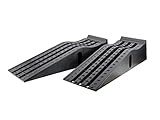
How to Choose Car Ramps By Your Vehicle and Use Case
Buying the wrong ramp comes down to three mismatches: not enough weight capacity, too steep an approach angle, and too little lift for the job. Match these five specs to your vehicle before you look at brand or price.
- Load Rating (GVW): This is Gross Vehicle Weight, not per-ramp capacity. If your sedan weighs 4,200 lbs, you need ramps rated for at least 4,200 lbs GVW as a pair. Most two-ramp sets list the combined rating. For safety margin, choose a rating 25-30% above your vehicle’s curb weight.
- Lift Height: 6.5 to 9 inches covers oil changes and basic underbody access. 10 to 12 inches gives more room for exhaust or transmission work but requires a longer ramp to keep the angle safe.
- Ramp Angle / Approach Angle: Standard ramps are 17-18 degrees. Low-profile cars with less than 5 inches of ground clearance need 10-12 degree ramps or they will scrape the front lip or bumper.
- Width: Standard passenger tires need an 8 to 12 inch wide track. Trucks, SUVs, and wide performance tires need 14 to 17 inch wide platforms to prevent the tire hanging over the edge.
- Material: Solid-core plastic is light, rust-proof, and nestable for storage. Welded steel is heavier but offers the highest capacities and a more stable feel for trucks. Hybrid foam-core with traction coating is the choice for low-angle, low-clearance applications.
Best Car Ramps Compared: Specs That Matter
These are established ramp types and models you will find in 2026, grouped by construction style. Specs are manufacturer listed and reflect per-pair GVW ratings.
| Model / Type | Material | GVW Capacity (Pair) | Lift Height | Incline Angle | Ramp Length | Width (per ramp) | Weight (pair) |
|---|---|---|---|---|---|---|---|
| RhinoGear RhinoRamps MAX (11912) | Solid-core plastic | 16,000 lbs | 8.5 inches | 17 degrees | 36 inches | 12 inches | 18 lbs |
| RhinoGear RhinoRamps (11909AB) | Solid-core plastic | 12,000 lbs | 8 inches | 17 degrees | 35 inches | 12 inches | 16 lbs |
| Race Ramps RR-56 (56″ Sport Ramp) | Solid foam core with traction coating | 6,000 lbs | 8 inches | 10.8 degrees | 56 inches | 12 inches | 13 lbs |
| Race Ramps RR-XT 2pc (XT Low-Profile) | Solid foam core with traction coating | 6,000 lbs | 10 inches | 10.8 degrees | 67 inches | 14 inches | 18 lbs |
| Nicky Nice / Blitz Steel Service Ramps | Welded steel with raised side rails | 8,000 lbs | 8 inches | 17.5 degrees | 36 inches | 11 inches | 26 lbs |
| Heavy-Duty Steel Truck Ramp (13,000 lb class) | Welded steel, extra-wide | 13,000-20,000 lbs | 9-12 inches | 16-18 degrees | 38-44 inches | 15-17 inches | 45-65 lbs |
RhinoGear models dominate for general DIY use because they balance weight, capacity, and price, typically in the $50 to $120 range for a pair. Race Ramps cost significantly more, generally $200 to $400+ per pair, but are the only safe option for cars that cannot climb a standard 17-degree slope. Heavy-duty steel ramps sit in the $80 to $200 range but weigh twice as much and can rust if stored damp.
Decision Matrix: Which Ramp Type Fits Your Situation
Use your vehicle and workspace as the filter, not just lift height.
| Your Situation | Recommended Ramp Type | Why |
|---|---|---|
| Daily driver sedan, coupe, or crossover for oil changes; standard garage; limited storage | 12,000-16,000 lb plastic ramps (e.g., RhinoRamps) | Light enough to move with one hand, nest together vertically, and wide enough for 205-255mm tires. 8-8.5″ lift is enough for a drain pan and wrench. |
| Sports car, lowered car, or EV with under 5″ ground clearance / low front splitter | Long foam-core low-profile ramps (e.g., Race Ramps RR-56 / XT) | 10.8-degree angle prevents scraping. Foam core won’t scratch floor and provides better grip on smooth concrete. Check EV curb weight – many exceed 5,000 lbs. |
| Full-size truck, SUV, or van over 5,500 lbs | Extra-wide welded steel ramps | Higher per-axle weight and wider tires need 15″+ width and heavier gauge steel. Plastic ramps at the limit will flex more under prolonged load. |
| Small garage or apartment storage; need to move ramps often | Plastic or foam-core | Foam-core and plastic pairs weigh 13-18 lbs total vs. 45+ lbs for steel. Both are easier to hang on a wall. |
| Frequent use, 2+ times per month | Plastic with built-in stops OR steel with grated surface | Repeated use wears rubber stops and traction coatings first. Choose a model with replaceable rubber feet rather than glued-on pads. |
Will It Clear? A Quick Fit Calculation
Many returns happen because the bumper hits the ramp before the tire does. You can check fit in two minutes with a tape measure.
Step 1: Measure your true ground clearance
Measure from the lowest point of the front bumper, air dam, or splitter straight down to the floor. This is your clearance, not the manufacturer’s advertised figure.
Step 2: Compare to ramp geometry
A ramp with height H and length L has an approach angle. If your bumper overhang is long, even a modest ramp will scrape. A practical test: lay a straight board 36 inches long from the tire contact patch toward the ramp. If the board hits the bumper before it reaches 8 inches high, a standard 17-degree ramp will scrape.
Step 3: Calculate required ramp length for safe clearance
For a desired lift height H and a maximum angle A your car can take, the minimum ramp length needed is: Length = H / sin(A)
Example: You want 8 inches of lift and your lowered sedan can only tolerate a 12-degree approach without scraping. Required length = 8 / sin(12°) = 8 / 0.2079 = 38.5 inches. A standard 35-inch plastic ramp is too short/steep. You need a 56-inch or longer low-profile ramp. If your car can tolerate 17 degrees, required length = 8 / sin(17°) = 8 / 0.292 = 27.4 inches, so a standard 35-36 inch ramp works with margin.
If you drive an EV with a battery pack close to the ground, also check breakover angle. Even if the nose clears, the center of the ramp transition can contact the undertray on very long-wheelbase vehicles. Longer, gentler ramps reduce this risk.
Material Tradeoffs and Ownership Realities
Ramps fail predictably at the same points. Knowing what wears helps you maintain them and avoid common mistakes.
Plastic (Polypropylene / Polyethylene)
Pros: Will not rust, impervious to oil and coolant, very light. Cons: Can slide on smooth, dusty concrete if rubber feet are worn or missing; can deform slightly if left in direct summer sun under load for hours. What wears first: the rubber anti-skid pads on the bottom and the raised wheel stop at the top. Clean with degreaser and water, and replace the bottom traction pads if they harden or peel. Never use on a slope or uneven asphalt, the feet will not grip and the pair can kick out.
Welded Steel
Pros: Highest stiffness, best for heavy trucks, integrated raised rails give visual guidance. Cons: Heavy, welds and seams rust if paint chips, narrower 11-inch versions feel tippy with wide tires. What wears first: powder coat on the tire track and weld points at the stop. Keep paint touched up, store indoors, and put a rubber mat underneath on polished floors to protect the floor and reduce slide.
Foam-Core with Coating
Pros: Extremely light for size, lowest angles available, gentle on floors. Cons: Coating can chip if dragged across concrete, lower GVW limits, more expensive. What wears first: the textured outer coating and the leading edge where tires first contact. Avoid dragging them and clean by wiping rather than pressure washing, which can force water into chips.
Common Mistakes That Cause Slips or Damage
- Mixing ramp types or heights side-to-side. Always use a matched pair on a level surface.
- Not chocking the rear wheels. Ramps prevent forward roll, not backward roll. Set the parking brake and chock both rear tires.
- Positioning ramps on an expansion joint or oil spot. The front feet need full, dry contact.
- Over-shooting the stop. Approach slowly in the lowest gear and have a spotter the first time. Plastic stops are strong but not designed for repeated impact at speed.
- Working on the car while it is only on ramps for wheel-off jobs. Ramps are for wheels-on maintenance like oil, fluid checks, and underbody inspection. For brake or suspension work, use jack stands rated for the vehicle weight on a flat concrete floor.
Final Picks by Use Case
Best for Most DIYers: RhinoGear RhinoRamps MAX
The 16,000 lb GVW rating covers almost any passenger vehicle, 8.5 inches of lift is a usable working height, and the 36-inch footprint stores easily against a wall. If you only service one family car and want the simplest, most stable general-purpose option, this category is the benchmark.
Best for Low Cars and EVs: Race Ramps RR-56 or XT Series
When ground clearance is 4 to 5 inches, the extra 20 inches of length is not a luxury – it is the difference between clearing and cracking a splitter. The XT two-piece design also allows you to remove the incline section once the car is elevated, giving better door access in tight garages.
Best for Trucks and SUVs: Extra-Wide Steel Ramps (13,000 lb+ Class)
Look for 15 inches or wider, welded side rails, and a minimum 10,000 lb per-pair rating for half-ton trucks. The weight penalty is worth it for stability under a higher center of gravity and heavier front axle load.
For most shoppers in 2026, capacity and angle matter more than lift height. Choose the ramp that your car can actually climb without contact and that rates comfortably above your vehicle’s curb weight, then pick the lightest material that meets those numbers.
FAQ
Can I use car ramps on a sloped driveway?
No. Ramps should only be used on a flat, level, hard surface – ideally concrete. Any grade increases the chance of kick-out while driving up and reduces stability while you are underneath. If your garage floor slopes toward the door, position the car perpendicular to the slope or find level ground.
Are plastic ramps strong enough for a 6,000 lb SUV?
Some are. Check the GVW per pair. A ramp rated at 12,000 lbs GVW is rated for a 12,000 lb vehicle, but you should keep a margin. For a 6,000 lb SUV, a 12,000 lb plastic set has a 2x margin and is acceptable, while a 6,000 lb-rated foam ramp would be at its limit and is not recommended.
Do I need wheel chocks with ramps?
Yes. Always chock the wheels that stay on the ground and set the parking brake. Ramps are not a substitute for chocks, and chocks are not a substitute for jack stands when wheels need to be removed.