Best Pill Cutters for Small and Round Pills
What's inside
- Top 3 Picks
- Quick Comparison
- How We Chose
- 1. Ezy Dose Pill Cutter & Splitter – Best for Everyday Standard Tablets With Built-In Storage
- 2. ONE PIX Pill Cutter Splitter for Small and Tiny Pills – Best Overall for Small and Round Tablets
- 3. DEPAD Pill Cutter Splitter for Small and Tiny Pills – Best for Adjustable Grip Across Mixed Tablet Sizes
- 4. EQUADOSE Pill Cutter – Best Premium Option for Precise Cuts on Brittle Tablets
- 5. AUVON Scissors-Shaped Pill Cutter – Best Budget Pick for Travel and Tight Storage
- 6. DUBSTAR Pill Cutter Splitter for Small and Tiny Pills – Best for Cutting Several Small Pills in One Pass
- 7. Daviky Pill Cutter Splitter for Small and Tiny Pills – Best for Safety-Conscious Households
- 8. JohnBee Pill Cutter – Best Budget Option for Households With Mixed Pill Sizes
- 9. GAONLY Pill Cutter Splitter for Small and Tiny Pills (1/2 & 1/4) – Best Premium Option for Halves and Quarters
- 10. MKTWVG Pill Cutter for Small Pills – Best for Thirds as Well as Halves and Quarters
- 11. GAONLY Pill Cutter 1/4 – Best for Quartering Small or Large Tablets in One Motion
- 12. AVIDACE 2PCS Pill Cutter – Best Budget Two-Pack for Keeping a Spare Everywhere
- How to Choose
As an Amazon Associate I earn from qualifying purchases. This post may contain affiliate links at no extra cost to you.
The best pill cutter for small and round pills is the ONE PIX Pill Cutter Splitter for Small and Tiny Pills. Its centering device traps a tiny tablet on two axes before a hidden blade descends — the exact combination that stops a round pill from rolling out of the cradle and shattering instead of slicing. It suits anyone splitting sub-10 mm tablets regularly who wants one dependable mid-range tool rather than a drawer full of cheap cutters that crush. If you would rather spend as little as possible, the AUVON Scissors-Shaped Pill Cutter takes tablets from roughly 5 mm to 15 mm at a budget-tier price and stores almost anywhere. If precision matters more than cost — quartering small tablets, for instance — the EQUADOSE Pill Cutter with its double stainless steel blade and centering device is the premium choice. The rest of this guide compares blade sharpness, grip design and cut precision across twelve currently listed cutters so you can match one to the tablets you actually take. Splitting a tablet changes how it dissolves, so confirm with a pharmacist first that yours can be divided at all.
Our Top Picks
 AUVON Scissors-Shaped Pill Cutter1 Count (Pack of 1)5.63 x 0.24 x 0.39 inches0.1 poundsCheck on Amazon
 DUBSTAR Pill Cutter Splitter for Small and TinyPill Cutter (1 Piece)4.21 x 1.85 x 1.38 inches0.2 poundsCheck on Amazon


Top 3 Picks
Best Overall: ONE PIX Pill Cutter Splitter for Small and Tiny Pills
The ONE PIX pairs a centering device with a hidden blade, so a small round tablet is held in place before the cut rather than chased around a wide cradle. That single design decision is why it handles the pills most cutters fail on — the tiny, perfectly round ones. It also accepts more than one tablet at a time, which saves handling if you split a whole week’s doses in one sitting.
Best Budget: AUVON Scissors-Shaped Pill Cutter
AUVON’s scissors design sidesteps the cradle-fit problem entirely: the tablet sits between two small jaws and the blade closes on it from the side, which works for tablets from roughly 5 mm to 15 mm. It costs a fraction of a premium cutter and folds flat enough for a purse or travel kit. The trade-off is that you control the cut with your hand rather than a fixed guide, so consistency depends on a steady squeeze.
Best Premium: EQUADOSE Pill Cutter
EQUADOSE uses two stainless steel blades arranged so the tablet is cut from both sides toward the centre, with a centering device holding it steady. The double-blade approach reduces the sideways pressure that crumbles brittle or coated tablets, and the build quality is a step above the plastic-heavy field. It is the pick for anyone splitting small tablets daily and wanting the most repeatable result the category offers.
Quick Comparison
| Product | Best for | Key specs | Price tier |
|---|---|---|---|
| Ezy Dose Pill Cutter & Splitter | Everyday standard tablets, one-handed cutting | Single stainless steel blade; halves only; one pill at a time; built-in storage compartment in handle; hinged plastic body with molded cradle | Budget |
| ONE PIX Pill Cutter Splitter | Small and tiny round tablets, batch splitting | Centering device plus hidden blade; multiple-pill capacity; small/tiny tablet focus; compact clamshell body | Mid-range |
| DEPAD Pill Cutter Splitter | Multi-pill sessions with varied tablet sizes | Adjustable holder/grip; multiple-pill splitting; small and tiny pill focus; stainless blade | Mid-range |
| EQUADOSE Pill Cutter (Blue) | Maximum cut precision on brittle or coated tablets | Double stainless steel blade cutting from both sides; centering device; V-shaped cradle; blue body | Premium |
| AUVON Scissors-Shaped Pill Cutter | Travel, tight storage, tablets roughly 5–15 mm | Scissors-style jaws; sharp stainless blade; accepts most 5–15 mm vitamins and tablets; slim folded profile | Budget |
| DUBSTAR Pill Cutter Splitter (Purple) | Cutting several small pills in one pass | Multiple-cut design; small and tiny pill focus; purple body; compact clamshell | Mid-range |
| Daviky Pill Cutter Splitter | Small and tiny pills with a safety-first design | Dual safety blades; small and tiny pill focus; enclosed blade path | Mid-range |
| JohnBee Pill Cutter (Blue) | Mixed pill sizes in one household | Handles small or large pills and vitamins; blue body; hinged cutter format | Budget |
| GAONLY Pill Cutter Splitter (1/2 & 1/4) | Halves and quarters of small tablets | Two cut options (half and quarter); small and tiny pill focus; stainless steel blade | Premium |
| MKTWVG Pill Cutter for Small Pills | Thirds and quarters where dosing calls for it | Cuts into 1/2, 1/3 and 1/4; small-pill focus; portable body | Mid-range |
| GAONLY Pill Cutter 1/4 | Quartering small or large tablets in one motion | Stainless steel blade; cuts into quarters in a single press; accepts small or large pills | Premium |
| AVIDACE 2PCS Pill Cutter | Two locations, or a spare in the bag | Two cutters per pack; standard hinged cutter format; compact | Budget |
How We Chose
This roundup is built from product listings, published manufacturer specifications and what is known about how the category behaves over time — not from hands-on trials, because nobody here has handled these specific units. The first filter was the search intent behind “best pill cutters for small and round pills”: a cutter that only works on big oval tablets fails the brief no matter how well reviewed it is, so anything whose listing describes a wide fixed cradle with no centering feature was pushed down the list. Second, we looked at blade architecture. Single-blade cutters are the norm; double-blade and scissors designs reduce the lateral force that cracks coated tablets, so those earn weight when the pill in question is round and small. Third, we weighed grip and retention: a centering device, adjustable holder or enclosed jaw all solve the same problem — stopping a 6 mm disc from skittering away — and a cutter with none of them is a poor fit regardless of price. Fourth, we checked for an upgrade path: does the model offer quarters, thirds or multi-pill capacity if the reader’s needs grow? Finally, price tier had to earn its place. Premium cutters are included where the extra spend buys a genuinely different mechanism, not just nicer plastic.
1. Ezy Dose Pill Cutter & Splitter – Best for Everyday Standard Tablets With Built-In Storage
As an Amazon Associate we earn from qualifying purchases at no extra cost to you.

Ezy Dose is one of the few pill cutter names most people already recognize from the pharmacy shelf, and this is its classic cradle-style tool: a hinged lid carrying a single stainless steel blade that descends into a molded recess sized for mainstream tablets. It suits the reader who takes one ordinary round or oval tablet a day, wants the cut done in a single motion, and would rather not keep a separate pill organiser on the counter — the handle doubles as a small storage compartment, which is the feature that has kept this model in circulation for years. If your tablets are genuinely tiny, though, this is not the tool designed for them: the recess is proportioned for standard tablet diameters, so a small round pill can slide sideways in it and take a glancing hit from the blade.
- Blade: single stainless steel blade, straight edge
- Cut options: halves only
- Capacity: one tablet per cut
- Storage: built-in compartment in the handle
- Body: hinged plastic with a molded pill cradle
- Finish: colour varies by pack
- Price tier: budget
The strengths here are familiarity and simplicity. There is nothing to adjust, nothing to assemble and nothing to lose — the blade is enclosed when the lid is shut, so it travels reasonably well in a bag, and the storage compartment means the pills you are cutting and the tool that cuts them live in the same place. For a standard 10 mm round tablet, the molded cradle does its job: the pill sits flat, the lid closes, and the blade meets it close to the centre line. The one-motion action also matters more than it sounds, because the longer a tablet sits in a cutter while you fiddle with alignment, the more likely it is to shift. Ezy Dose keeps that window short.
Where it falls short is the specific problem this article is about. The cradle is a fixed size, and a fixed cradle is only precise for the pill size it was molded around. Small round tablets — the 5 mm to 7 mm range — have room to move, and movement at the moment of the cut is what produces the classic crumbled edge or the off-centre split. The single blade also pushes through from one side, which imparts a small lateral force; on a chalky or film-coated tablet that has already been weakened by an uneven seating, that is enough to shear a corner off.
Pros
- Widely recognized brand with a long track record in the category
- One-motion cutting with no adjustment or setup
- Built-in storage compartment keeps pills and cutter together
- Enclosed blade when closed, so it is safer to carry
- Budget-tier pricing makes it an easy first cutter
Cons
- Fixed cradle is not shaped for very small or very round tablets
- Halves only — no quarters or thirds
- Single-blade action puts more lateral stress on brittle tablets
- Colour varies by pack, which matters if you are matching a set
- No centering device or adjustable grip
Compared with the ONE PIX, the difference is entirely in pill retention. The ONE PIX adds a centering device and a hidden blade specifically so a small tablet cannot drift, which is the upgrade you want the moment your pills drop below about 8 mm. Compared with the AUVON scissors cutter, the Ezy Dose wins on convenience — one press versus a controlled squeeze — but loses on small-pill adaptability, because the scissors jaws close on whatever sits between them rather than requiring the tablet to fit a molded recess. If your tablets are standard size, the Ezy Dose is the simpler tool. If they are small, it is the wrong shape.
2. ONE PIX Pill Cutter Splitter for Small and Tiny Pills – Best Overall for Small and Round Tablets

The ONE PIX is the pick that actually answers the question in the title. Its listing describes a multiple pill splitter built around a centering device and a hidden blade, and those two features work together: the centering device physically guides a small tablet into the cut line before the blade moves, and the hidden blade means the cutting edge is not exposed until the mechanism is engaged, so there is no chance of the pill being nudged out of position while you line things up. It suits the reader splitting small or tiny tablets — the ones that skitter across a countertop — several times a week, and it suits anyone who prefers to prepare a batch of doses in one sitting rather than cutting one pill at a time.
- Blade: hidden blade within the cutting mechanism
- Grip design: centering device that aligns small and tiny tablets
- Capacity: designed for splitting multiple pills
- Pill focus: small and tiny tablets rather than large caplets
- Body: compact clamshell format
- Price tier: mid-range
The centering device is the whole argument for this cutter. On a round tablet, the failure mode is almost never a dull blade — it is the tablet rolling a fraction of a millimetre as the blade lands, so the cut runs off the diameter line and clips an edge. A centering device removes that degree of freedom by holding the pill against a shaped seat. Combined with a blade that travels on a fixed path rather than a free hinge, the result is a cut that lands in roughly the same place every time. That consistency is what makes a split dose predictable, and predictability is the entire point of owning a cutter instead of using a kitchen knife.
Multiple-pill capacity is the second useful feature, and it is easy to underestimate. If you split a week’s worth of doses on a Sunday evening, a single-pill cutter means seven separate alignment steps, and each one is a chance to seat the tablet badly. A cutter that accepts several pills in a row turns that into one pass. It is not a feature that shows up in a spec table as a number, but it changes how the tool fits into a routine, and it is one reason this model sits in the mid-range rather than the budget band.
Pros
- Centering device specifically addresses the rolling-small-pill problem
- Hidden blade reduces the risk of nicking a finger during loading
- Multiple-pill capacity speeds up batch preparation
- Purpose-built for small and tiny tablets rather than adapted from a standard design
- Compact enough for a travel kit
Cons
- Mid-range price for a device that still only halves tablets
- Small-pill focus means very large caplets may not seat well
- Centering seats can collect tablet dust and need periodic cleaning
- More parts to lose or misplace than a simple hinged cutter
The nearest alternative in this list is the DEPAD, which takes the same small-and-tiny-pill brief but approaches it with an adjustable holder rather than a fixed centering device. Adjustability is better if you split several different tablet sizes in the same week, because you can move the grip to match; a fixed centering device is better if you split one tablet size consistently, because there is nothing to readjust and nothing to drift out of calibration. Against the premium EQUADOSE, the ONE PIX gives up the double-blade mechanism, which is the feature that most reduces crumbling on coated tablets — but it costs less and handles the alignment problem just as directly.
3. DEPAD Pill Cutter Splitter for Small and Tiny Pills – Best for Adjustable Grip Across Mixed Tablet Sizes

The DEPAD is aimed at the same reader as the ONE PIX — someone cutting small and tiny tablets — but it solves the retention problem with an adjustable holder instead of a fixed centering seat. That makes it the better fit for households where more than one person takes tablets of different diameters, or where a single person takes two medications that are not the same size. Its listing also describes splitting multiple pills, so it works for batch preparation as well as single cuts. If you have ever seated a tablet in a cutter and felt it wobble because the recess was a size too big, the adjustable grip is the answer to that specific annoyance.
- Blade: stainless steel cutting blade
- Grip design: adjustable holder that adapts to the tablet in front of it
- Capacity: multiple pill splitting
- Pill focus: small and tiny tablets
- Adjustment: user-set grip rather than a fixed molded cradle
- Price tier: mid-range
Adjustability earns its keep in a way that is easy to describe but hard to appreciate until you own it. A fixed cradle is precise for exactly one tablet diameter and approximate for everything else. An adjustable holder lets you narrow the gap until the pill is held on both sides, which means the same tool works whether you are cutting a 6 mm round tablet or a 9 mm one. The trade-off is a setup step: you set the grip, then you cut, and if you switch pill sizes mid-session you set it again. For anyone who sorts doses weekly, that is a fair exchange, because the alternative is owning two or three cutters for two or three pill sizes.
The multiple-pill capability reinforces the same routine advantage. Loading several tablets and cutting them in sequence is faster than the load-cut-clear cycle of a single-pill tool, and it reduces the number of times your fingers are near the blade. The stainless steel blade, meanwhile, is the standard choice for the category for good reason: it holds an edge far longer than a coated or plastic edge would, and it can be wiped clean without rusting provided it is dried immediately.
Pros
- Adjustable holder adapts to different small tablet diameters
- Handles multiple pills in one session
- Stainless steel blade resists corrosion and holds an edge
- Good fit for multi-medication households
- Reduces the off-centre cuts caused by a loose cradle
Cons
- Requires a setup step before each size change
- Adjustment mechanism can loosen over time with heavy use
- Halves only, like most cutters in this tier
- More moving parts means more places for tablet dust to accumulate
Against the ONE PIX, the DEPAD trades a fixed centering device for an adjustable one — more flexible, slightly less repeatable if you never change pill size. Against the DUBSTAR, which also targets multiple small-pill cutting, the DEPAD’s distinguishing feature is that adjustable grip; the DUBSTAR leans on its multiple-cut format and a distinctive purple body, which is a cosmetic difference but a real one if you keep several cutters in a drawer and want to tell them apart at a glance. Against the Daviky, the DEPAD gives up the dual safety blade arrangement in exchange for the ability to fit a wider range of tablet sizes.
4. EQUADOSE Pill Cutter – Best Premium Option for Precise Cuts on Brittle Tablets

The EQUADOSE Pill Cutter is the premium pick, and the reason is mechanical rather than cosmetic. Its listing describes a double stainless steel blade working with a centering device: instead of one blade pressing through from a single side, two blades converge on the tablet from opposite directions, meeting near the middle. That arrangement halves the lateral force each blade applies, which is precisely the force that cracks the coating on a round tablet and leaves you with crumbs instead of two clean halves. It suits the reader who splits small tablets daily, who has already ruined pills with cheaper cutters, and who would rather pay once for the most repeatable result the category offers.
- Blade: double stainless steel blade, cutting from two sides
- Grip design: centering device holding the tablet on the cut line
- Cradle: V-shaped seat that cradles round tablets
- Cut options: halves
- Body: blue housing
- Price tier: premium
The physics behind the double blade is worth spelling out, because it explains why the extra cost is not simply branding. When a single blade descends on a tablet, the tablet has to resist a downward force plus whatever sideways component the blade geometry introduces. A round tablet seated in a shallow cradle has very little to push back against, so it rotates slightly, and the blade exits through the side of the pill rather than the diameter. Two blades meeting in the middle apply opposing forces that cancel, so the tablet experiences far less tendency to rotate. Combine that with a V-shaped cradle — which contacts a round tablet on two lines rather than one flat surface — and you get the closest thing in this category to a guided cut.
The centering device adds a second layer of control. Even with opposing blades, a tablet that starts off-axis will finish off-axis. By pushing the pill onto the centre line before the cut, the device removes the placement error that accounts for most uneven splits. The practical result is that a 10 mg tablet divided with this cutter tends to produce two pieces closer to 5 mg each than a single-blade tool typically manages — which matters if you are splitting doses for a reason rather than out of habit.
Pros
- Double blade reduces the lateral force that crumbles coated tablets
- Centering device improves placement consistency
- V-shaped cradle holds round tablets better than a flat recess
- Stainless steel blades resist corrosion and keep an edge
- Build quality is a clear step above budget-tier plastic cutters
Cons
- Premium price for a device that still only halves tablets
- Two blades mean two edges to keep clean and dry
- Bulkier than a scissors-style cutter, so less purse-friendly
- Overkill if your tablets are large and easy to split
Against the ONE PIX, the EQUADOSE is the upgrade you buy when alignment is already solved and the remaining problem is crumbling — the double blade is the feature the ONE PIX does not have. Against the GAONLY quarter cutter, the comparison is about what you need: EQUADOSE does halves with exceptional control, while the GAONLY models extend into quarters and thirds. If your prescription calls for a quarter tablet, no amount of blade quality in a halving cutter will help you, and that is the one situation where the premium spend should go elsewhere in this list.
5. AUVON Scissors-Shaped Pill Cutter – Best Budget Pick for Travel and Tight Storage

The AUVON Scissors-Shaped Pill Cutter does away with the cradle entirely. Its listing describes a scissors-format splitter with a sharp blade, intended for dividing most vitamins and tablets in the 5 mm to 15 mm range. Instead of seating a pill in a molded recess, you place it between two small jaws and squeeze; the blade closes on the tablet from the side. That makes it the most adaptable budget option here, because it does not care what diameter the tablet is — only whether it fits between the jaws. It suits travellers, anyone with limited drawer or counter space, and anyone who wants a spare cutter that lives in a bag without taking up room.
- Blade: sharp stainless steel blade in a scissors action
- Format: scissors-shaped handles with closing jaws
- Pill range: listed for most 5–15 mm vitamins and tablets
- Cut options: halves
- Storage: slim folded profile
- Price tier: budget
The scissors format has one genuine advantage over every cradle cutter in this list: it does not need the pill to match a size. A 5 mm tablet and a 14 mm tablet both sit between the same jaws, so a single tool covers a range that would otherwise need two or three cradles. The 5–15 mm range in the listing is a real, useful span — it covers the overwhelming majority of round tablets, including the small ones that frustrate fixed-recess designs. It also packs flat, which is why it makes a good second cutter even if it is not your primary one.
The trade-off is control. With a cradle cutter, the blade path is fixed and the only variable is how well the pill is seated. With scissors, the blade path depends on how you squeeze: angle the jaws slightly and the cut runs off-centre, squeeze too fast and a brittle tablet shears. That is not a defect, it is the nature of the format, and it means the AUVON rewards a slow, deliberate squeeze. For tablets that split easily, that is a non-issue. For chalky or coated tablets, expect to practice before you get consistent halves.
Pros
- Covers a wide pill range — listed at roughly 5–15 mm — with one tool
- Very compact and travel-friendly
- Budget-tier price makes it an easy spare or starter cutter
- No cradle to match against your tablet size
- Simple mechanism with few parts to fail
Cons
- Cut consistency depends on the user’s hand, not a fixed guide
- No centering device, so small round tablets can shift between the jaws
- Halves only
- Blade is exposed during use, so it demands more care around children
- Not ideal for very brittle or coated tablets
Compared with the Ezy Dose, the AUVON is the more flexible tool for small pills and the less consistent one for standard pills — a direct consequence of choosing adaptability over a fixed guide. Compared with the JohnBee, which also sits in the budget tier but is listed for small or large pills and vitamins, the AUVON is the more portable of the two and the JohnBee is the more conventional hinged format. If you want one cheap cutter that works on almost anything and fits in a pocket, the AUVON is the pick. If you want a cutter that stays on the bathroom shelf and handles whatever the household takes, the JohnBee is the more familiar shape.
6. DUBSTAR Pill Cutter Splitter for Small and Tiny Pills – Best for Cutting Several Small Pills in One Pass

The DUBSTAR is built around multiple cuts of small and tiny pills, and it comes in a purple body that makes it easy to identify in a drawer full of similar tools. It suits the reader who prepares doses in batches — someone who sits down once a week with a pill organiser and a bottle of small tablets, and who wants the cutting done quickly without seven separate alignment routines. It is also a reasonable choice for a household that keeps more than one cutter, since the colour coding removes the guesswork about which tool is for which pills.
- Blade: stainless steel cutting blade
- Format: compact clamshell cutter
- Capacity: designed for cutting multiple pills
- Pill focus: small and tiny tablets
- Finish: purple body
- Price tier: mid-range
Batch capacity is the feature worth paying attention to, and it is a workflow feature rather than a hardware one. Cutting one tablet at a time means a full cycle — open, seat, close, cut, retrieve, repeat — for every pill. Over a week’s worth of twice-daily doses that is fourteen cycles, and every one of them is a chance to seat a tablet badly. A multiple-pill cutter collapses those into a single session with fewer handling steps. The DUBSTAR is listed for small and tiny pills specifically, which means its seating geometry is proportioned for the tablets that most need help, rather than being a standard cutter with a marketing label attached.
On cut quality, the DUBSTAR sits in the same broad class as the other mid-range cradle cutters here: a single stainless blade descending into a shaped seat. That produces clean halves when the tablet is seated properly and a crumbled edge when it is not, which is why the seating geometry matters more than the blade material at this price point. Stainless steel is the right choice — it holds an edge and resists rust — but the difference between a good cutter and a frustrating one is almost always whether the pill stays still.
Pros
- Multiple-pill capacity suits weekly dose preparation
- Purpose-built for small and tiny tablets
- Stainless steel blade resists corrosion
- Distinctive purple body makes it easy to find and identify
- Compact enough to store alongside a pill organiser
Cons
- Halves only, with no quarter or third option
- No adjustable grip for households with several pill sizes
- Mid-range price for a single-blade mechanism
- Small-pill focus means large caplets may not seat correctly
Against the DEPAD, the DUBSTAR gives up the adjustable holder and keeps the batch capacity; the DEPAD is the better tool if the pills in your drawer are not all the same size, and the DUBSTAR is the simpler tool if they are. Against the ONE PIX, the difference is in how alignment is handled — the ONE PIX uses a centering device and a hidden blade, while the DUBSTAR relies on its seating geometry alone. Both are mid-range and both target tiny pills; the ONE PIX is the more engineered answer, and the DUBSTAR is the more straightforward one, distinguished mainly by colour and by how much you value the hidden-blade feature.
7. Daviky Pill Cutter Splitter for Small and Tiny Pills – Best for Safety-Conscious Households

The Daviky Pill Cutter Splitter is listed with dual safety blades and a focus on small and tiny pills, which puts it in the same brief as the ONE PIX and DEPAD but with a different emphasis: the blade arrangement is presented as the safety feature. It suits households with children or pets where a loose blade is a genuine concern, and it suits anyone who has nicked a finger loading a tablet into an open-blade cutter. The dual-blade description also suggests a two-sided cutting action, which is the same mechanical idea the premium EQUADOSE uses to reduce crumbling.
- Blade: dual safety blades
- Format: compact clamshell cutter
- Pill focus: small and tiny tablets
- Cut options: halves
- Safety design: blades enclosed within the cutting path
- Price tier: mid-range
Two blades instead of one changes the force profile of the cut. A single blade pressing into a round tablet from one side creates a small sideways component that encourages the pill to rotate, and rotation is how off-centre cuts happen. Blades approaching from two sides apply forces that largely cancel, so the tablet is less inclined to move and the cut is more likely to run along the intended line. On small round tablets, where the margin for error is a millimetre or two, that difference is visible in the finished halves.
The safety framing is not just marketing either. Any cutter that requires you to seat a tablet near an exposed edge carries a small risk, and the risk is higher when the tablets are tiny, because tiny tablets mean small fingers or tweezers close to the blade. A design where the blades stay inside the mechanism during loading removes that exposure. If you have ever hesitated before pressing a tablet into place, that is the problem this design solves.
Pros
- Dual blade arrangement reduces the lateral force that cracks tablets
- Safety-oriented design keeps blades enclosed during loading
- Purpose-built for small and tiny pills
- Compact, mid-range format that stores easily
- Good fit for households with children or pets
Cons
- Halves only — no quarters or thirds
- Two blades mean two edges to keep clean and dry
- No adjustable grip for mixed tablet sizes
- Mid-range price for a device with a single cut option
The closest alternative is the EQUADOSE, which also uses a double-blade approach but pairs it with a centering device and a V-shaped cradle and sits a tier higher on price. If the dual blade is what you want and budget is the constraint, the Daviky delivers the same core mechanical idea for less. Against the DUBSTAR, the Daviky trades batch capacity and a distinctive colour for the safety-blade design; if you cut one pill at a time and care about blade exposure, the Daviky is the better match, and if you cut a week’s worth in one sitting, the DUBSTAR is.
8. JohnBee Pill Cutter – Best Budget Option for Households With Mixed Pill Sizes
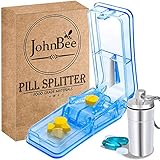
The JohnBee Pill Cutter is listed for small or large pills and for cutting vitamins, which makes it the generalist of this group. It suits a household where several people take different tablets and nobody wants to maintain a shelf of specialised tools — one cutter, in a familiar hinged format, that will handle a standard round tablet, an oval caplet and a vitamin softgel-adjacent tablet without complaint. It sits in the budget tier, so it is also the natural choice if you want a cutter in two rooms or a spare for a travel bag without spending mid-range money twice.
- Blade: stainless steel cutting blade
- Format: hinged cutter with a shaped cradle
- Pill range: listed for small or large pills and vitamins
- Cut options: halves
- Finish: blue body
- Price tier: budget
Versatility is the pitch, and it is a legitimate one at this price. A cutter sized for large pills tends to leave small pills loose in the cradle; a cutter sized for small pills can be too tight for a large caplet. A tool described as handling both is making a compromise in each direction, but for a household where no single pill size dominates, a workable compromise beats three specialist tools. The blue body is a small thing, but in a drawer with four similar cutters, colour is how you find the right one without opening each in turn.
The limitations are the same ones that apply to every fixed-cradle budget cutter. Small round tablets — the 5 mm to 7 mm class — will have room to move in a cradle that also has to accept large pills, and movement at the moment of the cut produces uneven halves. The single blade compounds this slightly by pushing from one side. Neither issue is fatal, and both can be managed by seating the tablet carefully and cutting slowly, but neither is solved by the design.
Pros
- Listed to handle both small and large pills, plus vitamins
- Budget-tier price makes a second unit affordable
- Conventional hinged format that needs no learning curve
- Stainless steel blade holds an edge
- Blue body is easy to identify in a drawer
Cons
- Compromise cradle is not ideal for very small round tablets
- Single-blade action puts more stress on brittle coatings
- Halves only
- No centering device or adjustable grip
- Less precise on tiny pills than purpose-built small-pill cutters
Against the AUVON scissors cutter, the JohnBee is the more conventional tool and the AUVON is the more adaptable one — the scissors jaws genuinely do not care about pill diameter, while the JohnBee’s cradle has to be a compromise. Against the Ezy Dose, the two are close competitors in the budget tier: the Ezy Dose brings a storage compartment, and the JohnBee brings a wider stated pill range. If you want a single cheap cutter that will not be defeated by a large vitamin, the JohnBee is the safer budget buy. If small round tablets are your main concern, neither budget option is the right tool, and the money is better spent on a centering-device model.
9. GAONLY Pill Cutter Splitter for Small and Tiny Pills (1/2 & 1/4) – Best Premium Option for Halves and Quarters

This GAONLY cutter is listed for small and tiny pills with both half and quarter cut options, which puts it in a small group of tools that can do more than halve a tablet. It suits the reader whose dose does not map neatly onto a whole pill — someone prescribed a quarter tablet, or someone whose titration schedule moves between halves and quarters. It is a premium-tier tool, and the extra spend buys the second cut option plus a stainless steel blade, not a fancier shell.
- Blade: stainless steel
- Cut options: halves and quarters
- Pill focus: small and tiny tablets
- Format: compact cutter with a guided cutting path
- Price tier: premium
Quartering is harder than halving, and it is worth understanding why before you decide whether you need it. A half cut has one alignment problem: get the tablet on the centre line and the blade does the rest. A quarter cut has two — the first cut has to be accurate, and the second cut has to be made perpendicular to the first, on a piece that is now half the size and much less stable. Errors compound: a tablet cut 60/40 and then quartered can produce pieces that differ from each other by a third. A cutter designed for quarters solves the perpendicularity problem with a fixed second cutting position, which is what this model provides.
Because the tool is listed for small and tiny pills, the seating geometry is proportioned for tablets that would otherwise rattle in a standard cradle. That matters more for quartering than halving, because the second cut is made on a fragment rather than a whole tablet, and a fragment has even less surface area to grip. A cutter that holds a whole 6 mm tablet adequately may still lose a half-tablet fragment at the moment of the second cut.
Pros
- Both half and quarter cuts from one tool
- Purpose-built for small and tiny tablets
- Stainless steel blade resists corrosion and holds an edge
- Fixed cutting positions improve quarter-cut repeatability
- Premium build for readers who cut daily
Cons
- Premium price for a tool that still cannot do thirds
- Quartering a small tablet demands care regardless of the tool
- More seating surfaces to keep clean
- Overkill if you only ever need halves
The obvious alternative is the GAONLY 1/4 cutter, which specialises in quarters and is listed for both small and large pills in a single fourth cut. The distinction is workflow: this model gives you halves and quarters in one tool, while the 1/4 model is built around producing quarters in one motion. If your dose alternates between a half and a quarter, the two-option model saves you from owning two cutters. If your dose is always a quarter, the dedicated model is the more direct answer. Against the MKTWVG, the comparison is cut options: GAONLY offers halves and quarters, MKTWVG adds thirds.
10. MKTWVG Pill Cutter for Small Pills – Best for Thirds as Well as Halves and Quarters

The MKTWVG Pill Cutter is unusual in this list because its listing claims precise cuts into halves, thirds and quarters, all from one portable tool. Thirds are rare in pill cutters, and they matter for a specific reason: some dosing schedules divide a tablet into three rather than two or four, and there is no way to produce a clean third with a halving cutter and a steady hand. It suits the reader whose dose is expressed in thirds, and it also suits anyone who wants one portable cutter that covers every common fraction rather than three separate tools.
- Blade: stainless steel cutting blade
- Cut options: halves, thirds and quarters
- Pill focus: small pills
- Portability: compact, travel-friendly body
- Price tier: mid-range
Thirding is genuinely difficult, and the difficulty is geometric rather than mechanical. A round tablet divided into thirds requires two cut lines that intersect the centre at 120-degree intervals; get the angle wrong and you produce pieces of visibly different sizes. A cutter that offers thirds does so by providing indexed cutting positions, which removes the guesswork about where the second cut goes. Whether you need it depends entirely on your prescription — but if you do, this is one of very few tools in the category that will help, and no amount of blade quality in a halving cutter is a substitute.
The portability angle is worth noting because it is often the deciding factor in practice. A cutter that lives in a bag gets used; a cutter that stays in a bathroom drawer gets used when you remember. A mid-range tool with three cut options and a compact body is a reasonable compromise for someone who travels frequently and does not want to pack two devices. The stainless steel blade is the standard choice and the right one for a tool that will be exposed to moisture in a wash bag.
Pros
- Rare thirds option alongside halves and quarters
- One tool covers every common tablet fraction
- Portable enough for a travel kit or handbag
- Stainless steel blade holds an edge and resists rust
- Mid-range price for three cut options
Cons
- Small-pill focus means large tablets may not seat well
- Multiple cut positions mean more surfaces to align and clean
- Third cuts still require the tablet to seat perfectly
- More mechanism than a simple halving cutter, so more to go wrong
Against the GAONLY two-option cutter, the MKTWVG wins on cut variety and loses on premium build — GAONLY offers halves and quarters with a higher-tier finish, while MKTWVG adds thirds at a mid-range price. Against the GAONLY 1/4 model, the comparison is narrow versus broad: the 1/4 model does one thing in a single press, and the MKTWVG does three things with more steps. If thirds are not part of your dosing, the extra positions are complexity you will never use, and a simpler tool is the better purchase.
11. GAONLY Pill Cutter 1/4 – Best for Quartering Small or Large Tablets in One Motion

This GAONLY model is built around a single purpose: cutting a tablet into quarters in one motion, with a stainless steel blade, and it is listed for both small and large pills. It suits the reader whose dose is consistently a quarter tablet and who would rather make one press than cut twice and hope the second line is perpendicular. The one-motion quarter is the whole value proposition — it removes the compounding-error problem that makes two-step quartering unreliable, especially on small tablets.
- Blade: stainless steel
- Cut options: quarters in one motion
- Pill range: listed for small or large pills
- Format: single-press quartering cutter
- Price tier: premium
The arithmetic of two-step quartering explains why one-motion quartering is worth a premium. Suppose your first cut is off by a millimetre and produces a 55/45 split. Your second cut divides each half again, and if it is also slightly off-centre, the largest piece can end up around 30 percent of the tablet and the smallest around 20. That is a spread of half again between the biggest and smallest quarter — a real difference if you are quartering to manage a dose. A single-press quartering mechanism eliminates the second alignment step entirely, so the only error left is the seating error on the whole tablet.
Being listed for both small and large pills means the cradle has to accommodate a range, which is a compromise on both ends, but the one-motion action offsets it somewhat: fewer steps means fewer opportunities for a small tablet to shift between cuts. The stainless steel blade is the right material for a tool that will be used regularly, and it can be wiped dry after each session to keep the edge clean of tablet dust, which is the single most common cause of a cutter that seems to have gone blunt.
Pros
- Quarters a tablet in one press, removing the second alignment step
- Listed for small and large pills, so it covers a wider size range
- Stainless steel blade resists corrosion
- Reduces the compounding error that plagues two-step quartering
- Good fit for a consistent quarter-tablet dose
Cons
- Premium price for a tool with a single cut option
- No halves setting, so it is not a general-purpose cutter
- Compromise cradle for the extremes of small and large pills
- Quartering remains the least forgiving cut in the category
Against the GAONLY two-option cutter, this is the specialist and that is the generalist: if you always quarter, the one-motion model is faster and less error-prone, and if you sometimes halve, the two-option model is the better single purchase. Against the MKTWVG, the GAONLY 1/4 does one fraction with a premium mechanism, while the MKTWVG does three fractions at a mid-range price with more steps. Buy the GAONLY if quarters are your dose; buy the MKTWVG if you need thirds as well.
12. AVIDACE 2PCS Pill Cutter – Best Budget Two-Pack for Keeping a Spare Everywhere

The AVIDACE 2PCS Pill Cutter is exactly what the name describes: two compact cutters in a single budget-tier pack. It suits the reader who wants a cutter at home and a cutter in a bag, a car or a second bathroom, without buying the same product twice at full price. It also suits anyone setting up a care routine for someone else — a second cutter for a parent’s house costs nothing extra here. As a straightforward hinged cutter in the conventional format, it asks nothing of the user in terms of learning.
- Blade: stainless steel cutting blade
- Quantity: two cutters per pack
- Format: standard hinged cutter with shaped cradle
- Cut options: halves
- Size: compact
- Price tier: budget
The value argument is simple and does not need dressing up. Two budget cutters cost less than one mid-range cutter in most cases, and for a household that needs a tool in two places, that is the more sensible allocation of money than buying a single better cutter that lives in one drawer. The conventional hinged design is also the most forgiving for a first-time user: open, seat, close, done, with no adjustment or alignment step to learn.
The honest limitation is that this is a general-purpose cutter, not a small-and-tiny-pill specialist. Its cradle is sized for mainstream tablets, so the small round tablets that prompted this article will have some play in the seat, and the single blade applies the usual one-sided force. It is a perfectly serviceable tool for standard tablets and a compromise for 6 mm round ones. If your pills are genuinely tiny, the two-pack is better thought of as the spare that lives in the car rather than the primary tool on the counter.
Pros
- Two cutters for a budget-tier price
- Conventional format with no learning curve
- Compact enough to keep in a bag or drawer
- Stainless steel blades
- Practical for households needing a cutter in two locations
Cons
- Not designed for very small or very round tablets
- Halves only
- No centering device or adjustable grip
- Fixed cradle will not suit every pill size
- Single-blade action is harder on brittle coatings
Against the JohnBee, the AVIDACE is the quantity play rather than the range play: JohnBee is listed for small or large pills and vitamins, while AVIDACE simply gives you two standard cutters. Against the Ezy Dose, the AVIDACE gives up the built-in storage compartment in exchange for a second unit. Neither is the right primary tool for tiny pills — for that, the ONE PIX or the DEPAD is the purchase — but as the backup cutter that means you never skip a dose because the tool is in the wrong room, a two-pack is genuinely useful.
How to Choose
Choosing a cutter for small and round pills comes down to four things: how small the tablet is, whether the cut is a half or a smaller fraction, how brittle the tablet’s coating is, and how often you do it. Everything else — colour, brand, whether the blade is described as surgical — is secondary. The criteria below are ordered by how much they actually change the result.
Start with the tablet’s diameter, not its weight
Dose strength tells you nothing about whether a cutter will grip. Diameter and shape do. A 5 mg tablet and a 50 mg tablet can be the same physical size, and a round tablet is harder to hold than an oval one of identical width because it has no flat edge to register against. Measure across the tablet, or compare it to a ruler mark, and use that number as your primary filter.
| Tablet diameter | Shape behaviour in a cutter | What to look for | Poor fit |
|---|---|---|---|
| Under 5 mm | Extremely prone to rolling and to being lost in a cradle | Centering device or adjustable grip; enclosed jaw | Any fixed wide cradle |
| 5–7 mm | Rolls easily; off-centre cuts are common | Centering device, adjustable holder or scissors jaws | Fixed cradle sized for 10 mm tablets |
| 7–10 mm | Manageable in most cutters if seated carefully | Shaped cradle plus a sharp single blade is usually enough | Very tight cradle that pinches the coating |
| 10–14 mm | Seats well; the risk shifts to blade pressure | Double blade or scissors format to reduce cracking | Undersized cradle that leaves the tablet proud |
| Over 14 mm | Needs a wide cradle and a long blade stroke | Large-pill cradle; check the cut completes in one press | Small-pill specialists with narrow jaws |
Decide whether you need halves, thirds or quarters
This is the criterion most people get wrong, because it is easy to assume a halving cutter will do. It will not. A quarter requires either two cuts or a mechanism with a fixed second position, and a third requires indexed positions at 120 degrees. If your dose is a quarter, buy a quarter-capable tool; there is no technique that turns a halving cutter into a reliable quartering one. If your dose is a half, resist paying for extra cut positions you will never use — the money is better spent on a better seating mechanism.
Understand what makes a blade cut rather than crush
A cutter does not slice like a knife. It applies a line of pressure, and the tablet fails along that line. That means sharpness matters less than you would think, and force direction matters more. A blade that is even slightly dull increases the pressure needed, and increased pressure on a brittle tablet is what produces crumbs. A blade that approaches from one side also introduces a sideways component that rotates the tablet. Two practical consequences follow: replace or clean the blade when cuts start crumbling, and prefer a two-sided or enclosed-jaw design if your tablets are coated or chalky.
Think about seating before you think about materials
Stainless steel is the correct blade material for this category — it holds an edge and does not rust when dried promptly. Almost every serious cutter uses it, so it is not a useful differentiator. What differs is the seat: a molded fixed cradle, a V-shaped cradle, an adjustable holder, a centering device, or scissors jaws. A V-shaped cradle contacts a round tablet on two lines instead of one flat face and is noticeably better at stopping rotation. An adjustable holder adapts to several tablet sizes. A centering device pushes the tablet onto the cut line before the blade moves. Scissors jaws grip whatever diameter you insert. Rank these by how much your tablets roll, not by how they sound in a listing.
Match the tool to how often you cut
Frequency changes the economics more than it changes the mechanism. Someone cutting one tablet occasionally can use a budget cutter and accept an occasional imperfect half. Someone cutting twice a day, every day, is making around 730 cuts a year, and at that volume the small advantages of a centering device or a double blade stop being luxuries. Run the numbers on a general market range: a cutter costing somewhere in the low teens, used twice daily for two years, works out to well under two cents per cut. A premium cutter at two to three times that price works out to a few cents per cut over the same period. The difference in absolute terms is small, which is the argument for buying the tool that produces a reliable half rather than the cheapest one that produces a usable half.
Check the accuracy math for your own dose
Uneven splits matter in proportion to the size of the error. Take a 10 mg tablet cut into pieces of roughly 6 mg and 4 mg — a 20 percent deviation from an even split. If your dose is 5 mg, you are getting 6 mg on one day and 4 mg on the next, alternating. Over a week that averages out, but on any given day it does not. This is why centering and seating matter: they