Best Professional Trinocular Compound Microscopes for Research
What's inside
- Top 3 Picks
- Quick Comparison
- How We Chose
- 1. Swift SW380T – Best for Most Research and Teaching Labs
- 2. Woehrsh Trinocular Microscope – Best for Camera-Integrated Digital Workflows
- 3. SWIFT SW350T – Best Budget Trinocular for Students and Start-ups
- 4. VEVOR Trinocular Compound Microscope – Best Budget High-Magnification Option
- 5. Poothoh Trinocular Microscope – Best Budget Scope With a USB Camera Included
- 6. PalliPartners 40x-2000x Biological Compound Trinocular Microscope – Best for Routine Brightfield Biology
- 7. AmScope T490B Compound Trinocular Microscope – Best Premium Platform for Oil-Immersion Work
- 8. OMAX M837L 1000X Trinocular Biological Compound Microscope – Best Premium Teaching-Lab Workhorse
- How to Choose
As an Amazon Associate I earn from qualifying purchases. This post may contain affiliate links at no extra cost to you.
Direct answer: for most research and teaching labs buying in 2026, the Swift SW380T is the best professional trinocular compound microscope for research overall. It combines a 40X–2500X magnification range, a Siedentopf trinocular head, a proper mechanical stage and a camera port that accepts standard C-mount adapters, at a mid-range price that leaves budget for a camera and a spare objective. If your funding is tighter, the SWIFT SW350T gives you the same Siedentopf trinocular architecture and a two-layer mechanical stage for less. If your work is oil-immersion brightfield and you want the deepest accessory ecosystem and the most documented upgrade path, the AmScope T490B is the premium choice. The rest of this guide explains exactly how magnification claims, objective classes, illumination and stage precision differ across these eight models, so you can match a scope to your specimens rather than to a number on a box.
Our Top Picks
 VEVOR Trinocular Compound Microscope8.66 x 5.51 x 14.17 in8.66 x 5.51 x 14.17 inches7.23 PoundsCheck on Amazon


Top 3 Picks
Best overall: Swift SW380T. The SW380T is the most balanced trinocular in this group: 40X–2500X magnification, a Siedentopf head that keeps both eyepieces at a fixed angle while you adjust interpupillary distance, and a trinocular port that is genuinely usable for imaging rather than an afterthought. It suits a working lab that needs one instrument to do both visual observation and documentation.
Best budget: SWIFT SW350T. The SW350T keeps the Siedentopf trinocular design and the two-layer mechanical stage but trims cost elsewhere. For students, start-up labs and anyone whose specimens are stained smears and prepared slides at 40X–1000X, it removes very little that matters.
Best premium: AmScope T490B. The T490B is the most established platform here for oil-immersion brightfield work, with a four-objective nosepiece that includes a 100X oil objective and a condenser designed to feed it properly. It is the pick when image quality at the top of the magnification range is the deciding factor.
Quick Comparison
| Product | Best for | Key specs | Price tier |
|---|---|---|---|
| Swift SW380T | Most research and teaching labs | 40X–2500X range; Siedentopf trinocular head; four-objective nosepiece; mechanical stage; LED transmitted illumination; C-mount-ready trinocular port | Mid-range |
| Woehrsh Trinocular Microscope | Camera-integrated digital workflows | 40X–5000X claimed range; dual mechanical stage; bundled HD USB camera; LED illumination; trinocular head | Mid-range |
| SWIFT SW350T | Students, start-up labs, tight budgets | 40X–2500X range; Siedentopf trinocular head; two-layer mechanical stage; LED illumination; camera port | Budget |
| VEVOR Trinocular Compound Microscope | High-magnification demonstrations | 40X–5000X claimed range; digital laboratory trinocular head; mechanical stage; LED illumination | Budget |
| Poothoh Trinocular Microscope | Budget imaging setups | 40X–5000X claimed range; research-grade build claim; bundled USB camera; trinocular head; LED illumination | Budget |
| PalliPartners 40x-2000x | Routine brightfield biology | 40X–2000X range; biological compound trinocular head; mechanical stage; LED illumination | Mid-range |
| AmScope T490B | Oil-immersion research and imaging | 2000X maximum; four-objective nosepiece including 100X oil; Abbe condenser around NA 1.25; trinocular head; mechanical stage with coaxial focus | Premium |
| OMAX M837L | Teaching labs and shared benches | 1000X maximum; four-objective nosepiece including 100X oil; trinocular head; mechanical stage; adjustable transmitted illumination | Premium |
How We Chose
This roundup is built from published product specifications, manufacturer documentation and category knowledge, not from laboratory benchmarking. The selection criteria were deliberately narrow. First, magnification range had to be honest and useful: a scope that advertises 5000X only counts if its objective and condenser combination can actually feed that number, and we explain below where empty magnification begins. Second, objective quality and nosepiece configuration had to match the stated purpose, since a 100X oil objective without a condenser capable of roughly NA 1.25 is decoration rather than capability.
Third, illumination had to be adjustable and transmitted, because brightfield work on stained specimens depends on controlling intensity and aperture rather than simply turning a lamp on. Fourth, camera-port compatibility had to be real: a trinocular tube that accepts a standard C-mount adapter with a reducing lens is a different instrument from a tube that only fits one proprietary camera. Fifth, mechanical-stage precision had to be adequate for repeatable positioning at high magnification. Finally, we weighed upgrade path and ownership realities, including which parts wear first, what consumables cost over a five-year horizon, and whether the platform accepts standard DIN objectives and RMS-threaded accessories. Every product below appears on the strength of its stated specifications and its fit for a specific research or teaching situation.
1. Swift SW380T – Best for Most Research and Teaching Labs
As an Amazon Associate we earn from qualifying purchases at no extra cost to you.

The Swift SW380T is the microscope most readers of this guide should start with. It is a research-grade compound trinocular with a 40X–2500X magnification range, a Siedentopf head and a camera port, and it sits at the mid-range price tier, which means the money you save relative to a premium platform can go into a camera, a spare objective or a set of prepared slides. Swift is a long-established name in the entry and mid-level microscopy market, and the SW380T is the model that best represents what the brand does well: a complete, coherent instrument rather than a bundle of mismatched parts.
Who it suits. A university teaching lab that needs eight identical instruments. A start-up biotech running routine brightfield counts and morphology checks. A graduate student who needs one scope for both visual work and figure-quality imaging. A clinical or veterinary reference lab doing smears. It is also the right answer for anyone who wants a trinocular head specifically so they can attach a camera without giving up the eyepieces.
Key specs at a glance:
- Magnification: 40X–2500X across the objective and eyepiece combinations supplied.
- Head: Siedentopf trinocular, inclined, with the interpupillary adjustment moving the eyepiece tubes rather than the whole head.
- Nosepiece: revolving, taking a standard set of DIN objectives.
- Stage: mechanical stage with coaxial controls for repeatable positioning.
- Illumination: LED transmitted illumination with adjustable intensity.
- Camera port: trinocular tube that accepts a C-mount adapter for a third-party camera.
Strengths. The Siedentopf head is the detail that separates this class from cheaper instruments. On a conventional binocular head, changing interpupillary distance moves both eyepieces through an arc, which means the tubes tilt relative to your eyes and the image can drift or vignette for users with different facial geometry. On a Siedentopf head the tubes stay parallel and slide laterally, so two people of different sizes can share the instrument without refocusing. In a shared lab, that is a real productivity feature, not a marketing line.
The trinocular port is the second strength. Because it accepts a C-mount adapter, you are not locked into one camera. A standard 0.5X reducing lens on a 1/2-inch sensor camera will fill the frame reasonably well, and because the adapter is removable you can swap between a low-cost CMOS camera for teaching captures and a better sensor for publication figures without buying a new microscope. That flexibility is worth more over a five-year ownership period than a small difference in magnification.
The third strength is that the SW380T is a known quantity. Consumables and accessories for this class of instrument are widely available: standard 45 mm parfocal DIN objectives, RMS-threaded lenses, 0.17 mm cover glass, immersion oil and replacement LED modules are all commodity items. You will not be hunting for a proprietary part in three years.
Pros
- Siedentopf head keeps the image stable when interpupillary distance changes, which matters on shared benches.
- Trinocular port accepts standard C-mount adapters, so camera choice stays open.
- 40X–2500X covers the full routine brightfield range, from whole-slide scanning at low power to cellular detail at 1000X.
- Mid-range price tier leaves budget for a camera and spare objectives.
- Standard DIN/RMS ecosystem means consumables stay cheap and available.
Cons
- Not the cheapest option here; the SW350T and the budget models cover the same core magnifications for less.
- The top of the stated range (2500X) is beyond the useful magnification the optics can genuinely resolve.
- Does not include a camera, so the imaging workflow requires an additional purchase.
- Brightfield only; fluorescence or phase contrast would require a different platform.
How it compares. Against the SWIFT SW350T, the SW380T is the more refined instrument, but the differences are subtler than the price gap suggests: both use a Siedentopf trinocular head and both reach 2500X on paper. The SW350T is the better value if your work stops at 1000X. Against the AmScope T490B, the SW380T gives up some optical pedigree at the very top of the range but keeps a more open accessory path and a lower entry cost. Against the Woehrsh, the SW380T trades a bundled USB camera for a more flexible camera port.
2. Woehrsh Trinocular Microscope – Best for Camera-Integrated Digital Workflows

The Woehrsh Trinocular Microscope is a laboratory-grade compound instrument with a 40X–5000X claimed magnification range, a dual mechanical stage and a bundled HD USB camera. It is the pick for anyone who wants to unbox one box and start capturing images the same day, without separately sourcing an adapter, a camera and software. The mid-range price tier reflects the fact that you are buying a complete imaging kit rather than a bare microscope.
Who it suits. Instructors who need to project live images to a class. Small labs that document every specimen as a matter of policy. Anyone doing remote collaboration, where the ability to send a captured image is more valuable than the ability to look through eyepieces. It is also a sensible choice for a lab that has no imaging infrastructure yet and wants a single purchase order rather than three.
Key specs at a glance:
- Magnification: 40X–5000X as stated by the listing, achieved by combining objectives, eyepieces and an auxiliary lens.
- Stage: dual mechanical stage with coaxial X-Y travel.
- Head: trinocular, so the camera and the eyepieces can be used from the same instrument.
- Camera: HD USB camera included and matched to the trinocular port.
- Illumination: LED transmitted illumination with adjustable brightness.
Strengths. The bundled camera is the whole point. Sourcing a camera separately means matching sensor size to a reducing lens, confirming the thread standard, and hoping the software runs on your operating system. When the camera ships with the microscope, that entire class of integration problem disappears, and the port is already configured so the image stays parfocal with what you see through the eyepieces. For a teaching lab running a practical session, that reliability is worth a lot.
The dual mechanical stage is the second strength. “Dual” here means two stacked plates: one moves the specimen in X, the other in Y, with coaxial knobs on a single control. The practical benefit is that you can traverse a slide in a systematic raster pattern without lifting your hand, which is how you actually find rare cells in a smear. On a single-layer stage with separate controls, that scanning motion is slower and less repeatable.
The 5000X claim deserves context. In this class, a 5000X figure is normally produced by combining a 100X oil objective with a 25X eyepiece and a 2X auxiliary lens: 100 × 25 × 2 = 5000. The arithmetic is correct, but the useful magnification ceiling of a 1.25 NA oil objective is roughly 1250X, so everything above that is empty magnification, meaning a larger but not more detailed image. That does not make the microscope bad; it means you should evaluate it on its 40X–1000X performance, which is where all real work happens.
Pros
- Camera included and matched to the port, so imaging works out of the box.
- Dual mechanical stage makes systematic slide scanning faster and more repeatable.
- Trinocular head allows simultaneous visual observation and capture.
- Mid-range tier but a complete workflow, not just an instrument.
- LED illumination keeps heat low over long sessions.
Cons
- The bundled camera locks you into one sensor; upgrading means replacing the camera and possibly the adapter.
- The 5000X headline overstates the resolution the optics can deliver.
- Bundled software is usually functional rather than advanced, and may not integrate with lab image-management systems.
- Less flexible than a bare trinocular if you already own a camera you prefer.
How it compares. Against the Swift SW380T, the Woehrsh wins on convenience and loses on flexibility: the SW380T’s open C-mount port lets you choose your own camera later, while the Woehrsh gives you one working camera immediately. Against the Poothoh, which also bundles a USB camera, the Woehrsh sits a tier higher and generally pairs that camera with a better stage and a more capable body. If your priority is documentation volume rather than optical ceiling, the Woehrsh is the more efficient purchase.
3. SWIFT SW350T – Best Budget Trinocular for Students and Start-ups

The SWIFT SW350T is the budget answer to the same question the SW380T answers at mid-range: it is a 40X–2500X trinocular compound microscope with a Siedentopf head, a two-layer mechanical stage and a research-grade designation, at a price that makes buying several at once feasible. If you are equipping a classroom, a community lab or a first research project, this is the instrument that gets you a real trinocular head without stretching the budget.
Who it suits. Undergraduate teaching labs buying in quantity. Hobbyist and citizen-science microscopists moving up from a monocular scope. Start-up labs that need functional brightfield capability now and can upgrade in a funding cycle. Anyone whose specimens are prepared slides, stained smears, pond water or tissue sections viewed at 40X–1000X.
Key specs at a glance:
- Magnification: 40X–2500X across supplied objective and eyepiece combinations.
- Head: Siedentopf trinocular, inclined, with parallel eyepiece tubes.
- Stage: two-layer mechanical stage with coaxial movement.
- Illumination: LED transmitted illumination with adjustable intensity.
- Camera port: trinocular tube for a C-mount camera adapter.
Strengths. The first thing to notice is what the SW350T keeps rather than what it cuts. The Siedentopf head is present, which is unusual at this tier and is the single most important ergonomic feature on a shared microscope. The two-layer mechanical stage is present, which means you get proper X-Y control instead of a slide holder you nudge by hand. And the trinocular port is present, so the instrument can grow into an imaging workflow later rather than being replaced by one.
The second strength is the economics of buying in multiples. At the budget tier, the difference between one scope and ten is the difference between a demonstration and a lab session where every student has their own eyepieces. Because the SW350T uses standard DIN objectives and a standard trinocular port, a department can standardise on one model and share a small pool of cameras, adapters and spare objectives across the whole set. That amortised accessory cost is where a budget platform actually saves money over five years.
The third strength is simplicity. Fewer features means fewer failure points: no motorised stage to drift, no proprietary electronics to fail, no firmware to update. For a teaching instrument that will be handled by dozens of inexperienced users per semester, robustness and easy repair matter more than the last increment of optical quality. Replacement LED modules, stage clips, fuses and objective lenses are all commodity parts in this class.
Pros
- Siedentopf trinocular head at a budget price, which is rare in this tier.
- Two-layer mechanical stage gives repeatable X-Y positioning.
- Low enough cost to buy several and equip a whole bench row.
- Standard DIN/RMS accessories keep long-term consumable costs low.
- Simple mechanical design with few failure points, good for heavy student use.
Cons
- Optical quality at 1000X will not match a premium platform, especially at the field edges.
- 2500X is reachable arithmetically but is beyond useful magnification.
- Build tolerances are adequate rather than precise; focus may drift slightly under heavy use.
- No camera included, so imaging needs an additional purchase.
How it compares. Against the Swift SW380T, the SW350T is the value play: same head architecture and same magnification ceiling, less refined optics and mechanics, noticeably less money. Choose the SW350T if your work is routine and your budget is shared; choose the SW380T if the instrument is for one researcher and image quality at high power matters. Against the VEVOR and Poothoh budget models, the SW350T’s advantage is the Siedentopf head, which those listings do not claim. That single feature is the reason this is our budget pick rather than a tie.
4. VEVOR Trinocular Compound Microscope – Best Budget High-Magnification Option

The VEVOR Trinocular Compound Microscope is a digital laboratory instrument with a 40X–5000X claimed magnification range, a mechanical stage and LED illumination, positioned at the budget price tier. VEVOR is a broad-line industrial and laboratory supplier, and this microscope follows the pattern of the brand: a specification-dense instrument at an aggressive price, aimed at buyers who want the widest stated capability per unit of spend.
Who it suits. Buyers who want maximum headline magnification for the money. Secondary and undergraduate teaching settings where the scope is used for demonstration. A workshop or field station that needs a spare instrument rather than a primary one. Anyone whose actual work is brightfield observation at 40X–400X and who wants a trinocular body without paying mid-range prices.
Key specs at a glance:
- Magnification: 40X–5000X as stated, combining objectives, eyepieces and an auxiliary lens.
- Head: digital laboratory trinocular head with a camera port.
- Stage: mechanical stage with X-Y control.
- Illumination: LED transmitted illumination, adjustable.
- Body: laboratory-style stand with coaxial coarse and fine focus.
Strengths. The headline strength is coverage per dollar. The 40X–5000X claim spans the entire routine brightfield range in a single purchase, and at the budget tier that breadth is genuinely useful for a teaching environment where you want to demonstrate low-power orientation and high-power detail on the same instrument without swapping objectives by hand.
The second strength is the trinocular head at a budget price. A dedicated camera port means you can attach a C-mount camera and capture what the class is seeing, which turns a single microscope into a projection tool. In a room with one instructor and twenty students, that capability changes the lesson more than any optical improvement would.
The third strength is LED illumination. Compared with older halogen systems, LEDs run cool, draw little power, last for tens of thousands of hours and hold colour temperature steady as you dim them. For a scope that will sit on a bench for years with intermittent use, that reliability removes a common maintenance task: replacing bulbs.
The 5000X number needs the same caution as the other high-magnification claims here. Reaching it requires stacking a 2X auxiliary lens on top of a 25X eyepiece and a 100X oil objective. Since a 1.25 NA oil objective supports roughly 1250X of useful magnification, treat anything above that as a larger image rather than a sharper one. Buy this scope for its 40X–1000X behaviour and you will not be disappointed.
Pros
- Wide stated magnification coverage at the budget tier.
- Trinocular port enables projection and capture in teaching settings.
- LED illumination is cool-running, long-lived and colour-stable when dimmed.
- Mechanical stage supports repeatable positioning.
- Low entry cost makes it viable as a second or spare instrument.
Cons
- The 5000X figure is empty magnification above roughly 1250X.
- Optical and mechanical refinement is below mid-range and premium models.
- No camera included despite the digital-lab framing.
- Documentation and support for a broad-line supplier can be thinner than for a microscopy specialist.
How it compares. Against the SWIFT SW350T, the VEVOR matches or exceeds the headline magnification but does not claim a Siedentopf head, which is the more important specification for a shared instrument. Against the Poothoh, the VEVOR gives up the bundled USB camera but generally offers a more substantial body. Against the AmScope T490B, it is a different category entirely: the T490B’s advantage is a condenser and objective set engineered to work together at the top of the range, which no budget instrument replicates.
5. Poothoh Trinocular Microscope – Best Budget Scope With a USB Camera Included

The Poothoh Trinocular Microscope is a research-grade professional compound instrument with a 40X–5000X claimed magnification range, a trinocular head and a bundled USB camera, at the budget price tier. It occupies the same convenience niche as the Woehrsh but lower down the market: you get the microscope and the imaging hardware in one purchase, which matters most to buyers who have never assembled an imaging setup before.
Who it suits. First-time imaging buyers who want a working capture workflow without researching C-mount adapters. Students who need to submit digital images with written work. Small clinics documenting smears. Hobbyists who want to share findings online. Anyone for whom the camera is the point and the microscope is the delivery mechanism.
Key specs at a glance:
- Magnification: 40X–5000X as stated, from combined objectives, eyepieces and auxiliary optics.
- Head: trinocular, with a port dedicated to the supplied camera.
- Camera: USB camera included, connecting to a computer for live view and capture.
- Illumination: LED transmitted illumination with adjustable brightness.
- Stage: mechanical stage for X-Y positioning.
Strengths. The bundled USB camera is the reason to buy this model. A USB camera feeds a live image to a laptop, which means you can view, capture and annotate without leaning into eyepieces, and you can share the image immediately. For a student working alone at night, that is a meaningful quality-of-life difference: the screen is more comfortable than binocular eyepieces over a long session, and the captured frame becomes part of the record automatically.
The second strength is that the imaging path is pre-matched. The hardest part of DIY microscope imaging is getting the camera sensor, the reducing lens and the trinocular tube to agree, so the image is parfocal with the eyepieces and fills the frame without severe vignetting. When a camera ships with the scope, that problem is the manufacturer’s rather than yours.
The third strength is price accessibility at the budget tier. A trinocular body plus a camera for the price of a mid-range bare microscope is a legitimate trade: you accept lower optical refinement and a camera you did not choose, and in exchange you get a complete documentation setup immediately.
As with every 5000X listing here, the number is arithmetic rather than resolution. It comes from stacking an auxiliary lens and high-power eyepieces on a 100X oil objective. Plan your work around 40X–1000X and the instrument will do everything a routine brightfield protocol requires.
Pros
- USB camera included, so imaging works without sourcing adapters separately.
- Live view on a computer screen is easier on the eyes than extended eyepiece use.
- Captured images are digital from the start, ready for reports and sharing.
- Budget price tier makes the complete kit affordable.
- LED illumination with adjustable intensity.
Cons
- Bundled camera sensor quality is basic; low-light performance will be limited.
- 5000X overstates the useful magnification of the optics.
- Mechanical refinement is below mid-range models, so fine positioning is less smooth.
- Upgrading the camera may require a new adapter or may not be possible at all.
How it compares. Against the Woehrsh, the Poothoh is the cheaper route to the same bundled-camera idea, with the Woehrsh offering a stronger body and a dual mechanical stage for the extra spend. Against the SWIFT SW350T, the Poothoh wins on imaging convenience and loses on head design, since the SW350T’s Siedentopf architecture is better for shared use. If you need a camera and you need it now, the Poothoh is the most direct path; if you already own a camera, the SW350T is the better microscope.
6. PalliPartners 40x-2000x Biological Compound Trinocular Microscope – Best for Routine Brightfield Biology

The PalliPartners 40x-2000x Biological Compound Trinocular Microscope is a mid-range instrument aimed squarely at routine biological brightfield work. Its stated range of 40X–2000X is narrower than the 5000X claims elsewhere in this guide, and that is not a weakness: 2000X is a more honest ceiling for a brightfield compound microscope, and a listing that does not chase the biggest number is often the more carefully specified instrument.
Who it suits. Biology departments running standard curricula: plant and animal tissue sections, blood smears, bacterial staining, pond-water surveys. A research assistant who needs a dependable daily instrument rather than a flagship. Anyone who wants a trinocular body at mid-range cost with a magnification range that matches what the optics can actually deliver.
Key specs at a glance:
- Magnification: 40X–2000X, a realistic ceiling for brightfield compound optics.
- Head: trinocular biological compound head with a camera port.
- Stage: mechanical stage for controlled X-Y movement.
- Illumination: LED transmitted illumination with adjustable intensity.
- Application: biological specimens, prepared slides and wet mounts.
Strengths. The most attractive feature is the restraint in the specification. A 2000X maximum implies a sensible objective set, typically built around a 100X oil objective paired with a 20X eyepiece, and it implies that the condenser and illumination are matched to that combination. Instruments that promise 5000X often do so by adding auxiliary lenses that degrade image quality; instruments that promise 2000X usually do not need to.
The second strength is suitability for the biological workflow specifically. Routine biology means stained sections and wet mounts, and both benefit from illumination you can dim smoothly. Thick or lightly stained specimens need more light; thin, deeply stained sections need less to avoid washing out contrast. An adjustable LED source lets you tune that continuously, and it stays colour-consistent as you do.
The third strength is the trinocular head at mid-range cost. Having a camera port means the instrument can serve double duty: eyepieces for finding and focusing, camera for capturing the field you settled on. In a teaching context, that lets one microscope serve a small group, and in a research context it lets you build an image archive without a second instrument.
For specimens that require fluorescence, phase contrast or polarised light, a brightfield compound microscope is the wrong tool and no amount of magnification will fix that. If your protocol involves fluorophores, budget for a different platform rather than trying to adapt this one.
Pros
- Realistic 2000X ceiling that matches what brightfield optics can resolve.
- Mechanical stage gives repeatable positioning at high power.
- Adjustable LED illumination suits both pale and deeply stained specimens.
- Trinocular port supports documentation without a second instrument.
- Mid-range price tier with a specification set aimed at routine biology.
Cons
- Lower stated maximum than the budget 5000X models, which can look like a disadvantage on paper.
- No camera included, so imaging requires an extra purchase.
- Brightfield only; no built-in provision for phase or fluorescence techniques.
- Less brand documentation available than for the longer-established microscopy names.
How it compares. Against the Swift SW380T, the PalliPartners offers a lower magnification ceiling and, in exchange, a specification that is easier to trust; the SW380T wins on head design and ecosystem depth. Against the VEVOR and Poothoh budget models, the PalliPartners is the more conservative instrument and likely the better long-term daily driver, though it costs more. Against the AmScope T490B, it lacks the condenser pedigree that makes oil immersion work well, but for 40X–400X routine work the difference will be modest.
7. AmScope T490B Compound Trinocular Microscope – Best Premium Platform for Oil-Immersion Work
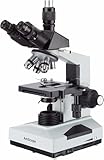
The AmScope T490B is a compound trinocular microscope with a stated 2000X maximum magnification, and it is the premium pick in this roundup. AmScope is one of the most widely recognised microscopy brands in the education and small-lab market, with a deep catalogue of objectives, condensers, adapters and cameras, and the T490B is the model that best represents the brand’s serious brightfield offering: a four-objective nosepiece including a 100X oil objective, a condenser capable of feeding it, and a mechanical stage with coaxial focus.
Who it suits. Researchers whose work depends on oil-immersion brightfield at 1000X and above. Labs that need a platform they can upgrade incrementally with additional objectives, filters or cameras. Departments that want a familiar, well-documented instrument that new staff can learn quickly. Anyone for whom the top of the magnification range is the deciding factor rather than a footnote.
Key specs at a glance:
- Magnification: up to 2000X, achieved with a 100X oil objective and high-power eyepieces.
- Nosepiece: four-objective revolving turret including a 100X oil-immersion objective.
- Condenser: Abbe-type, around NA 1.25, with an iris diaphragm to control contrast and resolution.
- Head: trinocular, inclined, with a camera port.
- Stage: mechanical stage with coaxial coarse and fine focus.
- Illumination: adjustable transmitted illumination.
Strengths. The 100X oil objective paired with a roughly NA 1.25 condenser is the reason this microscope costs more, and it is the specification that matters most for serious brightfield work. The condenser’s numerical aperture sets the maximum resolution the system can achieve; matching it to the objective’s NA is what produces crisp, high-contrast images at 1000X rather than soft, dim ones. On budget instruments, the 100X objective is often present but the condenser is not up to the job, which is why their high-power images disappoint.
The second strength is the accessory ecosystem. Because AmScope builds a wide range of compatible objectives, adapters and cameras, the T490B is a platform rather than a fixed product. You can add a camera now, a spare 40X objective later, and a different eyepiece set after that, without replacing the instrument. Over a five-year horizon, that incremental upgrade path usually costs less than buying a better microscope outright.
The third strength is documentation and familiarity. This is one of the most widely used teaching microscopes in the world, which means procedures, spare parts and troubleshooting advice are easy to find. For a lab manager onboarding new staff, that institutional knowledge is a genuine asset.
The fourth strength is the mechanical stage with coaxial focus. Coaxial coarse and fine focus on a single shaft means you keep your hand in one position while moving from a large focus adjustment to a small one, which reduces the risk of driving the objective into a slide at high power. At 1000X, where the working distance of an oil objective is measured in fractions of a millimetre, that safety margin is not a luxury.
Pros
- 100X oil objective paired with a condenser that can actually support it.
- Wide accessory ecosystem allows incremental upgrades instead of replacement.
- Extensive documentation and broad familiarity across teaching institutions.
- Coaxial coarse and fine focus improves control and protects slides at high power.
- Trinocular head supports simultaneous viewing and imaging.
Cons
- Premium price tier; significantly more than the mid-range and budget picks.
- Still brightfield only, so fluorescence and phase contrast need other equipment.
- Oil immersion adds a consumable and a cleaning routine that budget users may not want.
- 2000X is at the edge of useful magnification; treat 1000X as the practical ceiling.
How it compares. Against the Swift SW380T, the T490B is the more capable instrument at 1000X, where the condenser and objective quality make the difference, and the SW380T is the better value if your work rarely exceeds 400X. Against the OMAX M837L, the T490B has the larger accessory ecosystem and the higher stated magnification ceiling, while the M837L is the simpler teaching instrument. If oil immersion is central to your protocol, the T490B is the pick; if it is occasional, the mid-range options will serve you adequately.
8. OMAX M837L 1000X Trinocular Biological Compound Microscope – Best Premium Teaching-Lab Workhorse

The OMAX M837L is a 1000X trinocular biological compound microscope and the second premium option in this roundup. OMAX is a well-established microscopy brand with a long history in the educational and clinical market, and the M837L is a straightforward, dependable instrument: a four-objective nosepiece including a 100X oil objective, a trinocular head, a mechanical stage and adjustable transmitted illumination, without the extra complexity that drives up cost elsewhere.
Who it suits. Teaching laboratories that need durable instruments in volume. Clinical and veterinary practices doing routine smears. Researchers who value a simple, repairable instrument over a feature-dense one. Labs that already have OMAX equipment and want consistency across a bench.
Key specs at a glance:
- Magnification: up to 1000X, the practical useful limit for brightfield compound optics.
- Nosepiece: four-objective revolving turret including a 100X oil-immersion objective.
- Head: trinocular, inclined, with a camera port.
- Stage: mechanical stage with coaxial coarse and fine focus.
- Illumination: adjustable transmitted illumination with a condenser and iris diaphragm.
Strengths. The most valuable thing about the M837L is that its stated 1000X maximum is honest. A 100X oil objective paired with a 10X eyepiece gives exactly 1000X, and that is right at the useful magnification ceiling for a 1.25 NA system. Nothing in the specification is padded, which means the money went into the parts that determine image quality rather than into a number for the box.
The second strength is durability. A microscope in a teaching lab may be used by hundreds of students a year, most of them inexperienced. Simplicity is a feature here: fewer mechanisms means fewer things to break, and the mechanisms that exist, the coarse and fine focus and the mechanical stage, are the ones that benefit most from being robust. The trinocular head lets an instructor attach a camera for demonstration, and the oil objective means the same instrument can reach cellular detail when a class is ready for it.
The third strength is that a 1000X ceiling keeps the workflow honest. Because 1000X is the practical limit of the optics, users naturally learn to solve problems with staining, sample preparation and illumination control rather than by reaching for more magnification. That habit produces better microscopy than a 5000X label ever will.
One practical note for anyone using oil immersion regularly: the oil must be cleaned off the objective and the slide after every session, using lens tissue and a solvent appropriate for the immersion medium. Oil left to dry on a front lens can damage the cement around it, and oil transferred to a dry objective can cloud the image. This is a routine, not a hazard, but it is the single most common cause of premature objective replacement in teaching labs.
Pros
- Honest 1000X maximum that matches the useful magnification limit of the optics.
- 100X oil objective included for genuine high-power capability.
- Simple, robust mechanism suited to heavy student use.
- Trinocular head supports camera attachment for teaching and documentation.
- Well-known brand with an established educational and clinical presence.
Cons
- Lower stated maximum than the budget 5000X models, which can mislead comparison shoppers.
- Premium price tier for a 1000X instrument.
- No camera included.
- Brightfield only, with no provision for fluorescence or phase contrast.
How it compares. Against the AmScope T490B, the M837L is the simpler instrument with a lower magnification ceiling, but it is arguably the more honest specification and it is easier to maintain in volume. Against the PalliPartners, it costs more and delivers a better-matched oil-immersion setup. Against the budget models with 5000X claims, it trades a large number for optics that actually resolve what you are looking at, which is the right trade for anyone doing real microscopy.
How to Choose
Choosing a trinocular compound microscope comes down to six decisions, and they are not equally important. Magnification range is the least informative specification on the box and the one buyers weigh most heavily. Objective quality, condenser matching, illumination control, camera-port standard and stage precision are what determine whether the instrument is useful in a year.
Start with useful magnification, not maximum magnification
There is a hard physical relationship between an objective’s numerical aperture (NA) and the magnification at which extra power stops adding detail. The rule of thumb is that useful magnification tops out at roughly 1000 times the NA. Beyond that, you are enlarging an image that contains no additional information, which is called empty magnification.
| Objective | Typical NA | Useful magnification ceiling (≈1000 × NA) | With 10X eyepiece | With 25X eyepiece | Verdict |
|---|---|---|---|---|---|
| 4X | 0.10 | 100X | 40X | 100X | Useful |
| 10X | 0.25 | 250X | 100X | 250X | Useful |
| 40X | 0.65 | 650X | 400X | 1000X | Useful up to about 650X |
| 100X oil | 1.25 | 1250X | 1000X | 2500X | Useful up to about 1250X |
| 100X oil + 2X auxiliary lens | 1.25 | 1250X | 2000X | 5000X | Empty magnification above 1250X |
That table explains the entire magnification-claim landscape. A 5000X listing is the bottom row: a 100X oil objective, a 25X eyepiece and a 2X auxiliary lens multiplied together. The arithmetic is correct and the microscope is not fraudulent, but the image at 5000X is a soft, dim enlargement of what you already saw at 1000X. When you compare a 5000X budget scope against a 2000X premium scope, you are comparing a padded number against an honest one. Buy the honest one if image quality matters; buy the padded one if you need maximum stated capability for a procurement document.
Judge objectives by class, not by count
Objectives come in tiers, and the tier matters more than how many are in the turret. Achromatic objectives correct colour for two wavelengths and are adequate for routine teaching. Plan achromatic objectives add flatness of field, so the edges of the view stay sharp when the centre is focused, which matters for photography. Plan fluorite objectives add better correction and higher NA for the same magnification, and plan apochromatic objectives correct colour across the full visible spectrum at a price that usually exceeds the rest of the microscope.
For research documentation, plan achromatic is the practical minimum. For counting cells across a full field, the flatness matters more than you might expect: on a non-plan objective, the corners of a captured image will be visibly soft, and no amount of post-processing recovers detail that was never resolved. Ask whether the objectives are plan-corrected before you buy, and treat an unspecified objective set as achromatic.
Also check the mounting standard. Most compound microscopes in this class use DIN objectives with a 45 mm parfocal distance and an RMS thread of roughly 20.32 mm diameter at 36 threads per inch. Sticking to that standard means you can replace a single objective for a modest sum rather than buying a matched set from the original manufacturer.
Match the condenser to the objective
The condenser is the most overlooked component and the one that most often explains why two microscopes with identical magnification specifications perform differently. For brightfield work, an Abbe condenser with a numerical aperture around 1.25 and an adjustable iris is the standard pairing for a 100X oil objective. If the condenser’s NA is lower than the objective’s, you will never see the resolution the objective is capable of, no matter how carefully you focus.
The iris diaphragm is not a brightness knob. It controls the cone of light entering the specimen, and therefore both resolution and contrast. Opening it fully maximises resolution but reduces contrast; closing it too far increases contrast but destroys resolution. The correct starting point is roughly 70 to 80 percent of the objective’s NA, adjusted by eye for the specimen. A microscope without an adjustable condenser iris removes that control entirely.
Illumination: LED versus halogen
LED illumination is now standard in this class, and for good reason. An LED module draws a fraction of the power of a halogen lamp, runs cool enough that it will not heat a live specimen over a long session, holds a stable colour temperature as you dim it, and lasts for tens of thousands of hours. Halogen still has a small following for colour rendition in some photographic applications, but it runs hot, consumes bulbs, and shifts toward yellow as you reduce intensity.
What matters more than the light source is adjustability. You want continuous intensity control, and you want a field diaphragm or at least a condenser iris so you can trade contrast against resolution. A fixed-brightness LED is a downgrade from a dimmable halogen lamp for serious work.
Camera port compatibility
A trinocular head is only useful if its port accepts the camera you want. In practice, most ports in this class accept a C-mount adapter, which is a threaded tube with a 1-inch diameter and 32 threads per inch, usually containing a reducing lens. The reducing lens matters because microscope optics project an image circle much larger than a camera sensor: a 0.5X reducing lens suits a 1/2-inch sensor reasonably well, while a 0.35X lens is closer to correct for a larger sensor and a 1X lens will crop heavily.
Two practical checks before buying. First, confirm