Best Pantry Organizers to Maximize Space
What's inside
- Top 3 Picks
- Quick Comparison
- How We Chose
- 1. Tiawudi 12 Pack Plastic Storage Bins – Best for Uniform Small-Item Zones
- 2. Moforoco White 9-Tier Over The Door Pantry Organizer – Best for Door-Mounted Vertical Storage
- 3. SKTEET Set of 8 Clear Plastic Storage Bins – Best for Mixed-Size, Mixed-Depth Layouts
- 4. Kitchen Details 3 Tier Can Organizer – Best for Can Rotation on a Budget
- 5. LANDNEOO 12 Pack Multi-Use Clear Storage Bins – Best for Lowest-Cost Full-Pantry Coverage
- 6. 3IngSeagulls 2-Tier Expandable Rolling Pantry Cart – Best for Floor-Level Heavy Storage
- 7. NuoyuanShen Expandable Bamboo Can Rack Organizer – Best for Adjustable Natural-Material Can Storage
- 8. GAOKASE 4 Pcs Stackable Wire Baskets – Best for Deep Shelves and Bulk Categories
- How to Choose
As an Amazon Associate I earn from qualifying purchases. This post may contain affiliate links at no extra cost to you.
If you want one purchase that solves most pantry problems, the SKTEET Set of 8 Clear Plastic Storage Bins is the best pantry organizer for the widest range of kitchens: four large and four small stackable clear containers let you build tall columns in deep cabinets and shallow rows on narrow shelves without buying two separate sets. It suits anyone whose pantry mixes bulky cereal and pasta boxes with small packets, baking supplies, and snack bars. If budget is the binding constraint, the LANDNEOO 12 Pack Multi-Use Clear Storage Bins delivers the same clear-view logic at the lowest tier in this roundup, and if your problem is floor and shelf footprint rather than container count, the Moforoco White 9-Tier Over The Door Pantry Organizer turns unused door height into nine shallow shelves for spices, jars, and small bottles. The rest of this guide measures shelf fit, bin dimensions, material durability, and vertical gain across eight specific organizers so you can match one to your actual cabinet measurements instead of guessing from a photo.
Our Top Picks
 Tiawudi 12 Pack Plastic Storage Bins10.5" x 7.2" x 4.5" (4.2L)10.5 x 7.2 x 4.5 Inches8.9 poundsCheck on Amazon
 Moforoco White 9-Tier Over The Door Pantry Organizer9-Tier Standard5.5 x 15.8 x 68.5 inches8.8 PoundsCheck on Amazon
 Kitchen Details 3 Tier Can Organizer14.5 x 11.5 x 11 inches14.57 x 11.42 x 11.02 inches2.42 poundsCheck on Amazon
 2-Tier Expandable Rolling Pantry Cart with Wheels2-Tier11.81 x 29.5 x 18.5 Inches9 poundsCheck on Amazon


Top 3 Picks
Best overall: SKTEET Set of 8 Clear Plastic Storage Bins
The two-size format is what makes this the most adaptable set here. Four large bins handle pasta boxes, bags of rice, and snack multipacks, while four small bins take spice packets, bouillon, tea, and loose baking items, so a single shelf can serve two very different storage jobs. Clear walls mean you see contents without pulling the bin out, which is the single biggest time saver in a pantry you use several times a day.
Best budget: LANDNEOO 12 Pack Multi-Use Clear Storage Bins
Twelve identical clear bins at the lowest price tier in this roundup covers an entire pantry’s worth of small and medium items in one purchase. Identical sizing is a real advantage when you want uniform rows that line up cleanly, and it makes replacement trivial if one bin eventually cracks. It is the right first purchase if you have never organized a pantry before and want to see how you actually use the space before spending more.
Best premium: Moforoco White 9-Tier Over The Door Pantry Organizer
This is the pick when your shelves are full but your door is empty. Nine tiers of white metal racking convert the back of a pantry door into usable vertical storage for spices, small jars, and bottles, and because it hangs rather than sits, it costs you zero shelf or floor area. It suits narrow walk-in pantries and reach-in cabinets where every horizontal surface is already committed.
Quick Comparison
| Product | Best for | Key specs | Price tier |
|---|---|---|---|
| Tiawudi 12 Pack Plastic Storage Bins | Matching bins for many small items | 12 identical clear multi-use open-top bins; straight-sided; stackable when empty | Mid-range |
| Moforoco White 9-Tier Over The Door Pantry Organizer | Door-mounted vertical storage | 9 tiers; white metal; over-the-door hanging; spice-rack depth shelves | Premium |
| SKTEET Set of 8 Clear Plastic Storage Bins | Mixed sizes in one purchase | 8 bins total: 4 large + 4 small; clear; stackable | Mid-range |
| Kitchen Details 3 Tier Can Organizer | Canned goods on a budget | Chrome steel wire; 3 tiers; holds 36 cans; space-saving footprint | Budget |
| LANDNEOO 12 Pack Multi-Use Clear Storage Bins | Lowest-cost full-pantry coverage | 12 clear multi-use bins; open top; multi-room use | Budget |
| 3IngSeagulls 2-Tier Expandable Rolling Pantry Cart | Floor-level overflow and heavy items | 2 tiers; expandable width; rolling casters; can organizer | Premium |
| NuoyuanShen Expandable Bamboo Can Rack Organizer | Adjustable natural-material can storage | 3 tiers; expandable width; bamboo; can and soda organizer | Budget |
| GAOKASE 4 Pcs Stackable Wire Baskets | Deep shelves and bulk categories | 4 black wire baskets; stackable; open-weave sides | Mid-range |
How We Chose
This roundup is built from published product specifications, manufacturer documentation, and category research rather than first-hand use of the items. Every organizer listed had to clear four filters. First, specification clarity: if a listing did not state tier count, bin count, material, or a size split, it did not make the cut, because pantry organizers are bought on dimensions and a vague listing is a wasted purchase. Second, category fit: each pick had to solve a distinct problem — uniform small items, mixed sizes, cans, bulk categories, door height, or floor overflow — so that two entries in this guide are never competing for the same job. Third, use case realism: we weighted how a product behaves in the two layouts most people actually have, a reach-in cabinet with 12-inch shelves and a walk-in pantry with deeper adjustable shelving. Fourth, upgrade path: a pick had to be either a sensible first purchase you can build on or a specific upgrade that fixes a limitation cheaper organizers cannot, such as expandable width or casters. Price tiers reflect general market positioning, not a fixed figure, since listings move daily.
1. Tiawudi 12 Pack Plastic Storage Bins – Best for Uniform Small-Item Zones
As an Amazon Associate we earn from qualifying purchases at no extra cost to you.

The Tiawudi 12-pack is the right answer when your pantry problem is not space but scatter: a dozen different small items — spice packets, gravy mixes, tea bags, cookie cutters, drink powder sticks, individually wrapped snacks — that individually take up almost no room but collectively turn a shelf into a jumble. Twelve identical clear bins let you group those items into logical zones and see every zone at a glance. It suits households that cook from a fairly fixed repertoire and want a pantry where everything has a fixed address, and it suits renters because nothing is mounted or permanently altered.
Key specs
- Quantity: 12 bins in one purchase, all the same size.
- Material class: clear plastic, open-top, straight-sided — the standard multi-use pantry bin format.
- Shape: rectangular with an open top and no lid, designed to be pulled forward like a drawer rather than lifted.
- Intended use: pantry, kitchen cabinet, refrigerator, bathroom, and general household organization.
- Stacking: the straight-sided format stacks when empty for storage and nests when partially full.
The core strength is uniformity. When every bin is identical, you can build a grid — four across a 24-inch shelf, three rows deep on a deep shelf — and the whole thing reads as a single system instead of a collection of mismatched containers. Uniformity also makes labeling trivial: a strip of tape and a marker on the front edge, and the pantry becomes searchable rather than excavated. Replacement is the other quiet benefit. If one bin cracks after two years, you swap in a spare rather than rebuilding a mismatched set.
The limitation is equally predictable: one size fits some things well and nothing perfectly. A 12-pack of identical bins is inefficient if your pantry is dominated by tall cereal boxes, large bags of flour, or wide items that will not sit flat in a small bin. Those items need the large half of a mixed set or an open shelf, not another small bin. If your pantry is roughly 60% small items and 40% bulky ones, this is a strong buy. If it is the reverse, buy a mixed-size set instead and use this only for the small-item zone.
Pros
- Twelve bins in a single purchase covers an entire small-item category at once.
- Identical sizing produces clean, uniform rows that are easy to label and scan.
- Clear walls show contents without pulling the bin out.
- Open-top design means no lid to remove one-handed while holding a bag of flour.
- Straight sides waste almost no shelf width compared with tapered or round containers.
- Useful well beyond the pantry — cabinets, fridge, bathroom, laundry, craft storage.
Cons
- One size only; tall boxes, wide bags, and bulky produce will not fit well.
- No lids, so nothing is sealed against spills, moisture, or pests.
- Open bins collect dust and crumbs in the bottom over time.
- Small bins can become a dumping ground if you do not assign categories deliberately.
- Clear plastic shows every smudge and sticky ring.
How it compares
Against the LANDNEOO 12 Pack, the two are functionally close — both are 12-count clear multi-use bin sets, and the LANDNEOO sits at the lower price tier. The Tiawudi lands in the mid-range, which typically buys slightly thicker walls and cleaner molding, so it makes more sense if you expect the bins to be pulled in and out several times a day for years. Against the SKTEET Set of 8, the trade is count versus flexibility: you get four more containers with the Tiawudi, but the SKTEET’s large-and-small split will cover a more varied pantry in fewer total bins. If your shelves are already mostly full of bulky items, the SKTEET is the better single purchase; if your problem is a hundred small things, this is.
2. Moforoco White 9-Tier Over The Door Pantry Organizer – Best for Door-Mounted Vertical Storage

Every pantry has one large unused surface: the back of the door. The Moforoco 9-tier organizer converts that surface into nine shallow shelves, which is roughly nine linear feet of new storage edge in a standard-height pantry door, achieved without giving up a single square inch of shelf or floor space. It suits narrow walk-in pantries, reach-in cabinets with a full-height door, and utility closets where the horizontal surfaces are already committed to bulk items. It also suits anyone whose spice collection has outgrown a single shelf — nine tiers is enough to separate baking spices, savory spices, blends, and duplicates instead of stacking jars two deep.
Key specs
- Tier count: 9 shallow shelves.
- Material: metal, white finish — powder-coated or painted steel in this category.
- Mounting: over-the-door hanging; no drilling required.
- Intended use: pantry organization and storage, spice rack duty, small jars, bottles, and packets.
- Shelf depth: shallow, in the spice-rack class — sized for jars and small bottles rather than cereal boxes or bulk bags.
The gain here is vertical, not horizontal. A standard pantry door is roughly 80 inches tall, and nine tiers spread across that height means each shelf sits about 8 to 9 inches below the one above it — enough clearance for standard spice jars and most small bottles. That is the practical advantage over a three- or four-tier door rack: you are not choosing between categories, you can dedicate tiers. One tier for everyday spices, one for baking, one for extracts and small bottles, one for tea and drink mixes, one for vitamins or supplements if the pantry doubles as a household hub.
The material matters for longevity. A white metal rack will not warp in a humid kitchen the way an unfinished wood rack can, and it wipes clean with a damp cloth. The failure point on any over-the-door organizer is not the rack — it is the hanging hardware and the door gap. Before buying, measure the gap between the top of your door and the frame; over-the-door hooks need roughly an eighth of an inch of clearance to seat properly, and a door that closes flush against the frame may not accept them at all. Also check that the rack’s total height clears the bottom of the door swing and any lower cabinet hardware.
Weight is the second reality. Nine tiers invite you to fill nine tiers, and glass jars add up fast. Distribute heavy items toward the upper and lower tiers and keep the middle tiers for light packets, and the load stays stable and the door still swings smoothly. If your door is hollow-core, avoid loading the rack to the point where the door itself flexes.
Pros
- Uses the back of the door, so it costs zero shelf or floor space.
- Nine tiers allow genuine category separation instead of one crowded spice shelf.
- White metal finish is easy to wipe down and resists kitchen humidity better than unfinished wood.
- No drilling or permanent modification — removable if you move.
- Excellent for narrow pantries where a floor cart would block the walking path.
Cons
- Shallow shelves only; unsuitable for cereal boxes, bags of flour, or large containers.
- Requires adequate door-to-frame clearance for the hanging brackets.
- Adds weight to the door, which can affect how it swings and closes if overloaded.
- Premium tier pricing relative to simple bin sets.
- Items at the top tiers may be above comfortable reach for shorter users.
How it compares
Against the 3IngSeagulls rolling pantry cart, this is the opposite solution to the same overcrowding problem. The cart adds floor-level capacity and rolls out for access but consumes footprint in front of your shelves; the Moforoco adds capacity on a surface you were not using at all. If your pantry is narrow enough that a cart would obstruct movement, the door rack wins outright. Against a standard three-tier can rack, the Moforoco trades can capacity for breadth — it will not hold 36 cans, but it will hold spice jars, bottles, packets, and small containers that a can rack cannot organize at all. If your pantry’s overflow is specifically canned goods, buy the can rack; if it is a hundred small things with no home, buy this.
3. SKTEET Set of 8 Clear Plastic Storage Bins – Best for Mixed-Size, Mixed-Depth Layouts

Most pantries are not uniform, and the SKTEET set is the only pick here that ships with two sizes in one box: four large bins and four small bins. That split maps directly onto how a real pantry is used. Large bins take the medium-bulk category — pasta boxes laid flat, snack multipacks, bags of dried beans, baking supplies in their original packaging — while small bins take the high-count, low-volume category of spice packets, bouillon cubes, tea, and loose odds and ends. It suits the household that wants one purchase to cover both, and it suits anyone whose previous organizer purchase failed because every container was the same size.
Key specs
- Quantity: 8 bins total — 4 large and 4 small.
- Material class: clear plastic, open-top, stackable.
- Sizing: two distinct footprints, so large and small bins can be arranged in matched columns or separate rows.
- Stackability: designed to stack, which is the main vertical-gain feature of this set.
- Intended use: pantry, kitchen cabinet, refrigerator, and general household organization.
The real advantage is layout flexibility. Because the small bins are sized to sit on top of the large ones, you can build two-level columns on a shelf that is 12 to 15 inches clear — the large bin forms the base, the small bin stacks above, and you have doubled the usable capacity of that shelf footprint without adding a rack. Do that across a 36-inch shelf and you have effectively created six storage layers where there were three. That stacking behavior is why this set edges out the 12-count identical-bin sets for most pantries: it does more per square inch of shelf.
Clear plastic is doing specific work here too. In a pantry you use daily, the cost of a container is not just the purchase — it is the seconds you spend opening, searching, and closing it. Transparent walls cut that to near zero because you identify contents from a standing position. That is the practical case for clear over opaque baskets, and it is why this set works well for households where multiple people (partners, kids, roommates) need to find things without asking.
On durability, the honest answer for any clear plastic bin set is that the rim and the corners fail first. Thin plastic cracks where it flexes — the top edge you grip and the bottom corners that take the impact when a bin is dropped or shoved back onto a shelf. The practical mitigations are simple: never lift a full bin by one wall, never stack a heavy bin on a light one, and do not slide loaded bins across rough wire shelving, which acts like sandpaper on the base. Wash by hand in warm, not hot, water; dishwasher heat is what warps thin plastic and turns a straight-sided bin into a tapered one that no longer stacks. Expect a multi-year service life with normal daily handling and indefinite life if the bins stay on one shelf and are only pulled forward.
Pros
- Two sizes in one purchase covers both bulk and small-item categories.
- Small bins stack on large ones, doubling usable capacity on a single shelf footprint.
- Clear walls eliminate the search-and-dig cycle.
- Open tops mean no lids to manage one-handed.
- Stackable design gives real vertical gain without buying a rack.
- Eight bins is enough to organize a typical reach-in pantry without overspending.
Cons
- Only four of each size — a pantry heavy in one category may need a second set.
- No lids; nothing is sealed against moisture or pests.
- Stacking works best when the lower bin is full; half-full bins can shift.
- Clear plastic scratches and hazes with heavy scrubbing over time.
- Large bins may still be too short for full-height cereal boxes.
How it compares
Against the Tiawudi 12 Pack, this is the flexibility-versus-count trade. Tiawudi gives you four more containers; SKTEET gives you two sizes and stackability that actually increases shelf capacity. For a pantry that is mostly small items, buy Tiawudi. For a pantry with a genuine mix — which is most of them — SKTEET does more work per bin. Against the LANDNEOO 12 Pack, the difference is the same: LANDNEOO wins on price per bin and on having spares, SKTEET wins on coverage of awkward-sized items. The one situation where SKTEET clearly loses is a pantry dominated by tall boxes, where neither set is ideal and you should be looking at open shelving or a cart instead.
4. Kitchen Details 3 Tier Can Organizer – Best for Can Rotation on a Budget
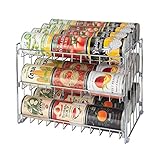
Canned goods are the single worst category in most pantries: heavy, cylindrical, prone to rolling, and impossible to see past once stacked. The Kitchen Details 3-tier chrome steel rack solves that specific problem by holding 36 cans in a stepped arrangement where every label faces forward. It suits households that buy canned tomatoes, beans, corn, soup, and tuna in quantity, and it suits anyone who has lost cans at the back of a shelf for a year and then thrown them away. It is also the lowest price tier in this roundup, which makes it the natural first upgrade for a pantry that has no system at all.
Key specs
- Capacity: holds 36 cans across three tiers.
- Material: chrome steel wire construction.
- Tier count: 3 stepped levels.
- Footprint: space-saving — the stepped design uses depth rather than width.
- Intended use: canned food storage in pantries, cabinets, and utility shelving.
The stepped design is the whole point. A standard 12-ounce can is roughly 2.6 to 2.7 inches in diameter and about 4.8 inches tall, so a shelf with 12 to 15 inches of clear height can take three tiers comfortably with room to reach in. Stepping the tiers means each row sits slightly back and slightly higher than the one in front, so you read the label on every can without moving anything. Compare that with stacking cans two high and four deep on a flat shelf, where the back row is invisible and functionally lost.
Chrome steel wire has real advantages here. It does not hold dust the way a flat surface does, cans slide along it easily, and it does not absorb odors or stains the way unfinished wood can. It is also light, so a full rack of 36 cans can be repositioned by one person without emptying it — useful if you reorganize seasonally. The honest limitation of chrome wire is moisture and scratching. Wire racks can develop surface rust at weld points if they sit in a damp basement pantry or get wiped with a wet cloth and left wet. Dry them immediately after cleaning. And because wire is harder than most shelf surfaces but softer than ceramic, a wire rack dragged across a finished shelf can leave marks — add small felt pads under the feet if your shelving is finished wood.
The other thing to plan for is can size range. A rack built for standard 12-ounce cans handles most soup, vegetable, and bean cans, but larger formats are a different problem entirely: a 28-ounce can is roughly 4 inches in diameter, and a #10 can used in food service is about 6.25 inches across and will not fit a standard rack at all. If your pantry includes those formats, keep them on a separate shelf and use this rack for the standard-diameter majority, which is usually the bulk of the collection.
Pros
- Holds 36 cans with every label visible from the front.
- Stepped tiers use shelf depth rather than width, saving horizontal space.
- Chrome steel wire is easy to wipe clean and does not absorb odors.
- Light enough to reposition without unloading.
- Lowest price tier in this roundup — an inexpensive way to fix the worst pantry category.
- Encourages first-in-first-out rotation, which reduces food waste.
Cons
- Standard can diameters only; large and #10 cans will not fit.
- Chrome wire can develop rust at welds in humid conditions if not dried after cleaning.
- Wire feet can mark finished wood shelving without padding.
- No containment — cans can roll off the open sides if the rack is knocked.
- Does nothing for non-can categories such as boxes, bags, or packets.
How it compares
Against the NuoyuanShen expandable bamboo can rack, the trade is adjustability and material versus capacity and price. The bamboo rack expands in width and offers three adjustable tiers, which suits awkward cabinet widths, but bamboo is a natural material that reacts to humidity and will not hold as many cans as a dedicated 36-can steel rack. If you have a standard-width shelf and a large can collection, the Kitchen Details rack is the more efficient buy. Against the 3IngSeagulls rolling cart, the difference is placement: the cart takes floor space and moves, while this rack sits on a shelf and stays. If you have shelf height but no floor space, this is the correct pick.
5. LANDNEOO 12 Pack Multi-Use Clear Storage Bins – Best for Lowest-Cost Full-Pantry Coverage

The LANDNEOO 12-pack is the entry point. Twelve clear multi-use bins at the budget tier means you can organize an entire pantry’s worth of small and medium items for less than the cost of almost any other single organizer in this guide. It suits first-time organizers who want to see how they actually use their pantry before committing to a system, and it suits secondary spaces — bathroom cabinets, laundry shelves, garage shelves, kids’ craft storage — where you want the same clear-bin logic without paying mid-range prices.
Key specs
- Quantity: 12 clear multi-use bins.
- Material class: clear plastic, open-top.
- Configuration: identical sizing across all 12 units.
- Intended use: pantry, kitchen cabinet, and general household organization.
- Price tier: budget — the lowest-cost multi-bin set in this roundup.
The case for this set is volume per dollar. Twelve bins lets you attack the pantry in one pass: one bin for baking soda, powder, and cocoa; one for savory spice packets; one for tea and drink mixes; one for kids’ snacks; one for baking chips and sprinkles; one for sauces and condiment packets; one for grains and rice; and so on, with spares left over. Because they are identical, they line up neatly, and because they are cheap, you are not precious about them — which matters, because the fastest way to organize a pantry is to stop deliberating and start assigning.
The trade for that price is in the details. Budget-tier plastic is typically thinner than mid-range plastic, which means the bins flex more when loaded and are more likely to crack at the rim if you carry a full one by the edge. They also tend to haze and scratch faster with abrasive cleaning. None of that is a dealbreaker — a set that costs a fraction of the alternatives and lasts three years is often a better purchase than a set that costs three times as much and lasts six, especially if your pantry needs change. Just handle them accordingly: lift from underneath, do not overfill, and hand-wash in warm water.
Where this set genuinely competes is secondary organization. Buying one premium organizer for the pantry and one budget 12-pack for the bathroom, laundry, and garage is a smarter allocation of money than buying premium everywhere. The clear-bin format works identically in a bathroom cabinet for toiletries, in a laundry room for stain treatments and dryer sheets, and in a garage for hardware. If you are organizing more than one space, this set’s value compounds.
Pros
- Lowest-cost way to cover an entire pantry in one purchase.
- Twelve identical bins produce uniform, easy-to-label rows.
- Clear walls make contents visible at a glance.
- Identical sizing means a cracked bin is trivially replaced.
- Works across pantry, bathroom, laundry, and garage.
- Low commitment — ideal for testing how you actually use your pantry.
Cons
- Thinner plastic than mid-range sets; more flex and faster rim wear.
- One size only, so tall boxes and wide bags will not fit.
- No lids; nothing is sealed.
- Open tops collect dust and crumbs.
- May not survive years of heavy daily handling the way thicker bins do.
How it compares
Against the Tiawudi 12 Pack, this is nearly the same product at a lower tier: same count, same clear open-top format, same intended use. The difference is material thickness and finish quality, which shows up in how the bins feel when loaded and how they age. If you are organizing a pantry you use constantly and want the bins to stay crisp for years, the Tiawudi is worth the step up. If you are organizing three spaces at once, or you are not yet sure what sizes you need, buy this set now and upgrade the pantry bins later once you know your categories. Against the SKTEET Set of 8, the choice is count versus sizes: twelve identical bins versus eight mixed-size bins. Choose LANDNEOO for breadth of small items; choose SKTEET for a pantry with genuinely awkward-sized contents.
6. 3IngSeagulls 2-Tier Expandable Rolling Pantry Cart – Best for Floor-Level Heavy Storage

Some pantry problems are not on the shelf at all. Bulk bags of rice and flour, large bottles of oil and vinegar, a slow cooker, a stand mixer, potatoes and onions — these are floor or low-shelf items, and they are exactly what the 3IngSeagulls 2-tier rolling cart is built for. It expands in width to fit the gap you actually have, rolls out on casters for full access, and takes weight that shelf-mounted organizers cannot. It suits households with a dead corner in the pantry, a gap beside the refrigerator, or a walk-in with floor space that currently collects bags.
Key specs
- Tier count: 2 levels.
- Adjustability: expandable width to fit different cabinet and pantry openings.
- Mobility: rolling casters — the cart pulls out and pushes back.
- Intended use: floor-level pantry organization, can organization, and general kitchen storage.
- Price tier: premium.
The expandable width is the feature that separates this from a fixed-width cart. Pantry openings are rarely standard — a gap might be 14 inches in one kitchen and 22 in another, and a fixed cart that is slightly too wide is useless while one that is slightly too narrow wastes the space. An expandable cart lets you match the opening closely, and because the cart rolls, you can pull the entire unit into the room rather than reaching into a dark gap. That is the practical difference between a cart you use and a cart that becomes a permanent obstacle.
Casters are the first thing to fail on any rolling cart. Small plastic wheels loaded with 40 pounds of flour and potatoes develop flat spots, seize, or shear at the mounting stem. Before buying, check the caster type: swivel casters with metal stems last considerably longer than press-fit plastic ones, and two locking casters make the cart stable in place instead of drifting when you lean on it. Also plan the load: put the heaviest items on the bottom tier and keep the top tier for lighter goods, because a top-heavy cart rolls unpredictably and can tip when pulled over a threshold.
Two tiers is a deliberate limit rather than a shortcoming. A three- or four-tier cart becomes tall enough that the top shelf is unstable when rolling, and tall carts are harder to maneuver in a narrow pantry. Two tiers keeps the center of gravity low. If you need more vertical capacity, the better move is a cart for bulk on the floor plus a shelf-based system above it — for example, this cart on the floor with a clear bin set or a can rack on the shelf directly overhead.
Pros
- Handles heavy items — bulk bags, large bottles, appliances — that shelf organizers cannot.
- Expandable width fits non-standard gaps between cabinets and appliances.
- Casters give full access to a deep or dark corner without unloading.
- Two low tiers keep the center of gravity stable while rolling.
- Uses floor space that is otherwise wasted or used for clutter.
Cons
- Consumes floor footprint, which is a problem in very narrow pantries.
- Casters are the most likely failure point and vary widely in quality.
- Only two tiers, so vertical capacity is limited.
- Premium price tier.
- Open design means items are visible but not contained; small items need separate bins on top.
How it compares
Against the Moforoco over-the-door organizer, this is the floor-versus-door trade. The Moforoco costs zero footprint but cannot hold anything heavy or bulky; the cart costs footprint but takes real weight and moves. If your pantry is narrow, the door rack is the better use of space; if you have a gap or a corner, the cart recovers capacity you cannot get any other way. Against the Kitchen Details can organizer, the cart is more versatile but less efficient at cans specifically — a dedicated rack holds 36 cans in a compact stepped footprint, while a cart holds fewer cans in more space but also handles everything else. The strongest setup for a walk-in pantry is often both: a can rack on the shelf and a rolling cart below it.
7. NuoyuanShen Expandable Bamboo Can Rack Organizer – Best for Adjustable Natural-Material Can Storage

The NuoyuanShen bamboo can rack solves the same problem as a steel can organizer but with two differences that matter: it expands in width to fit the shelf you have, and it is made of bamboo, which many people prefer visually in an open or visible pantry. It suits pantries where the shelves are visible from the kitchen, cabinets with odd internal widths, and households that want cans organized without a chrome rack’s industrial look. It also suits anyone who wants to adjust tier spacing to accommodate a mix of can heights.
Key specs
- Tier count: 3 tiers.
- Adjustability: expandable width; tiers adjust to accommodate different can sizes.
- Material: bamboo.
- Intended use: pantry can storage, soda and beverage organization.
- Price tier: budget.
The adjustable tiers are the practical advantage over a fixed steel rack. Can heights vary more than most people expect — a standard 12-ounce can is about 4.8 inches tall, but slim cans, short tuna cans, and taller specialty cans all differ, and a fixed rack leaves wasted clearance or blocks the tallest items. Adjustable tiers let you set each level to the contents. Expandable width does the same job horizontally: a rack that can stretch from a narrow cabinet to a wide shelf fits wherever you put it, and it can be re-expanded if you move.
Bamboo has specific strengths and specific care requirements. It is a dense, fast-renewing grass rather than a hardwood, and good bamboo racking is sturdy, lightweight, and resistant to the warping that affects cheaper softwoods in a kitchen. It also looks considerably better in a visible pantry than coated wire. What bamboo does not like is standing water and prolonged humidity. Wipe spills promptly rather than letting them sit, do not place the rack directly against a wall in a damp basement, and avoid soaking it during cleaning. A food-safe oil applied occasionally will keep the surface from drying and cracking, though many bamboo racks ship with a finish that does not require it.
The load consideration is straightforward: bamboo is strong in compression along the grain and the tier supports handle normal can weights without issue, but a bamboo rack will not carry the same total load as a welded steel rack of similar footprint. For a normal household can collection — soups, vegetables, beans, tomatoes, soda — that is a non-issue. For a bulk-buying household with dozens of heavy cans, the steel rack is the more durable choice.
Pros
- Expandable width fits narrow cabinets and wide shelves alike.
- Adjustable tiers accommodate varying can heights with less wasted clearance.
- Bamboo is lightweight and visually warmer than chrome wire.
- Handles both canned goods and soda or beverage cans.
- Budget price tier for an adjustable, multi-tier rack.
Cons
- Bamboo is sensitive to standing water and prolonged humidity.
- Lower total load capacity than welded steel wire.
- Requires more careful cleaning than chrome or plastic.
- Open tiers do not contain cans if the rack is bumped.
- Natural material means color variation between units.
How it compares
Against the Kitchen Details 3 Tier Can Organizer, the trade is capacity and price versus adjustability and material. The Kitchen Details rack holds 36 cans in a compact footprint at a lower tier and is easier to clean; the bamboo rack expands to fit odd widths and looks better in an open pantry but holds fewer cans and needs more careful maintenance. Choose based on where the rack will live: inside a closed cabinet, buy steel; on a visible shelf in an open kitchen, buy bamboo. Against the GAOKASE wire baskets, the comparison is category-specific — the baskets are for loose, irregular bulk items, the bamboo rack is for uniform cylinders. A pantry that stocks cans and bags of produce benefits from both.
8. GAOKASE 4 Pcs Stackable Wire Baskets – Best for Deep Shelves and Bulk Categories

The GAOKASE wire basket set targets the category that clear bins handle worst: bulky, irregular items. Bags of potatoes and onions, loose fruit, bags of chips, bread, large produce, cleaning supplies, and anything that needs airflow rather than a sealed container. Four stackable black wire baskets in the mid-range tier give you a modular system for deep shelves, and the open weave means you can see contents from the side as well as the front — a real advantage on a deep shelf where you would otherwise have to pull a solid bin all the way out to know what is in it.
Key specs
- Quantity: 4 wire baskets.
- Material: metal wire, black finish.
- Stackability: designed to stack, creating vertical layers on one shelf footprint.
- Construction: open-weave sides for airflow and side visibility.
- Intended use: pantry organization and storage bins for bulk and irregular items.
- Price tier: mid-range.
Open wire is the right material for produce and anything that needs to breathe. Sealed plastic traps moisture, which is why onions and potatoes go soft faster in a closed bin than in a basket. Wire also handles the weight of a full bag of potatoes without the flex that thin plastic shows, and it does not stain or hold odors the way an absorbent material would. Black wire in particular hides scuffs and the general wear that kitchen storage accumulates.
Stackability is what turns four baskets into a system. On a deep shelf, stacking two baskets gives you two layers in the footprint of one, and stacking four gives you four — the same vertical-gain logic as stackable bins, but applied to items too bulky for bins. The limitation is that a stacked wire basket must be lifted off the one below to access it, so reserve stacking for items you use less often and keep daily-use baskets at the top of the stack or unstacked at the front.
Wire is the category that rusts first. Any wire basket in a kitchen will eventually meet moisture — a damp cloth, a wet bag of produce, a spill — and rust starts at the weld points and the base where water pools. The prevention is simple and effective: dry the baskets fully after wiping, avoid storing wet produce directly in them, and put a liner or a sheet of paper towel in the base if you routinely store damp items. A light coat of oil on bare metal spots also slows corrosion. Treat them well and wire baskets last many years; leave them damp and they will show rust within a season.
The second consideration is shelf protection. Wire bases can scratch finished wood and leave marks on painted shelving, especially when a loaded basket is dragged. Felt pads on the base or a shelf liner under the baskets solve this entirely and cost almost nothing.
Pros
- Open weave allows airflow, which suits produce, bread, and anything that should not be sealed.
- Side visibility means you can identify contents without pulling the basket out.
- Stackable design doubles or quadruples usable capacity on one shelf footprint.
- Handles heavy bulk items without the flex of thin plastic.
- Black wire hides scuffs and everyday wear well.
- Works for non-food storage — cleaning supplies, tools, kids’ items.
Cons
- Wire rusts at welds and bases if not dried after contact with moisture.
- Open sides let small items fall through and offer no containment for loose powders.
- Stacked baskets must be lifted to access lower layers.
- Wire bases can scratch finished shelving without pads or liners.
- Not suitable for fine items like spice packets or small hardware.
How it compares
Against the SKTEET Set of 8 clear bins, this is a material and category split rather than a straight contest. Clear plastic bins win for small, uniform items where visibility through the wall matters most; wire baskets win for bulky, irregular, or damp items where airflow and load capacity matter. A well-organized deep shelf often uses both: wire baskets for produce and bags at the back, clear bins for packets and small containers at the front. Against the LANDNEOO 12 Pack, the wire baskets cost more per unit but hold categories the plastic bins simply cannot, and they will outlast thin plastic under heavy loads. If you are choosing only one, choose based on what is currently making your pantry unusable — small clutter points to bins, bulk overflow points to wire.
How to Choose
Start with three measurements, not a product
Pantry organizers fail for one reason more than any other: they were bought before the pantry was measured. Before you compare any product, take three numbers. First, the clear height between shelves — the vertical gap from the top of one shelf to the underside of the one above. Adjustable shelving typically gives you 12 to 15 inches at standard spacing; fixed shelving in older cabinets is often 8 to 10 inches. Second, the shelf depth: standard kitchen shelving runs about 12 inches, shallow cabinets are closer to 10, and deep pantry shelving can be 16 to 18 inches. Third, the shelf width, measured between the interior side walls, not the cabinet opening — cabinet doors and hinges eat an inch or more on each side, and an organizer that fits the opening but not the interior width will not go in.
The shelf-fit calculation that prevents most returns
Once you have those numbers, the fit math is simple arithmetic. Suppose you have a 30-inch-wide shelf, 12 inches deep, with 14 inches of clear height. If you choose a bin that is 6 inches wide and 10 inches deep, you can fit five across (30 ÷ 6 = 5) with no wasted width, and one row deep with 2 inches of depth left over — enough for a small item to slide behind, which is usually fine or can be blocked with a shelf liner. If you stack a small bin on top of that large one and the stack is 9 inches tall, you still have 5 inches of clearance to reach in. That stack turns a 5-bin shelf into a 10-bin shelf without adding any hardware. Do that calculation before buying, and you will know whether you need a mixed-size set or a uniform one.
For a deep 18-inch shelf, the math changes direction. Five 6-inch bins across leaves 12 inches of unused depth behind them — a third of the shelf wasted. Either choose deeper bins that use the full depth, or place a second row of bins behind the first and accept that you will pull the front row out to reach the back, or use wire baskets at the back for bulky items and bins at the front. The worst outcome is buying shallow bins for a deep shelf and losing a third of your capacity to a dead zone.
Vertical gain: where the real space comes from
Most pantries are underused vertically, not horizontally. A typical reach-in pantry has five or six shelves with 12 to 15 inches of clear height each, and most people stack items only one layer high on each. Adding a stacking bin set, a stepped can rack, or a wire basket stack effectively adds a layer per shelf, which is roughly a 30 to 50 percent increase in usable capacity with no new furniture. If you have more than 15 inches of clear height on a shelf, you are almost certainly leaving capacity on the table. If you have less than 10 inches, stacking is not viable and you should be looking at a single-layer solution or a door-mounted rack instead.
Material durability: what actually wears out
Different materials fail in different ways, and knowing the failure mode tells you how to buy.
- Clear plastic bins: the rim and corners crack first, especially if you lift a loaded bin by one wall. Thin budget plastic flexes more and hazes faster; thicker mid-range plastic holds its shape. Heat warps plastic, so hand-wash in warm water rather than running bins through a hot dishwasher cycle. Typical service life under daily use: three to six years.
- Chrome steel wire: rust at weld points and where the coating is scratched. Wipe dry after cleaning, and pad the feet if your shelves are finished wood. Service life is long — a decade or more — if kept dry.
- Painted metal (door racks, carts): paint chips at the joints where the rack flexes, and chips become rust sites. Casters on rolling units are the first mechanical failure — plastic press-fit wheels develop flat spots under load.
- Bamboo: dries, cracks, and can warp with prolonged moisture exposure. Wipe spills immediately and avoid soaking. Service life is long in a dry pantry, shorter in a humid basement.
- Adhesive mounts: if you use stick-on hooks or strips for a door rack, the adhesive fails long before the rack does. Over-the-door hanging hardware avoids this entirely.
Visibility: the rule that saves the most time
Clear and open organizers cost slightly more than opaque ones and are worth it. In a pantry you open several times a day, opaque containers create a hidden-stock problem: you cannot see what you have, so you buy duplicates, and you cannot see what is expiring, so you throw food away. Clear bins, open wire baskets, and stepped racks all solve this from a standing position. The exception is items that should be kept dark or sealed, such as potatoes and onions, which do better in an open wire basket anyway.
Decision matrix by situation
| Your situation | Best pick | Why |
|---|---|---|
| Pantry is mostly small items — packets, spices, snacks | LANDNEOO 12 Pack (budget) or Tiawudi 12 Pack (mid-range) | Twelve uniform bins cover the whole category at once and line up cleanly |
| Mixed small items and medium boxes, unknown sizes | SKTEET Set of 8 | Four large plus four small covers both categories and stacks to double shelf capacity |
| Large can collection, standard 12 oz diameters | Kitchen Details 3 Tier Can Organizer | Holds 36 cans with every label visible, lowest price tier |
| Odd-width cabinet or visible open shelving | NuoyuanShen Expandable Bamboo Can Rack | Expandable width and adjustable tiers fit non-standard spaces |
| Full shelves, empty door | Moforoco 9-Tier Over The Door Organizer | Adds nine tiers of storage using zero shelf or floor space |
| Bulk bags, heavy bottles, dead corner on the floor | 3IngSeagulls Expandable Rolling Cart | Takes real weight and rolls out for access to deep spaces |
| Produce, bread, bulk bags on deep shelves | GAOKASE 4 Pcs Wire Baskets | Airflow and side visibility, stacks to add layers on a deep shelf |
| Organizing pantry plus bathroom plus laundry on a tight budget | LANDNEOO 12 Pack, multiples | Lowest cost per bin; identical sizing works in any room |
Cost per bin and cost per use
Compare organizers by cost per bin, not sticker price. A 12-pack in the budget tier generally works out to a low single-digit cost per bin; a mid-range 12-pack costs somewhat more per bin; a mixed set of eight lands in between because you are paying for two mold sizes rather than twelve identical units. That framing matters when you are deciding between a 12-pack and an 8-pack: the 8-pack is not cheaper, it is differently sized.
Cost per use is the more useful number for anything you touch daily. Take a mid-range 12-pack. If the set effectively costs about $2 per bin and you open that bin once a day for two years, that is roughly 730 uses, or well under a cent per use — cheaper than almost any disposable alternative and far cheaper than replacing food you forgot you had. A premium door rack or rolling cart costs more per unit but replaces the need for additional shelving, so the comparison is against furniture, not against bins. Framed that way, the premium picks are often the better value when space itself is the scarce resource.
Common mistakes to avoid
- Buying before measuring clear height. Stacking only works above roughly 10 inches of clearance, and most stacking sets need 12 to 15.
- Buying all one size. Unless your pantry is genuinely uniform, a mixed set covers more ground with fewer containers.
- Ignoring door clearance. Over-the-door racks need roughly an eighth of an inch between the door top and the frame, and the rack must clear the door swing.
-
Affiliate disclosure. As an Amazon Associate we earn from qualifying purchases at no extra cost to you. Prices accurate as of the date shown.Best Pantry Organizers to Maximize SpaceCheck price on Amazon
Related guides