Best Palm Nailers for Tight Spaces and Joist Hangers
What's inside
- How Palm Nailers Work in Confined Spaces
- Compact vs. Standard Pneumatic vs. Cordless Palm Nailers Compared
- Spec Comparison: Leading Palm Nailers for Joist Hangers
- Fastener Compatibility: What Actually Matters for Joist Hangers
- Grip Comfort and Control in Tight Spaces
- Driving Performance: What to Expect
- Decision Matrix: Which Palm Nailer Fits Your Situation
- Cost Per Use: Pneumatic vs. Cordless Ownership
- Durability and Ownership Realities
- What to Check Before You Buy
- FAQ
- How Palm Nailers Work in Confined Spaces
- Compact vs. Standard Pneumatic vs. Cordless Palm Nailers Compared
- Spec Comparison: Leading Palm Nailers for Joist Hangers
- Fastener Compatibility: What Actually Matters for Joist Hangers
- Grip Comfort and Control in Tight Spaces
- Driving Performance: What to Expect
- Decision Matrix: Which Palm Nailer Fits Your Situation
- Cost Per Use: Pneumatic vs. Cordless Ownership
- Durability and Ownership Realities
- What to Check Before You Buy
- FAQ
As an Amazon Associate I earn from qualifying purchases. This post may contain affiliate links at no extra cost to you.
The best palm nailer for tight spaces and joist hangers is a compact pneumatic model like the Bostitch PN100K for continuous framing work, while the Milwaukee M12 2458-20 is the better pick if you need cordless convenience for occasional joist hanger nails in finished or power-limited spaces.
Both types drive nails with a repetitive hammering action instead of a single shot, which is exactly why they fit where a full-size framing nailer or joist hanger gun cannot. Your choice comes down to fastener range, air supply, and how often you will be in cramped bays.
As an Amazon Associate we earn from qualifying purchases at no extra cost to you.

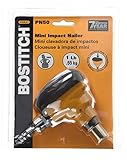


How Palm Nailers Work in Confined Spaces
A palm nailer is a small, cup-shaped pneumatic or battery-powered tool that you push over the head of a loose nail. A magnetic tip holds the nail while an internal piston hammers it at 3,000+ blows per minute. You control depth with hand pressure, not a trigger sequence.
That design solves two joist hanger problems:
- Clearance: Most palm nailers are under 3.5 inches in diameter and 5 inches tall, so they fit between 12-inch on-center joists, inside corners, and against rim joists where a standard nail gun magazine collides with lumber.
- Angle control: Because you place the nail by hand first, you can reliably hit the angled double-shear holes in Simpson Strong-Tie and USP joist hangers without the nail skittering out.
The trade-off is speed. A palm nailer drives one nail at a time and requires you to position each fastener, so it is slower than a dedicated joist hanger nailer for a full deck but far more versatile for retrofits, blocking, and hardware.
Compact vs. Standard Pneumatic vs. Cordless Palm Nailers Compared
Palm nailers fall into three categories that directly affect tight-space performance.
1. Standard Pneumatic Palm Nailers
Represented by the Bostitch PN100K and Grip-Rite palm nailers. These are the most powerful and durable option. They run on 70-120 PSI from a compressor, accept the widest nail range (typically 6d to 16d, or 2 to 3-1/2 inches), and weigh 1.8 to 2.6 lbs. Steel or aluminum housings handle jobsite abuse. The downside is the air hose, which can snag on joists and requires a compressor.
2. Compact / Mini Pneumatic Palm Nailers
Represented by the Freeman PMPN38 Mini and similar compact models. They shave about an inch off height and 0.5 lb off weight by using a smaller piston and shorter body. Nail range is usually limited to 5d to 12d (1-1/2 to 3-1/4 inches) and they deliver slightly less impact energy. They excel overhead and in 10 to 12-inch joist bays where every half-inch matters, but they may struggle to consistently sink 16d common nails into dense LVL or old-growth lumber.
3. Cordless Battery Palm Nailers
Represented by the Milwaukee M12 Palm Nailer 2458-20 on the 12V platform. No compressor or hose, so maneuverability is unmatched in crawlspaces, attics, and remodels. Driving energy is lower than pneumatic, nail range is typically up to 3-1/2 inches but with slower cycle speed, and runtime is limited by battery capacity (around 150-200 16d nails per 2.0Ah charge). Weight is higher due to motor and battery, and the tool body is longer.
Spec Comparison: Leading Palm Nailers for Joist Hangers
Numbers matter when you are fitting between joists. These are manufacturer-published specs for current 2026 models:
| Model / Type | Weight (Tool Only) | Overall Height x Diameter | Nail Capacity (Length / Gauge) | Operating Pressure / Power | Housing Material |
|---|---|---|---|---|---|
| Bostitch PN100K (Standard Pneumatic) | 2.2 lbs | 4.9 in x 3.4 in | 1-3/4 in to 3-1/2 in (6d-16d) loose nails | 70-120 PSI | Aluminum body, hardened steel piston |
| Freeman PMPN38 (Mini Pneumatic) | 1.7 lbs | 3.5 in x 3.2 in | 1-1/2 in to 3-1/4 in (5d-12d) loose nails | 70-100 PSI | Aluminum body, steel nosepiece |
| Grip-Rite GRPN100 (Standard Pneumatic) | 2.5 lbs | 5.1 in x 3.5 in | 2 in to 3-1/2 in (6d-16d) loose nails | 80-120 PSI | Cast aluminum, rubber grip sleeve |
| Milwaukee 2458-20 M12 (Cordless) | 3.1 lbs with 2.0Ah battery | 6.5 in x 3.0 in | 1-1/2 in to 3-1/2 in (up to 16d) loose nails | 12V Li-Ion, ~3,000 BPM | Steel nose, reinforced nylon housing |
Key takeaway for joist hangers: Standard pneumatic models accept the full 1-1/2 in 10d joist hanger nails and the longer 3-1/2 in nails for ledger and header fastening without swapping tools. Mini models save weight but often list a maximum of 3-1/4 in, which excludes some 16d sinkers. Cordless models accept the length but add height that can be tight for overhead blocking between joists.
Fastener Compatibility: What Actually Matters for Joist Hangers
Joist hangers are not just about length. Code calls for specific fasteners, and palm nailers must handle them:
- 10d x 1-1/2 in joist hanger nails: The critical fastener. Every palm nailer listed above drives it, but magnetic holders vary. A strong magnet that holds the nail at a slight angle prevents the nail from falling out when you reach overhead.
- 16d common / 3-1/2 in nails: Needed for the ledger and face-mount through the header. Standard pneumatics and the Milwaukee cordless drive these reliably. Mini pneumatics may require full 100 PSI and clean, dry lumber to sink them flush.
- Nail type: Palm nailers drive loose bulk nails, not collated strips. You can use hot-dipped galvanized, stainless, or double-dipped joist hanger nails without worrying about collation compatibility or gun-specific nails. Avoid hardened concrete or cut nails; they can damage the piston.
- Shank diameter: Most 10d hanger nails are 0.148 in, 16d are 0.162 in. Palm nailers accept both without adjustment, unlike cartridge nailers that require different nosepieces.
Grip Comfort and Control in Tight Spaces
Driving performance in joist hangers depends as much on control as power.
Palm vs. pistol grip: Pneumatic palm nailers with a rounded, strap-style palm pad distribute recoil across your palm and let you push with your whole hand. This is more stable overhead than a pistol-grip cordless tool that concentrates weight forward. If you have hand fatigue issues or wear gloves, look for a thick rubber overmold like on the Bostitch PN100K.
Vibration and recoil: Pneumatic models transmit sharp, short impacts but minimal pushback if you maintain steady pressure. Cordless models vibrate slightly more and require you to keep the nail perpendicular until it is set. In confined bays where your elbow is against a joist, the shorter body of a mini pneumatic lets you keep your wrist straight, reducing deflection.
Hose vs. hose-free: A hose adds drag but acts as an air exhaust and keeps the tool lighter. In a continuous joist line, a swivel fitting and a 1/4 in lightweight flex hose matters more than the tool weight. For one or two hangers in a crawlspace, cordless eliminates the need to drag a compressor through an access hatch.
Driving Performance: What to Expect
Palm nailers are not impulse nailers. Expect 2 to 4 seconds per 1-1/2 in hanger nail and 4 to 7 seconds per 3-1/2 in 16d in SPF lumber, longer in Douglas fir or LVL. Performance tips that affect results:
- Set the compressor to 90-100 PSI for 1-1/2 in nails and 100-110 PSI for 16d. Below 70 PSI, nails may not set flush and you will be tempted to tilt the tool, which bends nails.
- Keep the tool perfectly inline with the nail. Even 5 degrees off-axis in a joist hanger hole causes the nail to glance off the hanger coating and bend.
- Let the tool do the work. Pushing harder does not speed driving; consistent moderate pressure allows the piston to reciprocate fully. Lifting off early leaves a proud nail head.
Decision Matrix: Which Palm Nailer Fits Your Situation
| Your Situation | Best Type | Why |
|---|---|---|
| Installing 10+ hangers, building a deck or addition, have compressor access | Standard Pneumatic (Bostitch PN100K / Grip-Rite) | Highest power, widest nail range, lowest cost per nail, no battery swaps during production work |
| Tight 10-12 in joist bays, overhead work, retrofitting between existing joists | Mini Pneumatic (Freeman PMPN38 type) | Shortest height and lightest weight for extended overhead use, still pneumatic power for hanger nails |
| 1-4 hangers, crawlspace/attic, no compressor, remodel in finished home | Cordless (Milwaukee M12) | No hose or compressor noise, excellent maneuverability, sufficient power for occasional hanger nails |
| Budget under $75 and infrequent use | Standard Pneumatic, value-tier brand | Pneumatic palm nailers generally range from $50-$120; cordless kits start around $180-$250 with battery |
| Frequent mixed use: hangers, blocking, fence brackets, sill plates | Standard Pneumatic | Handles both short hanger nails and full 16d sinkers without compromise |
Cost Per Use: Pneumatic vs. Cordless Ownership
A practical calculation clarifies long-term cost beyond purchase price.
Assumptions: You install 200 joist hanger nails per year. A standard pneumatic palm nailer costs around $80, plus $0 if you already own a compressor. A cordless kit costs around $200 with one 2.0Ah battery. Bulk 10d 1-1/2 in hanger nails cost about $0.04 each regardless of tool.
Pneumatic: $80 / 5 years = $16/year + negligible electricity/air. Cost per nail year 1 = $0.44 ($80+ $8 nails /200), year 5 = $0.12 per nail as tool cost amortizes.
Cordless: $200 / 5 years = $40/year + battery replacement approx. $40 every 3 years. Cost per nail year 1 = $1.04, year 5 = $0.28 per nail.
If you already own a suitable compressor and hose, pneumatic is cheaper by a wide margin for frequent use. If you must buy a compressor just for hangers, cordless becomes cost-competitive for light use.
Durability and Ownership Realities
Palm nailers are simple tools but not maintenance-free.
- What wears first: The O-rings and bumper inside the piston cylinder. Dust from joists and metal shavings from hanger coatings accelerate wear. Dry firing without a nail is the most common cause of premature bumper cracking.
- Consumables: Pneumatic models need 3-4 drops of air tool oil before each use and after 2-3 hours of continuous driving. Cordless models need no oiling but the nose magnet can chip if dropped; a replacement nosepiece is typically $10-$15.
- Cleaning: Blow out the nosepiece with air after each session. Resin buildup inside the magnetic collar will cause nails to stick crookedly. Do not soak the tool in solvent; it swells the O-rings.
- Common mistakes: Using nails that are too short to stay magnetized (under 1-1/4 in), running over 120 PSI to compensate for a dull compressor regulator, and using the palm nailer as a hammer to set a bent nail. If a nail bends, pull it and start fresh; trying to straighten it damages the piston face.
- Storage: Pneumatic tools should be stored with a light coat of oil and disconnected from the hose. Cordless tools should be stored with the battery removed to prevent slow discharge.
General market pricing in 2026: pneumatic palm nailers $50 to $120, mini models $40 to $80, cordless palm nailer bare tools $130 to $170 and kits with battery and charger $180 to $260. Prices vary with materials (all-aluminum vs. composite) and included accessories like swivel fittings and carrying cases.
What to Check Before You Buy
- Confirm your compressor delivers at least 2.0 CFM at 90 PSI for continuous driving; a pancake compressor is sufficient, but a small hot-dog compressor may cycle constantly.
- Check nail diameter acceptance. Most list up to 0.162 in, which covers 16d, but some compact imports list only 0.148 in.
- Test fit with a sample hanger. Place a 1-1/2 in nail in the tool and see if the body clears the hanger flange and adjacent joist without canting your wrist.
- Look for a 360-degree swivel air inlet on pneumatic models and a belt clip on cordless models for ladder work.
FAQ
Can a palm nailer replace a dedicated joist hanger nailer?
For small jobs and retrofits, yes. For production framing with dozens of hangers, a dedicated pneumatic joist hanger gun that shoots collated 1-1/2 in nails is much faster. Many contractors own both: the gun for open framing and the palm nailer for tight bays the gun cannot reach.
Will a palm nailer drive Simpson Strong-Tie SD screws or only nails?
Palm nailers drive nails only. Strong-Drive SD connector screws require a drill or impact driver. Do not attempt to drive screws with a palm nailer; the threads will jam the nosepiece.
Do I need a special nail for palm nailers?
No. Any loose common, box, or joist hanger nail within the tool’s length range works. For structural hangers, use code-specified 10d 1-1/2 in galvanized hanger nails, not roofing or finish nails.