Best Slab Saws for Rock and Lumber in 2026
What's inside
- Quick comparison of slab saw classes
- Best overall: 14-inch lapidary slab saw
- Best budget: 10-inch benchtop saw
- Best for large rough and commercial slabbing: 18-24 inch saw
- Best for live-edge wood: chainsaw slabbing mill
- Best for regular lumber production: portable bandsaw mill
- How to choose a slab saw
- Decision matrix by situation
- Durability and ownership realities
- Frequently Asked Questions
As an Amazon Associate I earn from qualifying purchases. This post may contain affiliate links at no extra cost to you.
The best slab saw is the one whose blade diameter and vise travel match the biggest piece you will actually cut: a 10-12 inch saw suits hobby rock and agate work, an 18-24 inch saw suits serious lapidary shops, and a chainsaw or bandsaw mill is the right “slab saw” if you mean live-edge lumber. For most buyers who search this phrase, a 14-18 inch oil-or-coolant-fed lapidary slab saw from makers such as Covington, Lortone or Diamond Pacific is the sweet spot. This guide covers both meanings so you can pick the right machine class before comparing models.
As an Amazon Associate we earn from qualifying purchases at no extra cost to you.

Quick comparison of slab saw classes
| Pick | Best for | Key specs | Price range |
|---|---|---|---|
| 10-inch benchtop lapidary slab saw | Beginners, agate and jasper nodules, small rough | 10 in blade, about 3 in max cut depth, 1/3-1/2 hp motor, 90-120 lb | Budget to mid-range |
| 14-inch lapidary slab saw | Hobbyists who cut geodes and larger cabochon rough | 14 in blade, about 5 in cut depth, 1/2-3/4 hp, power feed optional | Mid-range |
| 18-inch lapidary slab saw | Serious rock shops, fossil and petrified wood | 18 in blade, about 6.5-7 in cut depth, 1-1.5 hp, drip or oil bath | Upper mid-range to premium |
| 24-inch and larger slab saw | Commercial slabbing, large boulders | 24 in blade, about 9-10 in cut depth, 2+ hp, automatic feed | Premium |
| Chainsaw slabbing mill (Alaskan-style) | Occasional live-edge slabs from felled logs | Guide bar 36-60 in, bolts to a 70+ cc saw, cuts slabs 2-3 in thick | Budget (plus the saw) |
| Portable bandsaw sawmill | Regular slab production from logs | Log diameter 26-28 in typical, 1/4 in kerf, gas or electric | Premium |
Best overall: 14-inch lapidary slab saw
A 14-inch saw is the class most hobbyists end up wishing they had bought first. The blade can take a 4-5 inch geode or a good-sized chunk of rough in a single pass, yet the machine still fits on a sturdy workbench and runs on a standard household circuit. Look for a cast or heavy sheet-steel body, a sealed or shielded motor, a coolant or oil reservoir that drains easily, and a vise that locks square to the blade. Per the manufacturers’ spec sheets, models in this class typically weigh 150-250 pounds with reservoir empty.
The main trade-off is size and cost compared with a 10-inch saw. If you only cut a few small nodules a month, the larger machine is more reservoir to fill, more blade to replace, and more floor space to dedicate.
Best budget: 10-inch benchtop saw
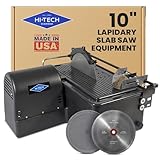
A 10-inch saw is the entry point and is perfectly adequate for agate, jasper and sliceable thundereggs. A 10-inch blade yields roughly 3 inches of cut depth, which means anything bigger than a fist needs to be rotated and cut from both sides. These saws are light enough to move, and replacement blades cost far less than 14-inch ones. Buyers should confirm the vise rail length (usually 5-7 inches of travel) and whether the saw includes a splash guard and clear lid, because without them the coolant mist reaches everything in the room.
The trade-off is capacity and blade life: thin small-diameter blades wear out faster per square inch of rock cut, and the slower feed rate makes big jobs tedious.
Best for large rough and commercial slabbing: 18-24 inch saw
If you are cutting petrified wood rounds, large fossils or boulders for resale, an 18-inch machine with an adjustable power feed is the practical minimum. The feed advances the rock at a steady rate, which prevents chatter and blade pinch, and it frees you to polish or sort while the saw works. Expect a 1 to 1.5 horsepower motor and a blade that lasts hundreds of square inches of cutting per blade when kept cool and aligned. Machines at this scale are heavy (often 400 pounds or more) and may need a dedicated stand and a 220-volt circuit.
The trade-off is cost, weight and fluid volume. An 18-inch oil-bath saw needs several gallons of oil or coolant, and disposal rules for used cutting oil vary by area, so check local guidance.
Best for live-edge wood: chainsaw slabbing mill
If “slab saw” means turning a felled walnut, maple or oak log into table-top slabs, a chainsaw mill such as the Granberg Alaskan-style frame is the lowest-cost route. It clamps to a guide bar of 36 inches or longer and rides on a leveled first cut, usually a 2×6 or a ladder rail. You will want a saw of at least 70 cc, with a ripping chain ground to a low angle, and patience: a 24-inch wide slab several feet long can take 15-30 minutes of continuous cutting per pass. The kerf is wide (about 3/8 inch), so you lose a lot of timber compared with a bandsaw mill.
The trade-off is speed and waste. For occasional table or mantel slabs it is fine; for repeated work, a portable bandsaw mill from brands such as Woodland Mills or Wood-Mizer saves hours and yield.
Best for regular lumber production: portable bandsaw mill
A bandsaw mill uses a thin 1/16-1/8 inch kerf blade on a rail-guided carriage. Entry-level models typically handle logs up to about 26-28 inches in diameter and 8-10 feet long; larger models extend to 36 inches and beyond. They produce flatter, more consistent slabs than chainsaw mills and waste less wood. Blade sharpening or replacement is the main running cost, and you will also need a way to move and load logs, such as a log arch or a tractor with forks.
The trade-off is the upfront cost and the footprint: you need level ground, a trailer or a storage spot, and a place to sticker and dry the slabs for months afterward.
How to choose a slab saw
Match blade diameter to your largest rock
Maximum cut depth is roughly one third of blade diameter minus the arbor flange. A 10-inch blade cuts about 3 inches deep, a 14-inch about 5, an 18-inch about 6.5-7, and a 24-inch about 9-10. If you plan to cut anything bigger than the cut depth, you will have to flip and re-cut, which risks misalignment.
Choose coolant system carefully
Oil-bath saws are messy but keep blades cool and extend blade life; drip systems use water-based coolant and are cleaner but need regular reservoir monitoring. Per most lapidary blade makers, running a diamond blade dry for even a short time can glaze it and crack the rim.
Check the vise and feed
A vise that tracks square keeps slabs parallel. Power feeds are worth the extra cost beyond 14 inches. Hand-fed cutting is fine on small saws but inconsistent pressure is the leading cause of wavy cuts and prematurely worn blades.
Plan for blade costs
Blades for 10-inch saws may cost a fraction of 24-inch blades, but you also cut more slowly. As a worked example: if a blade costs 100 units of your currency and cuts roughly 800 square inches of agate, each square inch costs about 0.125 units; a blade of the same price that lasts 1,200 square inches drops that to about 0.083. Larger saws with power feed and good cooling tend to reach the higher figure, provided you actually use them.
Decision matrix by situation
| Your situation | Best match | Why | Watch out for |
|---|---|---|---|
| Garage hobbyist, cuts a few nodules a month | 10-inch benchtop | Small footprint, low blade cost, under 120 lb | Cut depth of about 3 in forces flip-and-recut |
| Weekly rock cutting, sells cabochons at shows | 14-inch with optional power feed | 5 in depth covers most rough; steady feed saves time | Needs a stand rated for 200+ lb |
| Cuts petrified wood or large fossils | 18-inch with power feed | 6.5-7 in depth, higher horsepower, longer blade life | Oil volume, 220 V wiring, disposal rules |
| One or two live-edge tables a year | Chainsaw mill | Lowest entry cost if you already own a large saw | Wide kerf wastes about 3/8 in of wood per cut |
| Milling logs every month | Portable bandsaw mill | Thin kerf, flatter slabs, higher yield | Space, log handling, blade upkeep |
Durability and ownership realities
- What wears first: the blade, then the vise screw and the coolant pump. Rinse grit from the vise after every session.
- Rust: bare steel parts rust fast around water-based coolant; wipe and lightly oil exposed surfaces.
- Safety: wear eye protection, keep hands clear of the blade, and never reach into the box while the saw runs. Wet saws should be on a GFCI-protected circuit.
- Noise and dust: wet cutting controls silica dust, but slurry that dries can become airborne, so clean up with water rather than a broom.
Frequently Asked Questions
What is a slab saw used for?
A slab saw cuts a large rock, geode or log into flat, thin sections called slabs. In lapidary work those slabs are later trimmed into cabochons, bookends or display pieces. In woodworking, slabs are used for live-edge tabletops and mantels.
Can I use a tile saw as a rock slab saw?
A wet tile saw can cut small, soft stones in a pinch, but the blade is thin, the capacity is shallow and the water system is not designed for the grit slurry. A purpose-built lapidary saw lasts longer and gives better cuts.
How thick should I cut slabs?
For cabochons, 4-6 mm is common; for display slabs, 8-12 mm; for tabletop wood slabs, 2 to 3 inches before drying. Cut slightly thicker than the final target because grinding and flattening will remove material.
Do I need oil or water in the saw?
Follow the saw manufacturer’s guidance. Many traditional lapidary saws use a light cutting oil, while newer designs work with water plus a rust-inhibiting additive. Using the wrong fluid can damage seals or reduce blade life.
How long does it take to dry a wood slab?
A common rule of thumb is about one year per inch of thickness for air drying, followed by a period of acclimation indoors. A kiln can shorten the timeline to weeks, but it costs extra.