6 Best Rotary Tools for Detail Work (October 2026) Buying Guide
Key takeaways
- The best rotary tools for detail work compared by speed range, battery and kit size, plus two accessory kits and tips on collets and safe speeds.
What's inside
As an Amazon Associate I earn from qualifying purchases. This post may contain affiliate links at no extra cost to you.
The Fanttik F2 PRO cordless rotary tool kit is the best pick here for detail work. It lists a 25,000 RPM top speed, five speed settings, a magnetic motor, a charging hub and 55 accessories, which gives hobbyists and modelers more headroom than the other cordless minis at 18,000 RPM or less. It suits 3D-print cleanup, miniature painting prep, jewelry polishing and light engraving. “Detail work” means small, controlled jobs such as engraving, sanding in tight corners and trimming fine edges, where control matters more than raw power. Two items in this lineup are accessory kits, not tools, and are labeled that way below.
Quick List
- HARDELL Mini Cordless Rotary Tool (69 pcs) – best for a USB-C rechargeable starter kit for 3D-print cleanup
- Fanttik F2 PRO Cordless Rotary Tool Kit – best for higher speed and finer control across five settings
- Cordless Mini Rotary Tool Set (64 pcs) – best for an engraving-pen style tool with a wide speed range
- WORKPRO Mini Cordless Rotary Tool (71 pcs) – best for quiet, lightweight comfort during long sessions
- 69-Piece Rotary Tool Accessories Kit – accessory kit only, best for adding small-shank sanding bits to a compatible tool
- WORKPRO 698-Piece Accessories Kit – accessory kit only, best for stocking a large library of bits
Which One Is Right for You?
| If you… | Choose |
|---|---|
| clean up 3D prints and want a rechargeable tool with USB-C charging | HARDELL Mini Cordless Rotary Tool |
| want the highest listed speed and a more modern kit | Fanttik F2 PRO Cordless Rotary Tool Kit |
| prefer a slim pen-style tool for engraving glass, metal and wood | Cordless Mini Rotary Tool Set (64 pcs) |
| sit at a bench for hours and value low noise and light weight | WORKPRO Mini Cordless Rotary Tool |
| already own a small rotary tool and need more bits for sanding and carving | 69-Piece Rotary Tool Accessories Kit |
| own a rotary tool and want a very large assortment of bits, discs and polishers | WORKPRO 698-Piece Accessories Kit |
For detail work, speed control and weight matter most. A pen-style cordless tool is easier to hold like a pencil, and a wider speed range lets you slow down for plastic and speed up for metal. Check the tool’s collet size before you buy accessories, since small-shank bits do not fit every tool.
All 6 Picks in Detail
1. HARDELL Mini Cordless Rotary Tool (69 pcs) – Best for a USB-C Starter Kit
As an Amazon Associate we earn from qualifying purchases at no extra cost to you.

This is a compact rechargeable rotary tool aimed at hobbyists, particularly people cleaning up 3D prints. It comes as a 69-piece kit in a case, with five speeds from 5,000 to 18,000 RPM, a 2,000 mAh battery and USB-C charging. The pen-like shape and LED light make it a sensible choice for engraving, light sanding and detailed trimming.
- Five speeds from 5,000 to 18,000 RPM, per the listing
- 2,000 mAh rechargeable battery with USB-C charging
- LED light to illuminate the work area
- 69-piece accessory kit with a storage case
- Engraving pen style body
- Collet size and runtime: confirm on listing
Pros:
- USB-C charging means a common cable and charger will do
- Five speeds give useful control for plastic, wood and soft metal
Cons:
- Lower top speed than the Fanttik F2 PRO
- A mini tool offers less torque for heavy grinding
Next to the generic 64-piece set, this model has clearer charging and brand details.
A pen-style tool is easiest to use with a pencil grip, resting the side of your hand on the bench so the bit moves in small, steady increments. For 3D-print supports, start at the lowest speed, because high speeds create friction heat that can soften plastic and smear it instead of cutting it.
2. Fanttik F2 PRO Cordless Rotary Tool Kit – Best for Higher Speed and Finer Control

The F2 PRO is the standout in this group on listed specifications. The title describes a strong magnetic motor, five speeds, a top speed of 25,000 RPM, a Revostor hub and 55 accessories, and mentions 3D printer use. Higher top speed is useful for polishing, engraving harder materials and cutting with small discs, while the five speed settings still allow slow operation for plastic.
- Magnetic motor, per the listing
- Five speed settings with a maximum of 25,000 RPM
- Revostor hub, which the listing associates with storage and charging; confirm details on the product page
- 55 accessories included
- Cordless design aimed at hobby and 3D printer cleanup
- Battery capacity and collet size: confirm on listing
Pros:
- Highest listed speed of the four rotary tools
- Hub-style charging and storage keeps the tool and bits organized
Cons:
- Fewer accessories than several of the bargain kits
- Higher speed demands more care with plastics, which melt easily
If you plan to cut or grind harder materials such as metal or ceramic, the higher speed helps small bits cut cleanly rather than rub. Even so, the F2 PRO is still a cordless mini-class tool, so keep expectations realistic for heavy cutting. Confirm the battery capacity, accessory shank size and charging details on the product page before you buy.
It is the one to choose over the HARDELL or generic sets if you want more speed range and a more complete system.
Think of the top speed as a ceiling, not a target. Most detail tasks happen at moderate speeds, where bits stay in control and tools run cooler. The extra headroom helps when you move to harder materials or work with small-diameter bits that need high speed to cut efficiently.
3. Cordless Mini Rotary Tool Set (64 pcs) – Best for an Engraving-Pen Style Tool

This set pairs a cordless rotary tool with 64 accessories. The listing states five speeds, a range of 5,000 to 18,000 RPM, a 3.7V rechargeable battery and an LED light, and describes it as an engraving pen. It is a no-frills kit for casual crafting, engraving names on tools or smoothing small edges. The brand is not stated in the listing name, so support and parts are uncertain.
- Five speeds from 5,000 to 18,000 RPM
- 3.7V rechargeable battery, per the listing
- LED light
- 64-piece accessory set
- Engraving pen format
- Brand, battery capacity and charging type: confirm on listing
Pros:
- Speed range equals more expensive mini tools
- Good starter choice for light-duty engraving
Cons:
- Brand and support are unclear from the listing
- Some details such as battery capacity are not stated
Engraving pens like this are well suited to labeling tools, personalizing small metal and glass items, and light carving in wood. The technique matters more than the tool: trace the design lightly in pencil or marker first, keep the bit moving in small overlapping passes, and let the speed do the cutting rather than pushing. For glass, use a diamond bit and a low to moderate speed, and keep the surface cool.
Choose this over the HARDELL only if the price or accessory mix appeals, since the two share the same speed range.
When a listing does not name the brand, confirm the return policy and look for replaceable accessories. Pen-style tools commonly use small collets, so check the shank size of bits you plan to buy later.
4. WORKPRO Mini Cordless Rotary Tool (71 pcs) – Best for Quiet, Comfortable Long Sessions

The WORKPRO mini tool targets engraving, drilling and carving, and the listing highlights low noise, light weight, three speeds and an ergonomic handle. Its listed range is 12,000 to 17,000 RPM, so it has less low-speed range than the five-speed pen tools. That makes it a better fit for wood, soft metal and general carving than for delicate plastics that need very slow speeds.
- Three speeds from 12,000 to 17,000 RPM, per the listing
- 71-piece kit
- Low noise operation, as advertised
- Lightweight with an ergonomic handle
- Intended for engraving, drilling and carving
- Battery capacity and charging method: confirm on listing
Pros:
- Comfortable and quiet for longer sessions
- Established tool brand that is easy to find support for
Cons:
- Narrow speed range with a high minimum speed
- Only three speed steps limits fine control
Compared with the Fanttik F2 PRO, this tool is simpler and quieter but has a narrower speed range.
Quiet operation is a practical feature, not just a comfort one. A tool that is less harsh to hear tends to be used with more patience, and for hobbyists working late or in shared spaces that counts. Keep in mind that low noise is a marketing description in the listing, and the real-world difference will vary by accessory and material.
The high minimum speed means you should use a light touch and quick, short passes on plastic. For wood, soft metals and shell, the speed range is a better match.
5. 69-Piece Rotary Tool Accessories Kit – Accessory Kit Only

This is not a rotary tool. It is a set of 69 accessory bits, including sanding bits for woodworking, drilling and sanding, with shanks of 1.0, 1.6 and 2.3 millimeters listed. It belongs here as a runner-up because detail work depends on having the right bit, but you will need a tool with a compatible collet. Small shank sizes like these are typical of mini rotary tools and engraving pens, not of larger tools with 1/8 inch (3.2 millimeter) collets.
- 69 pieces of bits and sanding accessories
- Listed shank diameters of 1.0, 1.6 and 2.3 millimeters
- Intended for woodworking, drilling and sanding, per the listing
- Not a tool, no motor or battery
- Collet compatibility: confirm against your tool
- Case and bit types: confirm on listing
Pros:
- Adds variety for sanding and drilling at small scale
- Small shanks suit the miniature tools in this guide
Cons:
- Useless without a compatible rotary tool
- Shank sizes may not fit larger standard tools
Match the bits to the task. Small sanding drums and mandrels help with shaping curves in wood and resin, fine drill bits make pilot holes in thin material, and small burrs let you carve or smooth tight corners. If your tool takes a larger collet, you would need an adapter or a different set, so confirm the fit in writing before ordering. Store the bits in the case with the shanks inserted in their slots to keep them from rolling away.
Consider this only after you have chosen a tool and confirmed its collet size.
A smaller shank is not automatically a drawback. It reflects the small tools the shank is made for, and for modeling, jewelry and print cleanup it is often what you want.
6. WORKPRO 698-Piece Accessories Kit – Accessory Kit Only
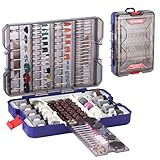
This is also an accessory kit, not a tool. The listing describes 698 pieces of rotary tool bits for cutting, grinding, sanding, polishing, cleaning, drilling and carving. It is a bulk library for people who already own a rotary tool and want to try different tasks. Most of the pieces will be small, so the real value depends on whether the bits you will actually use are well made and fit your collet.
- 698 pieces, per the listing
- Covers cutting, grinding, sanding, polishing, cleaning, drilling and carving
- Not a tool; requires a compatible rotary tool
- Shank sizes and included mandrels: confirm on listing
- Case type and organization: confirm on listing
- Maximum rated speed for discs: confirm on listing
Pros:
- Large selection to try many techniques
- Single case holds everything in one place
Cons:
- Many pieces may go unused and cutoff discs need careful handling
- Does not include a motor, battery or charger
If you are new to rotary tools, resist the temptation to start with a large set. Start with a handful of general bits, learn which ones you reach for, and add specific polishers or burrs later. Check that every mandrel and screw is included, because small parts get lost easily and a missing mandrel makes sanding discs useless.
Between the two kits, the 69-piece set is small-shank and sanding focused, while this one is a broad general library.
With any large accessory set, sort out the pieces you use and discard worn items. Cutoff discs are thin and can shatter, so use them only at or below their rated speed, with eye protection and a guard where possible.
Specs Compared
| Model | Type | Speed range | Power | Pieces | Light |
|---|---|---|---|---|---|
| HARDELL Mini Cordless | Cordless tool kit | 5,000 to 18,000 RPM, 5 speeds | 2,000 mAh battery, USB-C | 69 | LED |
| Fanttik F2 PRO | Cordless tool kit | Up to 25,000 RPM, 5 speeds | Magnetic motor; battery confirm on listing | 55 accessories | Confirm on listing |
| Cordless Mini Set (64 pcs) | Cordless tool kit | 5,000 to 18,000 RPM, 5 speeds | 3.7V rechargeable | 64 | LED |
| WORKPRO Mini Cordless | Cordless tool kit | 12,000 to 17,000 RPM, 3 speeds | Confirm on listing | 71 | Confirm on listing |
| 69-Piece Accessories Kit | Accessories only | Not applicable | None | 69 | Not applicable |
| WORKPRO 698-Piece Kit | Accessories only | Not applicable | None | 698 | Not applicable |
How We Chose These
This guide is built on desk research. We began with the six products supplied for this topic and read each listing for speed range, power source, kit contents and any stated features. We then compared those details with common guidance on rotary tool speeds, collet sizes and accessories for detail work such as engraving, sanding and print cleanup. We noted the two products that are accessory kits rather than tools and placed them as runner-ups. Where the listing does not state a value such as battery capacity or collet size, we say to confirm it on the product page. We do not make claims about runtime or performance that we have not verified.
What to Look For
Speed range and control
Rotary tools are measured in revolutions per minute. Mini cordless tools commonly run from around 5,000 to 18,000 RPM, and more powerful ones go to 25,000 or more. For detail work, the low end matters as much as the top speed. Low speeds around 5,000 to 8,000 RPM suit plastics, resin and soft materials that melt from friction, while high speeds suit metal, glass and hard wood. Choose a tool with at least five speed steps if you work with mixed materials, and treat high speeds as an option, not a default.
Collet size and accessory compatibility
The collet is the small chuck that grips the bit. Full-size rotary tools usually take 1/8 inch (3.2 millimeter) shanks, and many mini tools use smaller collets, such as 1/16 inch or 3/32 inch (about 2.35 millimeters). Bits with shanks of 1.0, 1.6 and 2.3 millimeters need smaller collets or collet inserts. Always match the shank to the collet, since a loose bit wobbles and can fly out. Buying a tool with a clear collet specification saves frustration later.
Ergonomics, battery and charging
Pen-style tools are light and are held like a pencil, which is best for detailed work at close range. A pistol-grip or ergonomic handle is more comfortable for long sessions. Battery capacity, given in milliamp-hours, determines how long you can work between charges, and USB-C charging is convenient because you can use a common cable. An LED light removes shadows. Charge lithium batteries with the supplied cable, avoid charging unattended on soft surfaces, and stop using a battery that swells or overheats.
Accessories that matter
A large piece count looks impressive, but a few good bits do most of the work. For detail work, small carbide or diamond burrs, fine sanding drums, felt polishing tips, and thin cutoff discs cover most tasks. Check that cutoff discs and grinding stones carry a rated maximum speed that is higher than the tool’s top speed. Replace worn or chipped bits immediately.
Safety and care
Rotary tools spin small accessories at very high speed, so a few habits prevent most injuries. Wear safety glasses or a face shield whenever the tool is running, because fragments from burrs and discs can fly out. Use a dust mask when sanding wood, resin or 3D-printed plastic, since fine dust is unhealthy to inhale. Clamp small workpieces rather than holding them in your fingers. Allow the bit to come to a full stop before setting the tool down, and unplug or switch off before changing accessories. Do not run a cutoff disc above its rated speed or use it for side grinding, and discard any disc that is cracked or chipped. For cordless models, use the supplied charging cable, keep batteries away from heat and replace any pack that swells.
A worked example
Suppose you are cleaning the support marks from a small 3D-printed figure. Pick a small sanding drum or a fine burr, set the tool to its lowest speed, and wear safety glasses and a dust mask. Touch the bit lightly and move it in short strokes. If you see plastic smearing or shiny melted edges, drop the speed or lift off more often. Finish by hand with fine sandpaper. The same tool at 18,000 RPM would probably melt the plastic, which shows why a wide, low starting speed beats a high maximum.
Questions
What speed should I use for detail work?
Start low, around 5,000 to 8,000 RPM for plastics and soft materials, and move upward for wood, metal and glass. Increase speed gradually and use a light touch. Too much speed generates heat and ruins fine detail.
Are mini cordless rotary tools powerful enough?
For engraving, polishing, sanding and print cleanup, yes. They have less torque than full-size corded tools, so they struggle with heavy grinding or thick metal. Treat them as precision tools, not heavy-duty replacements.
Can I use any bit in any rotary tool?
No. The shank diameter must match your tool’s collet. Many full-size tools use 1/8 inch shanks, while mini tools may use smaller sizes. Check the collet specification before you buy accessories.
Do I need a case or hub?
A case is not essential but it helps keep small bits from getting lost. A hub or charging stand keeps the tool and accessories in one place. These are conveniences rather than performance features.
How should I protect myself when using a rotary tool?
Wear safety glasses at all times, use a dust mask when sanding or grinding, and tie back loose hair and clothing. Make sure the bit is fully seated, never exceed a disc’s rated speed, and let the tool stop spinning before you put it down.
Are big accessory kits worth it?
They can be, if you do varied projects. Many pieces in a large kit go unused, so buy a bigger set only if you know what you need. A small set of quality bits often performs better than hundreds of low-quality ones.
Update History
- October 20, 2026 – Initial publication; product set drawn from current catalog listings.
- Check the product page for current specifications and availability before buying.
Sources
- Retailer listing titles and specification fields for the HARDELL, Fanttik, WORKPRO and generic rotary tool and accessory products
- General published guidance on rotary tool speeds, collet sizes and accessory ratings
