
What's inside
As an Amazon Associate I earn from qualifying purchases. This post may contain affiliate links at no extra cost to you.
Our Top Picks

The Short Answer
The best wet tile saw is the one that can make the cuts your tile requires, with a water system that works, on a table that holds the tile flat. For a bathroom or backsplash with standard ceramic, a compact tabletop saw is usually plenty. For large-format porcelain, natural stone or whole-house floors, a bigger sliding-table or rail saw is worth the money and the space. Pay attention to the blade, the water pump and the rip fence as much as the motor, because these decide how clean the edges are and how long the saw lasts. Whatever you buy, plug it into a GFCI outlet and wear eye, ear and lung protection.
Below you will find the saw types explained, what the specifications really mean, blade selection, setup, safe operation and maintenance. No brands are ranked, since the right saw depends on your tile and your workload.
In This Guide
- Why a wet saw at all
- Types of wet tile saws
- How to choose
- Key features
- Blades and power explained
- Setup and first cuts
- Safety
- Maintenance
- Common mistakes
- Who should choose what
- Checklist
- FAQ
- Conclusion
Why Use a Wet Saw at All
A wet tile saw feeds water across a diamond blade while it cuts. The water does three jobs: it cools the blade so the diamond segments are not glazed over by heat, it flushes away the slurry of ground tile, and it keeps hazardous dust out of the air. Cutting hard materials such as porcelain and stone dry on an ordinary saw produces chipped edges, a burnt blade and a cloud of fine dust.
Alternatives exist. Manual score-and-snap cutters are fast and dust-free for straight cuts on thinner ceramic, and angle grinders with diamond blades can notch around pipes. But for repeatable, clean, accurate cuts, particularly on dense porcelain, a wet saw remains the standard tool, and it is the one most people end up buying or renting.
Types of Wet Tile Saws
Tabletop (benchtop) saws. These are the compact, lightweight models many homeowners buy. A small motor drives a blade over a pan of water, and a tray slides the tile into the blade. They are inexpensive, easy to carry and sufficient for bathroom walls, kitchen backsplashes and small floors. Their limits are a small table, shorter cut length and motors that struggle with thick, dense or very large tile.
Rail or bridge saws. Here the motor and blade travel along rails over a fixed tray that holds the tile, so the tile stays still while the blade moves. Many installers prefer this arrangement for accuracy on large-format tiles, and the cut quality tends to be better because the tile is not being pushed into the blade. They are heavier and need a stand.
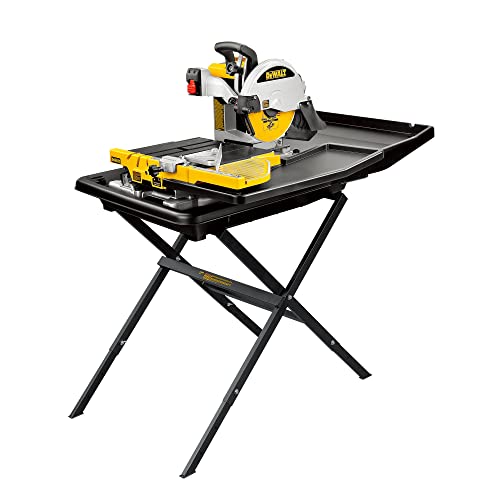
Sliding-table saws on stands. This is the classic professional layout: a table slides the tile past a fixed blade, mounted on a folding stand with a large water reservoir. They cut longer tiles, hold up to daily use and handle bevels. They are bulky, so they suit a garage, a work trailer or a regular job-site routine.
Handheld wet-cutting tools. Some grinders and tile cutters can be fed water, and they are useful for notches, cut-outs and in-place trimming. They do not replace a table-mounted saw for repeated straight cuts, and the water-feed accessories must be used with proper electrical protection.
Masonry and stone saws. Larger saws for thick pavers, natural stone slabs and landscape materials use bigger blades and more powerful motors. They are overkill for ordinary wall tile but necessary for thick stone work.
Comparison of wet tile saw types
| Type | Best for | Strengths | Trade-offs |
|---|---|---|---|
| Tabletop saw | Small bathrooms, backsplashes, occasional use | Light, affordable, easy storage | Short cut length, less power, small table |
| Rail or bridge saw | Large-format porcelain, accurate repeat cuts | Tile stays still, clean edges | Heavier, needs stand and space |
| Sliding-table saw on stand | Professional daily use, floors, longer tiles | Large capacity, durable, big water reservoir | Bulky, harder to transport |
| Handheld water-fed tool | Notches, cut-outs, in-place trimming | Portable, flexible | Not suited to long straight cuts |
| Masonry or stone saw | Thick pavers, natural stone slabs | Deep cut, strong motor | Heavy, expensive, more than most need |
How to Choose
Start with the tile. Measure the largest tile you expect to cut, the thickness, and the material. Porcelain is dense and brittle and demands a good blade and a steady feed. Natural stone varies from soft marble to hard granite. Glass tile chips easily and needs a special blade. Standard ceramic wall tile is the most forgiving.
Then consider how many cuts you will make. One bathroom involves a few dozen cuts, and a rental may be the smartest option. A whole house of floor tile involves hundreds, and a robust saw pays for itself in speed and fewer broken tiles.
Think about transport and storage. Tabletop saws fit a car trunk; stand-mounted saws need a truck or van. If you work in an apartment or finished room, consider where the slurry will go and how you will protect the floor.
Finally, think about the water setup. Clean water means cleaner cuts and longer blade life, and a saw with a large reservoir lets you work longer before refilling.
Key Features That Matter
Rip fence and miter guide. A fence that slides smoothly and locks square gives consistent strips, and a miter guide helps with diagonal cuts. Check for play: any wobble shows up as an angled cut.
Table size and support. The tile should sit flat and be fully supported, or it can crack at the end of the cut. Extensions help with larger tiles.
Water pump and spray. The pump should deliver water to both sides of the blade at a steady rate. Check how the pump is protected from slurry, how easy it is to remove for cleaning and whether the tray drains.
Blade guard and splash shield. A guard is safety equipment, and a good splash shield also keeps you drier. Make sure the guard does not block your view of the cut line.
Bevel capability. If you do mitered outside corners, a tilting head or bevel setting is valuable. It adds complexity, so make sure it locks firmly.
Plunge cuts. Some saws allow the blade to be lowered into the tile for L-shaped cuts around outlets and corners, which is helpful but takes practice.
Laser or light guides. They can help alignment, but the cut quality depends more on the fence and blade than on a guide light.
Blades and Power Explained
Blade rim types. Continuous-rim blades give the smoothest finish on porcelain and glass because there are no gaps to catch the tile edge. Segmented blades cut faster and are good for stone and masonry but leave rougher edges. Turbo-style rims are a compromise between the two.
Blade diameter. This sets the maximum depth of cut and thus the thickness of tile and the cut length. Use the diameter your saw was designed for and do not exceed the manual’s blade limit.
Bond and diamond quality. A softer bond exposes new diamond more quickly and suits hard porcelain, while a harder bond lasts longer on abrasive, softer materials. This is why blades are described for specific materials, and why using a ceramic blade on dense porcelain wears out quickly.
Motor power. Smaller saws often use a modest motor, which is fine for wall tile but can bog down with thick tile. Larger saws use stronger motors and maintain blade speed under load. Do not push a stalling motor; slow the feed instead.
Arbor size. The blade bore must match the saw’s arbor. Do not use adapter rings unless the manual permits it.
Amperage and cords. Check the motor’s current rating and use an extension cord suitable for the load and length, always in combination with GFCI protection.
Setup and First Cuts
- Pick the spot. Use a level, firm surface outside or in a well-ventilated area, away from finished flooring. A tarp or plastic sheet catches splashes.
- Assemble the stand and ensure the saw does not rock. Level it so the water drains properly.
- Power it safely. Plug into a GFCI-protected outlet and arrange the cord so it does not lie in water or cross the cutting path.
- Fit the blade. Unplug the saw, check the rotation arrow on the blade matches the saw, and tighten the arbor nut firmly but not excessively.
- Fill the reservoir with clean water to the marked level, and confirm the pump delivers water to the blade before the first cut.
- Set the fence. Measure the distance from blade to fence, lock it and test on a scrap tile.
- Dry-fit your pattern and mark cuts. Allow for the grout line and a small expansion gap where required.
- Cut slowly. Let the blade do the work. Slow the feed as the cut ends so the tile does not chip.
Safety
- GFCI protection is non-negotiable. Water and electricity are an unforgiving mix. Use a GFCI outlet or a GFCI-protected cord, and test it before use.
- Eye and ear protection. Wear safety glasses or goggles and hearing protection. Wet cutting still throws tile fragments and the noise is considerable.
- Respiratory protection. Tile, mortar and stone contain silica. Wet cutting keeps much of it out of the air, but dried slurry becomes dust when swept or disturbed. Wear a respirator suited to fine dust while cutting and cleaning up, and avoid dry sweeping.
- Keep hands clear. Use the table and fence to guide the tile, and keep fingers away from the blade path, especially on small pieces. For narrow cuts, use a push block.
- Never remove the guard or defeat any safety feature.
- Clothing. Skip loose sleeves, jewelry and dangling cords. Wear non-slip, waterproof footwear since the floor will get wet.
- Disconnect power before changing blades, cleaning the pan or adjusting the pump.
- Handle tile edges carefully. Freshly cut edges are sharp, so consider gloves for handling finished pieces, but not near the blade.
- Slurry disposal. Do not wash slurry down household drains, where it can settle and clog pipes. Let solids settle, remove them, and dispose according to local rules.
Follow the manufacturer’s manual at all times; if it differs from this guide, trust the manual.
Maintenance
Change the water regularly. Dirty water carries abrasive slurry that clogs the pump and wears the blade faster. Empty and rinse the pan after each session so slurry does not harden. Clean the pump intake, since a blocked intake means poor water flow and a hot blade.
Inspect the blade for cracks, missing segments and glazing. A glazed blade stops cutting well; a light pass through an abrasive dressing stone can reopen the diamond. Wipe and dry the table, rails and fence, and lightly lubricate the sliding parts as the manual recommends. Inspect the cord and switch, and store the saw dry and covered, with the pump drained to avoid freezing damage in cold weather.
Common Mistakes
- Pushing too fast. This chips the glaze, stalls the motor and can break the tile.
- Using the wrong blade. A blade made for ceramic wears out quickly on porcelain, and a rough segmented blade damages glass.
- Letting the water run low. The pump sucks air and the blade overheats.
- Skipping GFCI. A minor fault becomes a major hazard in a wet working area.
- Cutting unsupported tile. Long pieces hanging off the table snap.
- Ignoring slurry. It hardens on surfaces and in drains.
- Forgetting the grout gap. Cutting tiles to exact measurement leaves no room for the joint.
Who Should Choose What
A homeowner with one project should consider renting or buying a basic tabletop saw. Look for a flat table, a fence that locks square and a pump that is easy to clean. A serious DIYer with several rooms planned will benefit from a rail saw or a more powerful tabletop saw with a larger table. A professional installer should choose a sliding-table or rail saw on a stand with a robust pump and a big reservoir. Someone working mostly with natural stone or thick pavers needs a stronger motor and a larger blade capacity, and someone doing glass or fine mosaic should focus on a smooth continuous-rim blade and a gentle feed.
Comparison of buyer needs
| Situation | Suggested saw type | Blade focus | Priority |
|---|---|---|---|
| Single bathroom or backsplash | Tabletop | Continuous rim for ceramic | Ease of use and storage |
| Several rooms of porcelain floor | Rail or larger tabletop | Porcelain-rated continuous rim | Cut quality and table size |
| Daily professional work | Sliding-table on stand | Mix of porcelain and stone blades | Durability, reservoir, pump |
| Natural stone or pavers | Masonry or stone saw | Segmented or turbo rim for stone | Motor power and depth of cut |
Buying Checklist
- Measure the largest tile and the thickest material you plan to cut.
- Choose the saw type that supports that tile size with room to spare.
- Confirm the saw includes or accepts a continuous-rim blade suited to your tile.
- Check that the fence locks square and the table is flat.
- Verify the pump is easy to remove and rinse.
- Look at the reservoir size relative to your cutting time.
- Confirm that the guard and splash shield do not block your view.
- Plan GFCI protection and a properly rated extension cord.
- Buy safety glasses, hearing protection and a respirator.
- Plan where slurry and wastewater will go.
- Check how much space you have for the saw and its stand.
Frequently Asked Questions
Can I cut porcelain tile with a basic wet saw?
Often yes, if the saw has a continuous-rim blade made for porcelain and you feed slowly. Dense porcelain strains smaller motors, so feed gently and do not force the cut. Very large or thick porcelain calls for a stronger saw.
How often should I change the water?
Change it whenever it turns murky, and certainly between sessions. Clean water protects the pump and the blade, and it gives a cleaner cut.
Is a wet saw better than a dry cutter?
For clean, accurate cuts in hard materials, yes. Dry cutting with a grinder is fine for brief notches but generates a lot of dust, and the blade overheats on long cuts. A snap cutter is a good dust-free option for straight cuts in thinner ceramic.
Why is my tile chipping on the cut?
Common causes include feeding too fast, a worn or wrong blade, a tile not fully supported, and a blade turning in the wrong direction. Slow down, check the blade, support the tile and test on scrap.
Can I use a wet tile saw indoors?
You can, if you control the water and slurry. Protect the floor, keep the cord out of puddles, use GFCI protection and wear a respirator for cleanup. Many people prefer to set up outdoors or in a garage.
What does a continuous rim blade do differently?
It has no gaps between diamond segments, so it supports the tile edge as it cuts. That gives a smoother, less chipped edge on glazed porcelain, ceramic and glass at the cost of somewhat slower cutting.
How do I dispose of tile slurry?
Let it settle in a bucket, pour off the clear water where local rules allow, and let the solids dry before sealing them for disposal. Do not pour slurry down household drains, because it can harden in the pipes.
Should I rent or buy a wet saw?
If you have a small, one-time project, renting is often more economical. Buy if you plan multiple projects, want to work at your own pace and have space to store the saw. Whichever you choose, read the manual before the first cut.
Conclusion
A wet tile saw is judged by the quality of the cut, which depends on the blade, the water supply, the table and the fence as much as on the motor. Match the saw type to your tile and project size, choose a blade made for your material, set the saw up on a level surface with GFCI protection, and feed slowly. Add proper protection for your eyes, ears and lungs, and keep the slurry under control.
To compare options, browse a range of wet tile saws, choose a continuous-rim diamond blade matched to your tile, and add a GFCI-protected extension cord and a respirator and safety glasses before you start cutting.
As an Amazon Associate, we earn from qualifying purchases. If you click a link and buy, we may receive a small commission at no extra cost to you.
Related guides
More from Amazon
Programs that pair well with the guide above. Offers and eligibility are set by Amazon and may change.
A free business account with business pricing and bulk-buying tools for work, shop or home office.
Create a business accountFree shipping on eligible items, Prime Video and more. Eligible new members can start with a free trial.
Start a Prime free trialAudiobooks and podcasts to listen to on the go. Eligible new members can start with a free trial.
Try Audible freeAd-free music streaming. Eligible new subscribers can start with a free trial.
Try Music Unlimited freeAs an Amazon Associate we earn from qualifying purchases.






Write Your Review
No reviews yet. Be the first to share your experience!