
Key takeaways
- Hand tubing benders compared for brake lines, fuel lines and copper: lever, triple-head and plier picks with tube sizes, bend radii and angles listed.
What's inside
As an Amazon Associate I earn from qualifying purchases. This post may contain affiliate links at no extra cost to you.
A hand tubing bender forms a smooth, round bend in small-diameter tubing without collapsing the wall or flattening the curve, which separates a clean brake or fuel line from one that has to be cut out and made again. The tools in this category fall into three families: lever benders with a fixed form and radius for one tube size, triple-head benders that carry several size grooves on one frame, and bending pliers that form short bends in place, right where the line already sits.
The five picks below span all three families and cover tubing from 3/16 inch up to 1/2 inch outside diameter. Each entry lists the tube sizes it handles, the bend radius or maximum angle from the manufacturer’s listing, and the tubing materials it is made for.
Disclosure: As an Amazon Associate, we earn from qualifying purchases made through links on this page, at no extra cost to you.
How to Choose a Tubing Bender
Start with tube size. Every bender is built around specific outside diameters. Brake lines are usually 3/16 or 1/4 inch, fuel lines run 5/16 or 3/8 inch, and copper refrigeration line commonly reaches 1/2 inch. A groove that is too large lets the tube flatten; one that is too small will not accept the tube at all.
Lever, triple-head or pliers. A lever bender gives a fixed, repeatable radius and suits long runs and matching bends. A triple-head tool trades some leverage for three or four sizes on one frame. Bending pliers handle one or a few small sizes and shine when the line is already installed.
Check the bend angle and radius. Many hand benders form bends up to 180 degrees for return bends and tight routing, while plier-style tools often stop at 90 degrees. A larger radius is gentler on hard or thin-wall tubing; a tight radius fits confined engine bays.
Match the tool to the tubing material. Soft copper and aluminum bend easily and work in nearly any bender. Steel brake line needs a sturdier form and more leverage, and stainless steel or titanium calls for a heavy-duty instrument bender with roll dies that reduce friction.
Look for markings and indexing. Calibrated degree scales, bend-start marks and indexing handles help you stop at exactly 45 or 90 degrees and repeat the same bend on the next line.
The 5 Best Tubing Benders
1. RIDGID 38048 Model 608 Heavy-Duty Tubing Bender, 1/2-Inch
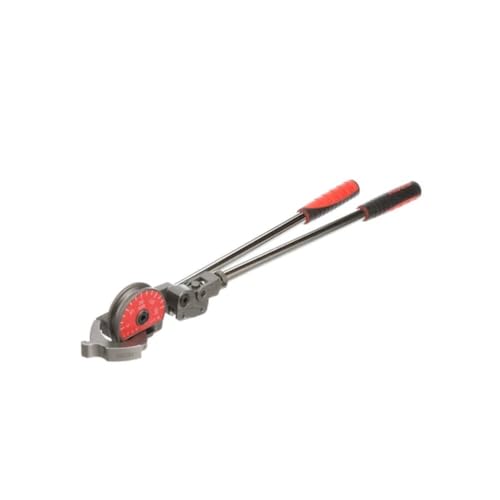
The Model 608 is RIDGID’s heavy-duty instrument bender for 1/2-inch tubing, built for stainless steel and other hard tubing such as steel and titanium. Its two-stage design allows in-place bending from 90 degrees to 180 degrees without the handles crossing, roll dies in the form reduce the force needed, and a vise clamp built into the form adds stability. Extra-long 16-inch handles supply the leverage hard tubing demands.
Specs
- Tube size: 1/2-inch O.D.
- Bend radius: 1-1/2 inches
- Bend angle: 90 to 180 degrees, two-stage in-place bending
- Handles: Extra-long 16-inch, roll dies in the bending form
- Extras: Built-in vise clamp
- Materials: Stainless steel, steel and titanium tubing
- Model: 38048 (Model 608)
2. Imperial Tool 470FH Triple Head 180 Degree Tube Bender

The 470FH puts four size grooves on one triple-head frame, covering 3/16, 1/4, 5/16 and 3/8-inch O.D. tubing, with 3/16-inch tube using the 1/4-inch slot. Calibrated markings guide accurate left-hand, right-hand and offset bends, and the patented Roto-Lok indexing lever produces tight 180-degree bends with less effort. The body is die-cast aluminum with cushion grips.
Specs
- Tube sizes: 3/16, 1/4, 5/16 and 3/8-inch O.D. (3/16-inch uses the 1/4-inch slot)
- Bend angle: Up to 180 degrees
- Markings: Calibrated scale for left-hand, right-hand and offset bends
- Handle: Patented Roto-Lok indexing lever, cushion grips
- Body: Die-cast aluminum
- Materials: Soft copper, aluminum, brass, thin-wall steel, thin-wall stainless steel
- Model: 470FH
3. OTC 6515 3-in-1 180 Degree Heavy Duty Tubing Bender

OTC’s 6515 is a compact 3-in-1 hand bender covering the three sizes most often found on vehicle lines: 1/4, 5/16 and 3/8-inch tubing. It forms bends up to 180 degrees and is listed for steel, aluminum, brass and copper tubing.
Specs
- Tube sizes: 1/4, 5/16 and 3/8-inch O.D.
- Bend angle: Up to 180 degrees
- Format: 3-in-1 single-frame hand bender
- Materials: Steel, aluminum, brass and copper tubing
- Model: 6515
4. Lisle 44150 3/16-Inch Tubing Bender Pliers

The Lisle 44150 is a dedicated pliers-style bender for 3/16-inch O.D. tubing, the standard size for most brake lines. Its head bends without kinking or collapsing the tube and without marking the surface, and it is specified for all types of 3/16-inch tubing, including steel. Because it works like pliers rather than around a fixed form, it forms bends progressively in tight spots, including on lines already routed on the vehicle.
Specs
- Tube size: 3/16-inch O.D., including steel tubing
- Bend type: Pliers-style, forms bends in place; no fixed bend radius
- Head: Designed to bend without kinking, collapsing or marking the tube
- Construction: Alloy steel
- Dimensions: 12 x 6 inches; weight 8 ounces
- Model: 44150 (TB441)
5. OEMTOOLS 25440 Tube Bender Pliers

The OEMTOOLS 25440 is an alloy-steel bending pliers that handles 1/4, 5/16 and 3/8-inch tubing in copper, brass, steel and aluminum. It forms left, right and offset bends up to 90 degrees, covering most directional changes needed when routing lines around brackets and crossmembers.
Specs
- Tube sizes: 1/4, 5/16 and 3/8-inch O.D.
- Bend angle: Left, right and offset bends up to 90 degrees
- Construction: Alloy steel
- Dimensions: 13.5 x 4.7 inches; weight 1.2 lb
- Materials: Copper, brass, steel and aluminum tubing
- Model: 25440
Which Tubing Bender Should You Pick?
For hard 1/2-inch tubing in stainless steel or titanium, the RIDGID Model 608 is the only pick here built specifically for that work, and its 1-1/2-inch radius and roll dies protect the tube wall. If your work moves between several small sizes, the Imperial 470FH covers four diameters on one frame with full 180-degree bends, while the OTC 6515 covers the three common vehicle line sizes in a simpler frame. For brake line repair on the vehicle, take the Lisle 44150 if nearly everything you touch is 3/16-inch line, or the OEMTOOLS 25440 if you also run 5/16 and 3/8-inch lines and mostly need bends up to 90 degrees.
FAQ
What size tubing bender do I need for brake lines?
Most passenger-vehicle brake lines are 3/16-inch O.D., with some 1/4-inch lines on larger vehicles. A dedicated 3/16-inch tool such as the Lisle 44150, or a multi-size bender whose grooves include 3/16 or 1/4 inch, covers most brake work.
Can a hand tubing bender bend stainless steel tubing?
Yes, but the bender has to be built for it. Hard tubing needs a heavy-duty form, roll dies and long handles for leverage, as on the RIDGID Model 608. Lighter benders are typically listed for soft copper, aluminum, brass and thin-wall steel.
What is the difference between a lever bender and bending pliers?
A lever bender pulls the tube around a fixed form, giving a consistent radius and repeatable angles up to 180 degrees. Bending pliers grip the line and form the bend progressively by hand, which suits short bends and lines already installed, but they follow no fixed radius.
Why does bend radius matter?
The radius sets how tight the finished bend is and how much the tube wall thins on the outside of the curve. A radius that is too tight for the material or wall thickness can kink or crack the tube, so match the stated radius to your tubing.
Conclusion
Choosing among hand tubing benders comes down to the tube sizes you run, the materials you bend, and whether the lines are on the bench or already on the vehicle. The RIDGID 608 handles hard 1/2-inch tubing, the Imperial 470FH and OTC 6515 cover multiple small sizes with full 180-degree bends, and the Lisle and OEMTOOLS pliers shape lines in place. Match the groove to the tube and the tool to the material, and bends come out round, smooth and repeatable.
Related guides
More from Amazon
Programs that pair well with the guide above. Offers and eligibility are set by Amazon and may change.
A free business account with business pricing and bulk-buying tools for work, shop or home office.
Create a business accountFree shipping on eligible items, Prime Video and more. Eligible new members can start with a free trial.
Start a Prime free trialAudiobooks and podcasts to listen to on the go. Eligible new members can start with a free trial.
Try Audible freeAd-free music streaming. Eligible new subscribers can start with a free trial.
Try Music Unlimited freeAs an Amazon Associate we earn from qualifying purchases.
Write Your Review
No reviews yet. Be the first to share your experience!