Best Low-Profile Aluminum Floor Jacks
What's inside
As an Amazon Associate I earn from qualifying purchases. This post may contain affiliate links at no extra cost to you.
Best Low-Profile Aluminum Floor Jacks for Sports Cars: Picks by Fit and Use
The best low profile aluminum floor jacks for sports cars are the ones that fit beneath your car at its actual lift point, reach far enough to position safely, and lift high enough for the work you plan to do. For most owners, a 1.5- to 2-ton aluminum jack with a minimum saddle height around 3 inches is the most useful balance; very low cars may need a 2-inch-class racing jack, while heavier vehicles call for a higher-capacity steel or hybrid option.
Compare the key specifications
The figures below are published specifications for representative models. Confirm the current manual and product listing before buying: manufacturers may revise models, and “low profile” does not guarantee a particular car will clear the saddle. Lift range, rather than capacity alone, often decides whether a jack suits a sports car.
As an Amazon Associate we earn from qualifying purchases at no extra cost to you.

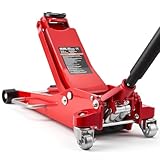
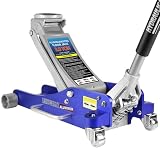

| Jack | Capacity | Minimum saddle height | Maximum lift height | Approx. weight | Best fit |
|---|---|---|---|---|---|
| Arcan ALJ3T | 3 tons | 3.75 in | 18 in | 56 lb | Higher capacity and useful lift for a home garage |
| JEGS 2-ton aluminum floor jack | 2 tons | 3.5 in | 19.25 in | 49 lb | Good maximum height for wheel and suspension work |
| Summit Racing 2-ton aluminum floor jack | 2 tons | 3.5 in | 19.25 in | about 50 lb | General-purpose garage use with a tall lift range |
| ESCO 10498 low-profile aluminum jack | 1.5 tons | 2.75 in | about 15.5 in | about 43 lb | Lower access for lighter cars and track-focused use |
Published weights and dimensions can vary by configuration, so treat close comparisons as approximate. The ESCO’s lower entry height can matter more than its lower maximum height when a front splitter or side skirt limits access. The Arcan and 2-ton options trade a higher minimum height for greater capacity or reach above the floor.
Choose by vehicle, workspace, and job
- Very low sports car or track car: Prioritize minimum height and a long, low nose. A jack with a 2.75-inch minimum may fit where a 3.5-inch model cannot. Measure the actual pinch-weld or central lift point; do not estimate from ground clearance alone.
- Routine tire rotations and brake work: A 2-ton model with a maximum lift near 19 inches offers more room to place a stand and remove a wheel. Check that its saddle and handle can reach the lift point without contacting bodywork.
- Heavier sports coupe or occasional SUV use: A 3-ton jack provides more rated capacity, but the extra rating does not make it suitable for every low car. Compare its minimum height and chassis dimensions before choosing it.
- Small garage or frequent transport: Favor a lighter jack with a handle that stores conveniently and casters that roll easily on your floor. Aluminum reduces carrying weight, but a long chassis still needs turning room.
- Frequent shop use: Consider serviceability, seal and release-valve support, and whether replacement parts are available. A heavier, durable jack can be a better ownership choice than the lightest option.
Fit is a two-measurement problem
Before purchasing, measure both the available entry clearance and the required lift. With the car parked on level ground, measure vertically from the floor to the intended lifting point. Allow a small margin for floor variation and the saddle pad; a jack whose stated minimum equals your measurement may not roll under or seat correctly.
Then measure how high the car must rise for the job. A tire needs to clear the floor, and a jack stand must fit under an approved support point. As a practical example, suppose your lift point is 3.2 inches above the floor and the jack’s minimum saddle height is 3.5 inches. It will not fit, even if the vehicle’s advertised ground clearance is several inches. A 2.75-inch jack leaves 0.45 inches of nominal clearance, but you still need room to roll it into position and account for any low underbody parts.
Maximum height is not the same as useful working height. The jack must lift the designated point enough to place a stand, while the stand itself must be appropriate for the vehicle. Never rely on a floor jack alone while working beneath a car.
Reach, chassis clearance, and saddle protection
Reach describes how far the saddle can travel under the car from the front of the jack. A long-reach chassis can help you reach a central front lift point without pushing the jack against a splitter. But long-reach models need more floor space to maneuver and may be awkward in a narrow garage. Check the overall length and the path from the garage door to the lift point, not just the saddle’s height.
Chassis clearance is separate from saddle height. The jack’s nose, side plates, and wheels must clear the car’s underside as it rolls inward. Look for a tapered front profile and inspect the width of the path around exhaust parts, undertrays, and aerodynamic panels. A jack can have a low saddle and still be too tall or wide at the front to fit beneath a particular car.
A broad, swiveling saddle can make alignment easier, but the contact surface should not damage paint or deform a pinch weld. Use a compatible rubber pad or a slotted pinch-weld adapter where the vehicle’s lifting instructions call for one. Pads are consumables: inspect them for splitting, hardening, or a loose fit, and replace them before they can slip. A soft pad is not a substitute for placing the jack at a manufacturer-approved lifting point.
Ownership trade-offs that listings often miss
Aluminum jacks are easier to move than many steel models, but “aluminum” does not mean maintenance-free. Road grit and metal chips can collect around the wheels, pump, and release mechanism. Wipe the jack down after use, keep the hydraulic ram clean, and store it with the saddle lowered in a dry place. Follow the manual for hydraulic-fluid checks and bleeding; adding the wrong fluid or overfilling can cause poor operation.
On a frequently used jack, casters and saddle pads tend to show wear before the main structure. Uneven rolling, a saddle that will not stay level, fluid around the ram, or a jack that slowly sinks under load are reasons to stop using it until inspected or repaired. Avoid lifting beyond the rated capacity, using the jack on sloped or soft ground, or forcing it sideways while loaded. Aluminum models are also vulnerable to damage from drops or rough handling, so lift them by their intended carrying points.
Bottom line
For a low sports car, start with minimum saddle height and chassis clearance, then verify reach and the height needed to set stands. Choose the ESCO-style lower-entry option when access is the limiting factor; choose a 2-ton, higher-lift design for routine garage work when the car clears it; and consider a 3-ton model when the vehicle and its approved lifting points justify the added capacity. The right jack is the one that fits the car and workspace with a safe margin—not simply the lightest or highest-rated one.