Best Milwaukee Table Saw
What's inside
As an Amazon Associate I earn from qualifying purchases. This post may contain affiliate links at no extra cost to you.
A Milwaukee table saw sits at an unusual crossroads in the jobsite category: it delivers the cordless convenience pros increasingly demand, yet its 8-1/4-inch blade opens questions about whether it can replace a full-size 10-inch unit for production cuts. Buyers comparing options here are really asking whether the platform investment pays off when paired with the right alternative saw.
We narrowed the field to eight machines that appear most often in owner discussions, spec sheets, and price comparisons heading into 2026. What separates a worthwhile pick from a regrettable one in this group comes down to rip capacity, motor class, and whether the tool’s form factor matches the actual cuts you make each week.
As an Amazon Associate we earn from qualifying purchases at no extra cost to you.



Our Top Picks
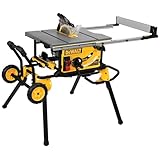
 DEWALT 15 Amp 8-1/4 in. Compact Portable JobsiteOne Size22.75 x 22.75 x 13 inches54 poundsCheck on Amazon
 Evolution R8MTS 8-1/4" Convertible Miter/Table Saw16-7/8" x 10-1/4"15.7 x 16.5 x 12.8 inches28.6 poundsCheck on Amazon
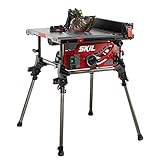
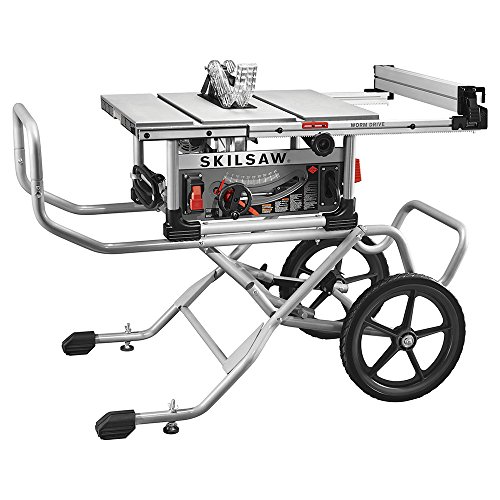 SKIL 10 Inch Heavy Duty Worm Drive Table52.6 x 29.5 x 35 inches52.6 x 29.53 x 35.08 Inches94.3 poundsCheck on Amazon

Quick Picks
| Product | Best for | Price |
|---|---|---|
| Milwaukee 2736-20 | Cordless jobsite work | $1,198.99 |
| SKIL TS6307-00 | Budget 10-inch ripping | $302.68 |
| DEWALT DWE7491RS | Rip capacity on wheels | $599.00 |
| DEWALT DWE7485 | Compact portable cuts | $429.00 |
| Evolution R8MTS | Multi-material conversion | $275.00 |
| SKIL SPT99-11 | Worm-drive power | $648.00 |
| Milwaukee Jig Saw (18VDC) | Curved cuts (not a table saw) | $154.00 |
| SKIL TS6308-00 | Lightweight 8-1/4-inch portability | $249.00 |
How We Picked
Three criteria drove these selections. First, published motor specs and blade size determine whether a saw handles your stock thickness and species without bogging. Second, rip capacity and fence quality decide how usable the machine is on sheet goods versus dimensional lumber. Third, owner-reported feedback on dust collection, fold-up mechanisms, and long-term fence accuracy separated the machines people keep from those they resell.
The 8 Best Milwaukee Table Saw in 2026
Milwaukee 2736-20 M18 8-1/4-Inch Table Saw
This is the cordless answer for framers and finish carpenters who already own M18 batteries. The tool-only price means the battery investment sits on top of $1,198.99, which narrows its value to existing Milwaukee users.
- Pro: No cord, no generator; cuts where your truck parks.
- Pro: 8-1/4-inch class keeps weight low enough to carry up stairs without a cart.
- Con: Blade diameter limits crosscut and rip depth compared to any 10-inch option on this list.
Skip it if you need a single saw for everything from plywood to two-by stock. The cordless freedom is real, but the cut capacity is not universal.
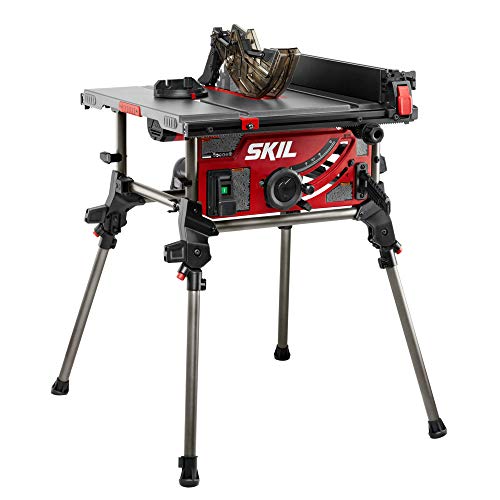
SKIL TS6307-00 10-Inch Jobsite Table Saw
For a first 10-inch table saw under $350, this folding-stand unit covers the majority of weekend-remodel ripping tasks. Owner threads praise its straight-line accuracy for the money, though fence rigidity gets mixed reports.
- Pro: 10-inch blade at this price is uncommon; handles sheet-goods crosscuts without a sliding table.
- Pro: Folding stand stores flat and rolls through a standard doorway.
- Con: 15-amp universal motor draws significant current on dense hardwood; expect slowdowns if you push it.
Not ideal for all-day production use. The budget build shows up in fence micro-adjustments and dust port fitment.
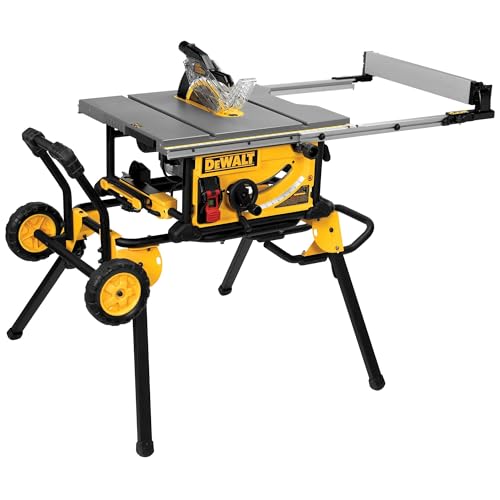
DEWALT DWE7491RS 10-Inch Table Saw
The 32-1/2-inch rip capacity is the headline. At $599 including a rolling stand, it competes directly on value with anything in the 10-inch portable class.
- Pro: Rack-and-pinion telescoping fence stays parallel better than cheaper gravity-fed designs.
- Pro: 4,800 RPM motor keeps the 10-inch blade in its sweet spot for clean cuts.
- Con: Heavier than the Milwaukee option; the rolling stand adds floor footprint in tight shops.
Pass if your workspace cannot accommodate a fixed or semi-permanent setup. Best for buyers who prioritize rip width over portability.
DEWALT DWE7485 Compact Portable Table Saw
Sits in the same 8-1/4-inch class as the Milwaukee cordless unit but runs on mains power at a much lower price. Owner feedback highlights its light weight and adequate 15-amp motor for standard dimensional lumber.
- Pro: $429 delivers a compact saw without the cordless platform tax.
- Pro: Roll-cage stand design folds and lifts as one unit, faster to break down than separate-stand rivals.
- Con: Smaller rip capacity than the DWE7491RS above; limited to jobs where 8-1/4-inch depth suffices.
If you already have a cordless Milwaukee setup, this is redundant. It shines for contractors without a battery ecosystem committed to 8-1/4-inch cuts.
Evolution R8MTS 8-1/4-Inch Convertible Miter/Table Saw
At $275 this is the most versatile footprint here. The 12-amp motor handles wood, plastic, and metal with the included TCT blade, and the head rotates to function as a miter saw.
- Pro: One machine converts between table-saw and miter-saw mode; saves bench space in small shops.
- Pro: Multi-material capability means no separate chop saw for PVC or soft metals.
- Con: 0-to-45-degree bevel and plus/minus-45-degree miter range is narrower than a dedicated 10-inch cabinet saw.
Do not buy it as your only saw for hardwood sheet goods. It is a space-saving multi-tool, not a rip powerhouse.
SKIL SPT99-11 Worm Drive Table Saw
Worm-drive geometry delivers torque to the blade through a lower RPM, which keeps the motor from stalling in dense stock. At $648 it undercuts most 10-inch worm-drive competitors by a wide margin.
- Pro: Worm-drive motor sustains cutting force in hardwoods where a direct-drive universal motor would bog.
- Pro: Includes a purpose-built stand; no extra purchase required to get a full setup.
- Con: Heavier and bulkier than the 8-1/4-inch units; not a one-hand carry up a ladder.
Wrong choice if your cuts are all plywood and dimensional pine. The worm-drive advantage only materializes when you fight dense grain.
Milwaukee 18VDC Jig Saw (Barrel Grip)
Let us be clear: this is not a table saw. It appears in Milwaukee table saw search results because shoppers filter by brand rather than tool type. At $154 it is a competent 18-volt jig saw with a barrel grip for users who prefer that hand position over a top handle.
- Pro: If you already own M18 batteries, this complements the 2736-20 by handling curves the table saw cannot.
- Con: It cannot rip, crosscut, or replace any table saw on this list.
Skip this entirely if you are shopping for a table saw. Buy it only as an accessory to the cordless setup above.
SKIL TS6308-00 Compact 8-1/4-Inch Table Saw
The lowest entry price at $249, and the stand is sold separately. For a hobbyist who needs occasional straight cuts and already has a stable work surface, the saw alone is a reasonable starting point.
- Pro: Under $250 for a functional 15-amp table saw; hard to beat as a first-cutting machine.
- Pro: Light enough to store on a shelf and deploy on a sawhorse in under a minute.
- Con: Stand costs extra, pushing total outlay closer to the DEWALT DWE7485 that includes one.
Skip it if you will use the saw more than a few weekends per year. The fence and dust port are budget components that wear quickly under regular load.
Buying Guide
Blade Size and Motor Class
An 8-1/4-inch blade maxes out at roughly 2-1/2 inches of cutting depth, which handles nominal lumber and three-quarter plywood but nothing thicker. A 10-inch blade clears three inches or more and accepts dado stacks on select models. Match motor amperage to your hardest material: 15 amps is the floor for a 10-inch corded saw, while a worm drive trades RPM for torque that resists stalls in oak and hickory.
Rip Capacity and Fence Design
Thirty-two and a half inches is generous for portable units. Anything under twenty-four inches forces you to flip the workpiece or support it independently for wide cuts. A rack-and-pinion fence that telescopes stays parallel across the full travel; a gravity-fed fence drifts as you slide it outward. Check owner photos of fence alignment before purchasing any budget 10-inch model.
Portability and Storage Footprint
A folding stand that rolls saves setup time on jobsites but demands a storage spot wide enough to hold it deployed. Compact 8-1/4-inch saws fit in a truck bed corner; worm-drive units with fixed stands do not. Decide whether you will leave the saw set up in a garage corner or pack it every evening.
Our Verdict
Top pick: The DEWALT DWE7491RS offers the best balance of rip capacity, fence quality, and included stand at $599. Budget pick: The SKIL TS6308-00 under $250 is the cheapest functional entry if you already own a stable surface. One condition favors the Milwaukee 2736-20 over everything else: you work on floors where power access is unreliable and your battery platform is already M18.
FAQ
Is the Milwaukee table saw worth buying tool-only?
Only if you already own multiple M18 batteries. The tool-only price of $1,198.99 plus required batteries and a charger pushes the system cost well above comparable corded 10-inch saws.
Can a Milwaukee table saw cut hardwood plywood?
Yes, the 8-1/4-inch blade handles three-quarter plywood cleanly. It will struggle with material thicker than two inches, where a 10-inch blade or worm-drive saw has more depth to work with.
Do compact table saws lose accuracy over time?
Owner threads consistently note that budget fence rails and cast-aluminum tables develop play after a year of heavy use. Regular waxing of the table surface and occasional fence alignment checks extend accuracy.
Should I buy a separate stand for the SKIL TS6308-00?
If you plan to use it more than occasionally, yes. The SKIL SFS0001 stand locks the saw at working height and prevents the flex you get on a sawhorse, but adding its cost narrows the price gap versus the DEWALT DWE7485 that ships with a stand included.