Types of Oscillating Tool Blades: What Each One Cuts and When to Use It
What's inside
As an Amazon Associate I earn from qualifying purchases. This post may contain affiliate links at no extra cost to you.
Every type of oscillating tool blade comes down to just two variables — the tooth or grit material (high-carbon steel, bi-metal, carbide, or diamond) and the blade shape (plunge, segment, flush-cut, scraper, rasp, or hook knife) — so the right choice is always dictated by the material you’re cutting, not by the brand of tool you own.
As an Amazon Associate we earn from qualifying purchases at no extra cost to you.


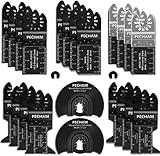

The Four Tooth and Grit Materials
High-carbon steel (HCS)
The cheapest option at roughly $2–6 per blade in multipacks. HCS cuts clean lumber, plywood, MDF, drywall, PVC, and soft plastics quickly, but the teeth are soft — a single strike on a nail or drywall screw bends or chips the edge rather than breaking it, and the blade is done. Reserve HCS for new-construction wood and drywall cutouts where you’re certain no fasteners are hiding.
Bi-metal
High-speed steel teeth welded to a flexible spring-steel body, typically $8–15 each. Bi-metal survives nail-embedded wood, drywall screws, copper pipe, EMT conduit, and aluminum trim, which makes it the default blade for remodeling — a wall cavity can hide anything. Its weakness is hardened steel: screw heads, bolts, and stainless fasteners round the teeth off in seconds.
Carbide-tooth
Carbide-tipped teeth like a miniature circular saw blade, sold under lines such as Diablo Demo Demon and Bosch Starlock carbide, at roughly $15–30 each. Carbide teeth cut hardened screws, bolts, cement board, fiber cement siding, plaster over wire lath, and thin cast iron. In nail-infested demo lumber a carbide blade commonly outlasts a bi-metal blade by a factor of 10 or more — expensive per blade, cheap per cut.
Carbide grit vs. diamond grit
These have no teeth at all — abrasive particles bonded to the edge, so they grind rather than slice. Carbide grit ($8–20) handles grout, mortar, thinset, and soft masonry. Diamond grit ($20–45) is the upgrade for porcelain tile, stone, epoxy grout, and cement backer board; it cuts slower but lasts dramatically longer on hard material that glazes carbide grit smooth in minutes.
Blade Shapes and What Each One Does
- Plunge (straight, 1-1/4″ to 2-1/2″ wide, about 1-3/4″ usable depth): rectangular cutouts in drywall and subfloor, notching studs, cutting pipe between joists.
- Segment / half-round (typically 3-3/8″ to 4″ diameter): long straight cuts along a surface — undercutting door jambs, trimming underlayment — and the curved edge reaches into corners a straight blade can’t.
- Flush-cut / offset: a bent shank lays flat against floors and walls to shear off protruding nails, shims, dowels, and trim ends.
- Scraper (rigid or flexible, ~2″ wide): adhesive, linoleum, carpet glue, caulk, gasket material, and paint.
- Rasp (finger or triangular): grinding and shaping wood, widening grout lines, sanding tight profiles.
- Hook knife: carpet, asphalt shingles, vinyl, roofing felt, and insulation.
- Sanding delta pad: hook-and-loop sheets for corner sanding — an accessory rather than a blade, but it shares the same mount.
Match the Blade to the Material
| Material you’re cutting | Blade shape | Tooth / grit | Per-blade cost | What kills it fast |
|---|---|---|---|---|
| Clean lumber, plywood, MDF | Plunge or segment | HCS | $2–6 | One nail strike |
| Nail-embedded wood (demo, pallets, subfloor) | Wide plunge | Carbide-tooth (budget: bi-metal) | $15–30 / $8–15 | Using HCS — dead in seconds |
| Drywall cutouts | Thin plunge | HCS | $2–5 | Hidden screws near studs |
| Copper, EMT, aluminum | Narrow plunge | Bi-metal | $8–15 | Hardened steel fasteners |
| Hardened screws, bolts, stainless | Narrow plunge | Carbide-tooth | $15–30 | Bi-metal — strips teeth |
| Grout removal | Segment or pointed | Carbide grit (diamond for epoxy grout) | $8–20 / $20–45 | Toothed blades clog instantly |
| Porcelain tile, stone | Segment | Diamond grit | $20–45 | Carbide grit glazes over |
| Cement board, fiber cement | Plunge or segment | Carbide-tooth or grit | $15–30 | HCS dies in seconds |
| Adhesive, caulk, carpet glue | Rigid scraper | Spring steel | $5–12 | Staples and tacks |
| Carpet, shingles, vinyl | Hook knife | HCS | $5–10 | Dirt embedded in material |
| PVC, ABS plastic | Plunge | Fine-tooth HCS | $2–6 | Too-high speed melts the kerf shut |
Starlock vs. Universal Mounts: What Fits Your Tool
The mount matters before the blade does. Universal-fit blades use a circular hole with notches, or an open-back “quick fit” slot, and they fit the vast majority of tools — DeWalt, Milwaukee (whose OPEN-LOK accessories use an enhanced open-back design), Makita, Ridgid, Ryobi, Porter-Cable, Rockwell, and Dremel Multi-Max tools via an adapter. Starlock is a patented snap-in interface developed by Fein and Bosch, used on current Bosch and Fein multitools plus some Festool and Metabo models. Starlock’s 12-point interlock locks mechanically with the tool head — no slop, and changes take a second by pressing the blade on.
Starlock comes in three power tiers: standard Starlock, StarlockPlus, and StarlockMax. A higher-tier tool accepts all lower-tier accessories (a StarlockMax tool takes everything), but the larger Max blades won’t mount on a standard tool. The critical catch: universal blades do not fit Starlock tools, and Starlock blades do not fit universal tools — there’s no adapter in either direction worth trusting.
| Mount | Found on | Accepts | Typical blade price premium |
|---|---|---|---|
| Universal / OIS open-back | DeWalt, Milwaukee, Makita, Ryobi, Ridgid, most Dremel | Universal-fit blades from any brand | Baseline — cheapest per blade |
| Starlock | Bosch, Fein, some Festool/Metabo | Starlock accessories only | Roughly 20–40% more per blade |
| StarlockPlus / Max tools | Higher-power Bosch and Fein models | All Starlock tiers | Same, plus access to larger blades |
What a Blade Actually Costs Per Cut
Listings sell you a price per blade; the number that matters is cost per cut. Working math on demolition lumber with embedded nails:
- $4 HCS blade: survives 0–2 nail strikes → roughly $2–4 per cut before it’s scrap.
- $12 bi-metal blade: handles roughly 20–40 nail/screw cuts before teeth round off → about $0.30–0.60 per cut.
- $22 carbide-tooth blade: handles 200+ cuts in the same material → about $0.10 per cut, and it’s still running.
Flip that math for clean wood: an HCS blade cutting only fresh lumber can outlast bi-metal dollar-for-dollar, because you’re not paying for metal capability you never use. Buy tooth material for the worst thing the blade will hit, not the average.
Durability and Ownership Realities
- Heat kills blades faster than material does. Let the oscillation do the work at light pressure and rock the blade to clear dust. A blued, discolored edge means the temper is gone. On metal, drop the tool to a mid-range speed (roughly 10,000–15,000 OPM instead of max) to cut heat buildup.
- What wears first: tooth tips round off on toothed blades; grit blades glaze smooth. On cheap universal blades the stamped mounting hole often deforms first — the blade wobbles before the teeth are even dull, which is where Starlock’s full-contact fit earns its premium.
- Grit blades grind, they don’t cut. Expect slower progress and fine slurry, not chips. For grout and cement board, hook up vacuum extraction and wear a respirator — crystalline silica dust is the real hazard, not the blade.
- Common mistakes: using an HCS wood blade on grout (clogs instantly), forcing the blade so the kerf bends and cuts wander, scraping pre-1978 paint without a lead test, and buying 50-piece generic kits where 40 blades are identical HCS you’ll rarely use.
Which Setup Fits Your Situation
| Your situation | Buy this | Approximate spend |
|---|---|---|
| Occasional homeowner — drywall patches, shims, trim | 10–15 pc universal kit (HCS + bi-metal + scraper) | $15–25 |
| Regular remodeler — demo with unknown fasteners | 2–3 carbide-tooth blades + bulk bi-metal | $40–60 |
| Bathroom or kitchen tile work | Diamond segment blade + carbide grout blade | $40–70 |
| Starlock tool owner | Starlock-interface blades; skip adapters entirely | 20–40% premium per blade |
| Value-platform cordless tool (Ryobi, Ridgid, etc.) | Universal open-back multipacks — lowest per-blade cost | $1–3 per blade in bulk |
Before ordering, check three things a listing rarely spells out: usable cutting depth (standard is ~1-3/4″; deep-cut variants reach about 2-1/4″), etched depth markings for controlled jamb undercuts, and a photo of the mounting hole — a round slotted hole means universal, a 12-point star means Starlock, and mixing them up is the most common return-worthy mistake.
Frequently Asked Questions
Will a universal blade fit a Starlock tool?
No. Starlock requires the 12-point interlock built into Starlock accessories; a round-hole universal blade physically cannot lock onto the head. The only adapters that exist run the other direction — letting older Fein accessories mount on newer Starlock tools.
Are oscillating blades interchangeable between brands?
Within the same mount system, yes. A universal-fit blade from a third-party maker like Imperial Blades works on DeWalt, Milwaukee, or Makita tools. Starlock blades interchange among Bosch, Fein, Festool, and compatible tools. The mount, not the logo, determines fit.
How many blades do I actually need?
Three covers most users: a bi-metal plunge blade (handles wood plus surprise nails), a carbide-grit or diamond segment blade (grout, masonry), and a rigid scraper (adhesive, caulk). Add a carbide-tooth blade only when you know you’ll hit hardened fasteners.
Do pricier blades cut faster?
In clean wood, no — a $4 and a $20 blade share nearly identical geometry and cut at the same speed. The premium buys survival: carbide in metal, diamond in tile, and a mounting interface that doesn’t wallow out under load.