Greenlee Carbide Hole Saw Kit: Sizes, Materials, and Electrician Use Cases
What's inside
- What’s in the kit — and which knockouts each cutter covers
- Carbide tooth spec and how the cutter actually works
- Carbide vs. bi-metal on stainless and fiberglass
- The knockout sizes electricians actually burn through
- Greenlee vs. IDEAL vs. Spyder: which kit for which job
- Ownership realities: what wears and what it costs per hole
- FAQ
- What’s in the kit — and which knockouts each cutter covers
- Carbide tooth spec and how the cutter actually works
- Carbide vs. bi-metal on stainless and fiberglass
- The knockout sizes electricians actually burn through
- Greenlee vs. IDEAL vs. Spyder: which kit for which job
- Ownership realities: what wears and what it costs per hole
- FAQ
As an Amazon Associate I earn from qualifying purchases. This post may contain affiliate links at no extra cost to you.
The Greenlee carbide hole saw kit is worth the money if your work involves punching conduit knockouts into stainless steel panels, painted enclosures, or fiberglass NEMA boxes — and it’s overkill if you mostly drill wood or mild steel a few times a year. The headline detail: its six carbide-tipped cutters (7/8″ through 2-1/2″) map one-for-one onto standard knockouts for 1/2″ through 2″ conduit, and carbide teeth hold an edge through stainless roughly ten times longer than a bi-metal hole saw.
As an Amazon Associate we earn from qualifying purchases at no extra cost to you.

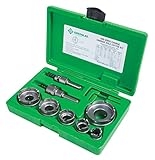


What’s in the kit — and which knockouts each cutter covers
Despite the “hole saw” name, the kit is built around hole cutters — shallow, carbide-tipped shearing tools on a quick-change arbor — not the deep cups on a threaded bi-metal arbor. A typical kit ships with six cutters, a quick-change arbor with a pilot bit, a hex wrench, and a fitted metal case. Depth of cut is about 1/4″, which is exactly what sheet stock requires and nothing more.
| Cutter diameter | Conduit knockout it makes | Where you’ll use it most |
|---|---|---|
| 7/8″ | 1/2″ | 1/2″ EMT/rigid connectors, cord grips, and — bonus — 22.5 mm pushbutton holes are nearly identical |
| 1-1/8″ | 3/4″ | 3/4″ conduit and liquid-tight fittings into boxes and panels |
| 1-3/8″ | 1″ | 1″ conduit entries, larger cable glands |
| 1-3/4″ | 1-1/4″ | Feeder entries on mid-size panels and disconnects |
| 2″ | 1-1/2″ | 1-1/2″ conduit and hub fittings |
| 2-1/2″ | 2″ | 2″ conduit — the practical ceiling of the kit |
That mapping is the whole reason electricians buy this kit: there’s no arithmetic on the job. If you routinely run conduit above 2″ — service entrance work, 2-1/2″ and 3″ conduit — the kit stops helping, and a hydraulic or ratcheting knockout punch set (Greenlee’s own Slug-Buster line for steel, Slug-Splitter for stainless) is the right tool instead.
Carbide tooth spec and how the cutter actually works
- Teeth: Tungsten carbide tips brazed onto an alloy-steel cup, with tooth geometry designed to shear sheet metal rather than grind through it. This is why it produces a clean, round, nearly burr-free hole in an enclosure wall.
- Depth limit: A flange stop controls penetration — roughly 1/4″ maximum — so you won’t punch through and damage wiring or components already mounted behind the panel.
- Slug ejection: An internal spring pops the slug free. Anyone who has pried slugs out of bi-metal saws with a screwdriver understands why this matters over a long day.
- Pilot bit: Replaceable and the cheapest consumable in the kit. It also wears or snaps first — keep two or three spares.
- Drive: Run it in a standard drill (or drill press) at low speed. It is not an impact-driver accessory.
Carbide vs. bi-metal on stainless and fiberglass
This is where the purchase decision actually lives. Stainless steel work-hardens and generates heat that destroys bi-metal teeth fast; fiberglass (GRP) enclosures contain abrasive glass that dulls edges almost as aggressively. Carbide shrugs off both — but it costs more per cutter and chips if abused.
| Greenlee carbide cutter kit | Typical bi-metal electrician’s kit | |
|---|---|---|
| Kit price range | ~$180–280 | ~$50–90 |
| Replacement per cutter/saw | ~$30–60 | ~$8–15 |
| Holes in 16 ga stainless (with oil, correct RPM) | ~75–150+ before noticeable dulling | ~5–15 before the edge is gone |
| Fiberglass / GRP | Holds the edge far longer; abrasive dust still wears over time | Dulls quickly; edge dies even if teeth look intact |
| Depth of cut | ~1/4″ (sheet stock only) | ~1-1/2″–1-3/4″ (wood, drywall, stacked material) |
| Failure mode | Chips if run hot, dry, or into hidden hardware | Dulls gradually; cheap to swap |
Speed discipline is what protects the investment. As a starting point in stainless, run cutters under 1-1/2″ around 250–400 RPM and the larger ones around 100–250 RPM, always with cutting fluid; mild steel tolerates roughly 1.5–2x those speeds; fiberglass should be cut at moderate speed with dust extraction and a respirator. If the hole edge discolors blue, you were too fast — and the cutter paid for it.
The knockout sizes electricians actually burn through
In real shop usage, the two smallest cutters do an outsized share of the work — the 7/8″ and 1-1/8″ cover 1/2″ and 3/4″ conduit, which is most branch-circuit and control wiring. Expect them to dull or be replaced first; fortunately cutters are sold individually, so the kit degrades gracefully rather than forcing a full rebuy. Beyond conduit, the same sizes cover cord grips, strain reliefs, sensor taps, and that handy 22.5 mm pushbutton equivalence mentioned above.
Greenlee vs. IDEAL vs. Spyder: which kit for which job
The most direct rival is the IDEAL carbide hole cutter kit — the TKO line is the same category of quick-change carbide cutters in nearly identical knockout sizes. Between the two, the honest answer is that both are pro-grade, and the practical choice often comes down to which brand your supply house stocks replacement cutters and pilot bits for. A Spyder carbide hole saw kit is a different tool entirely: deep-cut carbide cups with a core-eject arbor, built for wood, MDF, fiber-cement board, and stacked material on remodel work — excellent kit, wrong job for stainless panels.
| If your work is… | Buy |
|---|---|
| Panels, enclosures, and junction boxes weekly; stainless or painted steel | Greenlee carbide cutter kit (or IDEAL’s equivalent) |
| Remodel/rough-in through wood, cement board, plaster | Spyder carbide hole saw kit |
| Fewer than ~20 knockouts a year, mild steel only, tight budget | Bi-metal electrician’s hole saw kit |
| Conduit 2-1/2″ and up, or plate thicker than 1/4″ | Knockout punch set, not a hole saw |
Ownership realities: what wears and what it costs per hole
First to go is the pilot bit, then the teeth on the 7/8″ and 1-1/8″ cutters. Common killers: running dry on stainless, RPM too high, and plunging into a spot weld or a component behind the panel. Keep cutting fluid at the drill, blow fiberglass dust out of the teeth instead of letting it pack, and store cutters in the case rather than loose in a bag where carbide edges bang together.
The math at a modest 100 knockouts a year in 16 ga stainless: a bi-metal approach needs roughly 9–12 replacement saws at ~$10–15 each ($100–150/year, plus swap downtime and rougher holes). The carbide kit costs ~$200–280 once, then maybe two replacement cutters and pilot bits per year (~$90–100/year thereafter). Break-even lands somewhere in year one for a panel shop; a weekend installer will never reach it, which is exactly why the decision matrix above exists.
FAQ
Will it cut 10 gauge stainless?
Yes, slowly — low RPM, plenty of cutting oil, and steady pressure. Much thicker than that and you’re in knockout-punch territory; forcing a sheet-metal cutter through plate is how carbide teeth chip.
Do Greenlee cutters fit an IDEAL arbor (or vice versa)?
Treat each brand’s quick-change arbor as a proprietary system. Mixing platforms is unreliable, so match replacement cutters to the arbor brand you own.
Does this kit replace my bi-metal hole saws?
No — it replaces them for enclosure and panel work. You still want deep-cup saws for wood, drywall, and anything thicker than about 1/4″.