Best Festool Jigsaw Blades for Carvex and Trion Saws
What's inside
- Best Festool Jigsaw Blades for Carvex and Trion Saws
- Quick picks by cutting situation
- Compatibility: what fits a Carvex or Trion?
- Head-to-head: coarse universal versus fine-cut blades
- Choosing blades for curves, laminates, and metals
- A simple buying decision matrix
- Ownership realities: when to replace a blade
- Final recommendation
- Related Guides
- Best Festool Jigsaw Blades for Carvex and Trion Saws
- Quick picks by cutting situation
- Compatibility: what fits a Carvex or Trion?
- Head-to-head: coarse universal versus fine-cut blades
- Choosing blades for curves, laminates, and metals
- A simple buying decision matrix
- Ownership realities: when to replace a blade
- Final recommendation
- Related Guides
As an Amazon Associate I earn from qualifying purchases. This post may contain affiliate links at no extra cost to you.
Best Festool Jigsaw Blades for Carvex and Trion Saws
The best Festool jigsaw blades for most Carvex and Trion users are T-shank blades selected by material: a 4 mm-pitch wood blade for fast general cuts, a fine-tooth blade for clean joinery and laminates, a narrow curved-cut blade for tight radii, and a bi-metal blade for metal.
Festool PS 420 Carvex and PS 300 Trion saws use the same basic T-shank blade format, so the main buying decision is not the saw model. It is the blade’s length, tooth pitch, cutting direction, and material. A blade that fits the clamp can still be a poor choice if it is too short for the stock, too coarse for the finish required, or too wide for a curve.
As an Amazon Associate we earn from qualifying purchases at no extra cost to you.

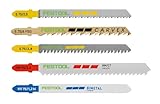


Quick picks by cutting situation
| Situation | Best blade type | Typical Festool example | Why choose it |
|---|---|---|---|
| Fast cuts in softwood and construction timber | HCS, coarse-tooth wood blade | WOOD UNIVERSAL S 75/4 K | 4 mm pitch removes waste quickly and resists clogging |
| Clean cuts in plywood, hardwood, and furniture parts | HCS, fine-tooth wood blade | WOOD FINE CUT S 75/2.8 FSG | Smaller teeth reduce breakout and leave a more controlled edge |
| Tight curves and shaped parts | Narrow, fine-tooth curve blade | WOOD CURVES S 75/4 K | Narrower blade body turns more readily than a wide straight-cut blade |
| Thick timber and long cuts | Long HCS wood blade | WOOD UNIVERSAL S 145/4 K | More usable blade length for stock approaching 100 mm |
| Steel, stainless steel, or mixed metal work | Bi-metal or hardened high-speed-steel blade | METAL STAINLESS STEEL HS 155/1.2 BI | Fine teeth and tougher construction tolerate metal cutting heat and vibration |
| Laminate or coated panels | Fine-tooth laminate blade | Festool laminate-specific T-shank blade | Designed to limit chipping in thin decorative surfaces |
Compatibility: what fits a Carvex or Trion?
Both the Carvex PS 420 and Trion PS 300 accept standard T-shank jigsaw blades. Festool’s tool-free blade clamp is designed around this shank style; U-shank blades are not the correct choice. The same T-shank principle also means many quality third-party blades can physically fit, although the blade’s length, thickness, width, and tooth geometry still determine whether it performs well.
Compatibility is not the same as capacity. A short 75 mm blade may fit the saw but be unsuitable for thick workpieces. Published cutting capacity depends on the material and blade, and the effective cutting depth is always less than the blade’s total length because part of the blade remains in the clamp and some length is needed for the stroke. For heavy stock, select the longer 105 mm or 145 mm class only when the extra reach is useful; a long, narrow blade can wander more easily in thin material.
T-shank details that matter
- Shank: Choose T-shank blades for the Carvex and Trion clamp.
- Blade length: Common Festool wood blades are approximately 75 mm, while longer options are around 105 mm to 145 mm overall.
- Tooth pitch: A 4 mm pitch is fast and open; approximately 2.8 mm is better for a cleaner general-purpose cut.
- Blade width: Narrow blades follow curves; wider blades track straighter in long cuts.
- Set: Side-set teeth cut a slightly wider kerf than the steel blade, allowing sawdust to clear but leaving more material removed.
Head-to-head: coarse universal versus fine-cut blades
WOOD UNIVERSAL S 75/4 K
This is the practical choice for speed. Its coarse tooth spacing is useful in softwood, framing lumber, chipboard, and general workshop work where the edge will be sanded or concealed. The larger gullets carry chips away effectively, particularly when cutting thicker stock.
The trade-off is finish quality. On veneered plywood, melamine, or a visible hardwood edge, the aggressive teeth can cause more breakout. Use a slower feed rate and the appropriate pendulum setting, but do not expect technique alone to turn a coarse blade into a finish blade.
WOOD FINE CUT S 75/2.8 FSG
A fine-cut blade is the better default for cabinet components, plywood, hardwood, and layout-sensitive cuts. The smaller pitch produces more teeth in the work at once, which generally improves control and reduces splinter size.
It cuts more slowly and can clog sooner in resinous wood or thick softwood. Excessive pressure is a common mistake: forcing the saw bends the blade, increases heat, and can produce a less accurate cut than a slower, lightly guided feed.
| Feature | Coarse universal blade | Fine-cut blade |
|---|---|---|
| Typical pitch | About 4 mm | About 2.8 mm |
| Best material thickness range | Medium to thick wood | Thin to medium wood and panels |
| Cutting speed | Higher | Moderate |
| Visible-edge quality | Acceptable to moderate | Better |
| Clogging risk in softwood | Lower | Higher |
| Curve suitability | Depends on blade width | Good when supplied in a narrow curve profile |
Choosing blades for curves, laminates, and metals
For curves, tooth pitch is only part of the decision. A narrow blade body is more important because it can rotate through a tighter radius without twisting. Use a curve-specific wood blade for templates, sink cutouts, and shaped furniture parts. Make relief cuts when removing a large waste section; this prevents the blade from binding as the offcut closes around it.
For laminate and melamine, choose a fine-tooth blade intended for coated panels and support the material firmly. Cutting with the good face down can help on some blade geometries, while a splinter guard and masking tape may further reduce surface damage. Always make a short test cut because the cleaner side depends on the tooth direction and blade design.
Metal requires a different approach. Bi-metal blades, such as Festool’s stainless-steel-oriented HS 155/1.2 BI type, use fine teeth and a more durable tooth structure than ordinary carbon-steel wood blades. Clamp the work securely, use cutting lubricant where suitable, and keep the feed steady. For thin sheet, sandwiching the metal between sacrificial boards can reduce vibration. Do not use a coarse wood blade on metal: it can snag, overheat, and damage both blade and workpiece.
A simple buying decision matrix
| Your priority | Buy first | Add later |
|---|---|---|
| Lowest consumable cost and occasional DIY work | Mixed wood pack with universal and fine blades | Curve blade if shaped cuts become regular |
| Cabinetmaking and visible edges | Fine-cut wood pack | Laminate-specific blade and a longer straight-cut blade |
| Frequent curved work | Narrow curve blades in two lengths | Fine-tooth backup blades for brittle plywood |
| Renovation or mixed materials | Universal wood and bi-metal metal blades | Specialty laminate or stainless-steel pack |
| Thick timber | Long 105 mm or 145 mm class wood blades | Shorter fine blades for detail work |
Ownership realities: when to replace a blade
Jigsaw blades are consumables. The teeth usually wear first, but a blade can become unsuitable earlier if it bends, overheats, or loses its set. Replace it when the saw begins wandering despite a straight guide, the cut requires noticeably more force, the edge burns, or the blade leaves repeated chips that were not present before.
Clean pitch buildup from resinous wood with a suitable blade-cleaning method rather than scraping aggressively across the teeth. Keep different blade types separated so fine teeth are not damaged by loose metal parts. Store blades dry and avoid tossing them together in a drawer; bent blades are rarely worth trying to straighten.
A practical cost calculation explains why the cheapest pack is not always the best value. If a pack costs $20 and provides 10 usable blades, its nominal cost is $2 per blade. If a coarse blade completes 30 fast cuts before replacement, that is roughly 7 cents per cut. A fine blade costing $2.50 may last for 20 clean cabinet cuts, or about 12.5 cents per cut, but it can save enough sanding and rework to cost less overall on visible parts.
Final recommendation
For a first purchase, choose a mixed pack containing a 75 mm-class universal wood blade, a fine-cut wood blade, and a narrow curve blade. Add a longer 105 mm or 145 mm blade when cutting thick stock, and buy bi-metal metal blades only for actual metal work. Because Carvex and Trion saws share the T-shank format, spend less time comparing saw compatibility and more time matching tooth pitch, blade width, length, and material to the cut in front of you.