Best Long Jigsaw Blades for Deep and Thick Cuts
What's inside
As an Amazon Associate I earn from qualifying purchases. This post may contain affiliate links at no extra cost to you.
Long jigsaw blades solve one problem: the stroke of a standard jigsaw blade runs out before thick material does, so if you regularly cut timber over 50mm, insulation, or stacked panels, you need extra usable cutting length combined with enough stiffness to keep the cut vertical. The catch is that blade length alone doesn’t guarantee a straight cut—wandering and deflection get worse as length increases, which is why tooth pitch, blade thickness, and shank fit matter just as much.
As an Amazon Associate we earn from qualifying purchases at no extra cost to you.


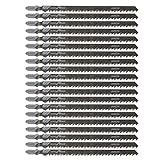

What “long” actually means on a jigsaw blade
Standard jigsaw blades run 75–100mm overall with roughly 50–75mm of usable teeth. A long blade for jigsaw work typically means 120–150mm overall, and extra long jigsaw blades reach 180–250mm. But the number that matters is usable cutting length—the tooth row minus what the guide roller and baseplate consume. Subtract about 25–30mm from overall length to get realistic cutting depth.
Because longer blades flex more, manufacturers compensate with thicker, wider stock. A deep-cut blade at 1.6–1.8mm thick resists side deflection far better than a 1.2mm scroll blade stretched to the same length. If your cuts keep drifting off square, stiffness—not sharpness—is usually the culprit.
Comparison of the main options
| Blade (type) | Overall length | Usable teeth (approx.) | Thickness | TPI / pitch | Max material thickness | Best for |
|---|---|---|---|---|---|---|
| Bosch T344D Speed for Wood | 152mm | ~125mm | ~1.4mm | 6 TPI | ~100mm softwood | Fast rough cuts in timber, chipboard |
| Bosch T1044DP Precision for Wood | 250mm | ~220mm | ~1.8mm | 3 TPI | ~180mm+ timber/insulation | Very deep straight cuts, thick beams |
| Festool S 105/4 FSG | 105mm | ~75mm | ~1.5mm | 4 TPI | ~70mm wood | Moderate depth with clean finish |
| Diablo long wood blades (e.g., deep-cut carbide sets) | ~130–150mm | ~100–125mm | ~1.5mm | 4–6 TPI | ~90–100mm | Dense hardwood, nail-embedded timber |
| Makita B-13 / similar long universal blades | ~132mm | ~100mm | ~1.3mm | 6 TPI | ~80mm wood | General-purpose deep cuts on a budget |
How to choose: the five criteria that prevent wandering
1. Usable cutting length vs. your material
Match usable teeth to material thickness plus a 10–15mm margin so teeth clear the workpiece on the upstroke. Cutting 90mm posts? You need ~105mm of tooth row minimum—rule out anything under 130mm overall.
2. Stiffness over length
A long blade jigsaw setup only stays square if the blade resists bending. Look for blades marketed as “precision” or “thick stock” around 1.6mm+, and keep the pendulum (orbital) action low or off on the deepest cuts—aggressive orbit amplifies deflection.
3. Tooth pitch for the material
- 3–4 TPI: very thick softwood, insulation, fast demolition-style cuts.
- 6 TPI: the versatile middle ground for timber and board up to ~80mm.
- 8+ TPI: unnecessary for deep wood cuts; friction and heat build fast.
A blade should keep at least three teeth in the material at all times, so coarse pitch is a feature on deep cuts, not a compromise.
4. Shank compatibility
Most modern jigsaws take T-shank blades, and all the blades above are T-shank. Older saws (some vintage Black+Decker, Skill, and universal-fit tools) use U-shank—check your tool before buying a multi-pack. Also confirm your saw’s stroke length can actually exploit a long blade; compact cordless saws with short strokes waste much of a 250mm blade.
5. Maximum rated thickness
Manufacturers rate maximum wood thickness, but treat it as a ceiling for occasional cuts, not daily use. Expect a blade rated for 100mm to cut noticeably straighter and faster in 60–70mm stock.
Decision matrix: pick by situation
| Your situation | Recommended blade | Why |
|---|---|---|
| Occasional deep cuts in 50–80mm timber | Makita/Bosch ~132mm, 6 TPI | Cheap, versatile, fits any T-shank saw |
| Regular 90–100mm posts and beams | Bosch T344D or Diablo deep-cut | Stiff stock keeps cuts square; aggressive pitch clears chips |
| Insulation, thick beams over 120mm | Bosch T1044DP 250mm | The only common option with ~220mm usable teeth |
| Hardwood or reclaimed/nail-embedded timber | Carbide-tipped long blade (Diablo/Bosch carbide range) | HSS/HCS teeth dull in minutes on nails; carbide survives |
| Older U-shank jigsaw | Long U-shank blades by spec (130mm+, 6 TPI) | Selection is shrinking—buy a multi-pack while available |
Ownership realities and common mistakes
Long blades wear differently than short ones. The tip section dulls first because it does all the cutting on thin material—so use the full tooth row by occasionally repositioning work, or accept that a “spent” blade still has sharp teeth up top. Teeth on coarse blades rarely blunt evenly; they chip, which produces wandering that looks like a bent blade.
Common mistakes:
- Buying length without stiffness. A thin 150mm scroll blade deflects worse than a 100mm blade you simply push harder.
- Full orbital action on deep cuts. Drop to setting 0–1 above ~60mm depth.
- Forcing feed rate. Let the 3–6 TPI teeth clear chips; pushing hard heats the blade and bends the cut.
- Ignoring the guide roller. On very long blades, check the roller isn’t worn—a sloppy guide lets even a stiff blade drift.
On cost: individual long blades run roughly $4–12 each, carbide versions $10–20. If you cut thick timber weekly, a carbide blade costing $15 that lasts 30+ cuts beats a $5 bimetal blade replaced every few sessions—about $0.50 vs. $1.50+ per cut.
FAQ
Can I use an extra long jigsaw blade in any jigsaw?
Physically yes if it’s T-shank and clears the baseplate, but saws with short stroke and low power won’t drive a 250mm blade efficiently through thick stock. Check clearance through the full stroke first.
Why does my long blade still wander?
Usually orbital action set too high, feeding too fast, or a blade too thin for the depth. Fix those before blaming the blade.
Do longer blades cut cleaner?
No—cleanliness comes from tooth geometry and pitch. Long blades trade a little finish quality for depth capacity.