Best Festool Carvex Jigsaws for Precision Curved Cuts
What's inside
- Best Festool Carvex Jigsaws for Precision Curved Cuts
- Festool Carvex models compared
- PS 420 EBQ-Plus: the better choice for a permanent workshop
- PSBC 420 EB-Plus: the better choice for mobility
- Head-to-head buying decision
- Dust extraction, guides, and curved-cut control
- How to set up a Carvex for a clean curve
- Ownership realities: blades, cleaning, and wear
- Final recommendation
- Best Festool Carvex Jigsaws for Precision Curved Cuts
- Festool Carvex models compared
- PS 420 EBQ-Plus: the better choice for a permanent workshop
- PSBC 420 EB-Plus: the better choice for mobility
- Head-to-head buying decision
- Dust extraction, guides, and curved-cut control
- How to set up a Carvex for a clean curve
- Ownership realities: blades, cleaning, and wear
- Final recommendation
As an Amazon Associate I earn from qualifying purchases. This post may contain affiliate links at no extra cost to you.
Best Festool Carvex Jigsaws for Precision Curved Cuts
The best Festool Carvex jigsaw for most workshop users is the corded PS 420 EBQ-Plus; choose the cordless PSBC 420 EB-Plus when cable-free control, site mobility, or cutting in awkward positions matters more than unlimited runtime.
Both models use the same compact Carvex platform and are designed for clean, controlled curves rather than simply removing material as quickly as possible. The meaningful buying decisions are power source, how often you cut thick stock, whether dust extraction is part of your workflow, and how much you value a low, balanced tool over battery independence.
As an Amazon Associate we earn from qualifying purchases at no extra cost to you.

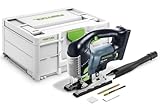


Festool Carvex models compared
| Model | Power | Maximum wood cut depth | Maximum aluminium / steel | Stroke rate | Approximate tool weight | Best suited to |
|---|---|---|---|---|---|---|
| PS 420 EBQ-Plus | 550 W corded | 120 mm | 20 mm / 10 mm | 1,500–3,800 strokes/min | Approx. 2.4 kg | Workshop furniture, repeated cuts, thick hardwood |
| PSBC 420 EB-Plus | 18 V cordless | 120 mm | 20 mm / 10 mm | 1,500–3,800 strokes/min | Approx. 2.3 kg without battery | Site work, installation, overhead and remote cutting |
Specifications can vary slightly by regional configuration and whether the quoted cordless weight includes a battery. The cutting capacities are limits, not promises of a smooth finish: blade type, material hardness, feed speed, and support underneath the workpiece have a larger effect on the result than the headline depth.
PS 420 EBQ-Plus: the better choice for a permanent workshop
The corded PS 420 EBQ-Plus is the safer recommendation if your jigsaw normally stays near a dust extractor and mains outlet. Its 550 W motor supplies consistent power for long sessions, so there is no battery change halfway through a curved countertop cut or a batch of cabinet sides.
That consistency is especially useful in hardwood. A jigsaw blade can wander when the operator slows down, pushes too hard, or lets the motor lose speed. The corded Carvex leaves more reserve for controlled feeding through thick timber, although a sharp, appropriate blade remains essential.
Where the corded model wins
- Repeated work where stopping to recharge would interrupt production.
- Thick hardwood, laminated panels, and dense sheet goods.
- Workshop cutting with a connected dust extractor.
- Users who already own Festool’s mains-powered extraction and guide accessories.
Its disadvantage is not cutting performance but freedom of movement. The cable can catch on the edge of a panel, cross the cut line, or make it less convenient to turn the tool around a large template. For delicate curves, managing the cable is one more source of unwanted movement.
PSBC 420 EB-Plus: the better choice for mobility
The cordless PSBC 420 EB-Plus offers the same stated 120 mm wood capacity and compact Carvex form without a power lead. It is particularly useful for fitting work, stair components, sink cut-outs, and repairs where the workpiece is already installed or the nearest outlet is inconvenient.
Its practical limitation is runtime rather than cutting depth. Runtime changes with battery capacity, material thickness, blade sharpness, pendulum setting, and how continuously the motor is loaded. A high-capacity 18 V battery is preferable for thick stock and repeated cuts; a smaller pack keeps the tool lighter for short, overhead work.
Where the cordless model wins
- On-site work where extension cords create trip or snag hazards.
- Cutting large panels while walking around the workpiece.
- Overhead or awkward-position cuts where cable drag affects accuracy.
- Installers who already use compatible Festool 18 V batteries.
If the jigsaw will be used for only a few minutes at a time, the cordless premium may be justified by convenience. If it will run for hours every week, the corded model usually provides the simpler ownership pattern: no battery rotation, no charging schedule, and no battery ageing to budget for.
Head-to-head buying decision
| Your situation | Recommended choice | Why |
|---|---|---|
| Mostly fixed workshop use | PS 420 EBQ-Plus | Continuous 550 W power and no runtime limit |
| Frequent work on installed panels | PSBC 420 EB-Plus | No cable to route around the workpiece |
| New to precision jigsaw cutting | Either; corded for value, cordless for handling | The blade, support, and feed technique matter more than the power source |
| Several hours of cutting each week | PS 420 EBQ-Plus | Unlimited operating time and lower dependence on spare batteries |
| Occasional short cuts away from outlets | PSBC 420 EB-Plus | Convenience outweighs charging requirements |
| Dust-sensitive indoor work | Either with extraction | Both support Festool CLEANTEC extraction connections |
Dust extraction, guides, and curved-cut control
Both Carvex versions can connect to Festool CLEANTEC dust extractors. Extraction is valuable not only for cleanliness: removing chips lets the blade follow the marked line, reduces recutting through loose debris, and improves visibility around the shoe. For a clean indoor cut, use the extractor whenever the material and setup allow it.
Festool’s guide-rail and circle-cutting accessories extend the jigsaw beyond freehand work. A guide-rail adapter can help produce straight, repeatable cuts, while a compatible circle-cutting setup is better for arcs than trying to steer the tool around a pencil line by eye. Check the accessory’s compatibility with the specific Carvex package and rail system before buying; guide accessories are not automatically included with every Plus set.
For visible edges, a splinter guard and the correct fine-tooth blade can be more important than the model choice. A zero-clearance insert helps support the material close to the blade, while a sacrificial board underneath reduces breakout on the underside.
How to set up a Carvex for a clean curve
- Choose the blade for the material. Use a fine, down-cut or laminate-oriented blade when the visible face must stay clean, and a conventional up-cut blade when underside breakout is acceptable. Do not use a worn blade to “save” a consumable; it increases heat and steering force.
- Support the entire panel. Place the workpiece on sacrificial supports so the off-cut cannot fall and twist the blade near the end of the cut.
- Mark the curve and make relief cuts. On a tight internal radius, short relief cuts into the waste area prevent the blade from binding as it turns.
- Set the pendulum action conservatively. Lower pendulum action generally gives a finer finish and better control; higher action removes material faster on hidden cuts.
- Let the blade do the cutting. Keep the shoe flat, advance at a steady rate, and avoid forcing the handle sideways. If the blade bends, pause and correct the setup rather than steering harder.
- Finish corners separately. Stop before a sharp inside corner, drill a correctly sized relief hole if appropriate, and approach the corner from the other direction. This reduces overcutting.
Ownership realities: blades, cleaning, and wear
The first consumable to wear is normally the blade, not the motor. Blades lose their set and sharpness gradually, so a curve may begin to feel harder to control before the teeth look visibly damaged. Keep separate blades for hardwood, softwood, laminate, and metal; mixing them leads to poor finish and unnecessary heat.
After dusty work, brush or vacuum the shoe, blade area, and extraction port. Fine dust around the blade guide can affect smooth movement. Avoid flooding the mechanism with lubricant: use only maintenance products and locations specified by Festool. Inspect the base for resin buildup, check that the blade is seated fully, and replace a bent blade rather than compensating with pressure.
On the cordless PSBC 420, batteries are an ownership cost as well as a convenience. A simple usage estimate helps: if a job requires 40 minutes of actual cutting and one battery normally provides about 20 minutes under that workload, plan on two charged batteries plus reserve rather than assuming the nominal amp-hour figure translates directly into cutting time. Actual runtime varies substantially with material and technique.
Final recommendation
Choose the PS 420 EBQ-Plus for the best value in a dedicated workshop, especially when you cut thick timber, run long sessions, or already work beside an extractor. Choose the PSBC 420 EB-Plus when cable-free positioning saves time or makes installed and overhead cuts safer to manage. Whichever version you select, budget for quality blades, dust extraction, and the appropriate guide or circle-cutting accessory: those items have a greater influence on precision curves than choosing between the two Carvex power systems.