Festool Kapex Miter Saw Buying Guide
What's inside
- Kapex models compared
- Which Kapex fits your work?
- KS 60 E versus KS 120 RE
- Crown-molding features that matter
- Dust extraction: a major reason to buy a Kapex
- Portability and cordless ownership
- What the premium price buys—and what it does not
- Durability, blades, and maintenance realities
- Final buying recommendation
- Related Guides
- Kapex models compared
- Which Kapex fits your work?
- KS 60 E versus KS 120 RE
- Crown-molding features that matter
- Dust extraction: a major reason to buy a Kapex
- Portability and cordless ownership
- What the premium price buys—and what it does not
- Durability, blades, and maintenance realities
- Final buying recommendation
- Related Guides
As an Amazon Associate I earn from qualifying purchases. This post may contain affiliate links at no extra cost to you.
The best Festool Kapex miter saw for most professional finish carpenters is the KS 120 RE when crown molding, large trim, and repeatable accuracy matter more than weight; choose the KS 60 E for transport and smaller stock, or the cordless KSC 60 if working where mains power and dust extraction are limited.
As an Amazon Associate we earn from qualifying purchases at no extra cost to you.


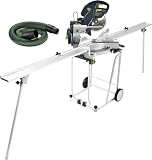
Kapex models compared
Festool’s Kapex range is aimed at precise crosscutting rather than heavy-duty framing. All three saws use a sliding compound-miter design, integrated work supports, adjustable bevel stops, and dust-extraction provisions. The important buying differences are blade size, cutting capacity, portability, and whether you need a cord.
| Model | Blade | Maximum crosscut capacity | Bevel range | Approximate weight | Best suited to |
|---|---|---|---|---|---|
| KS 60 E | 216 mm (8-1/2 in.) | 305 x 60 mm at 90° (about 12 x 2-3/8 in.) | 47° left / 46° right | 17.8 kg (39.2 lb.) | Portable trim work, flooring, cabinetry, and small workshops |
| KS 120 RE | 260 mm (10-1/4 in.) | 305 x 88 mm at 90° (about 12 x 3-7/16 in.) | 47° left / 47° right | 23.1 kg (51 lb.) | High-volume finish carpentry and large molding |
| KSC 60 | 216 mm (8-1/2 in.) | 305 x 60 mm at 90° (about 12 x 2-3/8 in.) | 46° left / 46° right | About 17.3 kg without batteries | Remote sites, punch lists, and cordless trim work |
Capacities vary with the cutting angle, material position, and use of the depth stop, so treat the figures above as maximum straight-cut specifications rather than an everyday promise. At a 45° miter, usable width is lower, and thick stock may require a second cut or careful repositioning.
Which Kapex fits your work?
| Your situation | Recommended choice | Why |
|---|---|---|
| Occasional home projects and limited budget | KS 60 E, if buying Kapex is justified | Lower weight and adequate capacity, although a conventional miter saw may offer better value |
| Daily installation of baseboard, casing, and crown | KS 120 RE | Larger blade, taller capacity, and more convenient crown-molding adjustments |
| Frequent stair, flooring, and punch-list work | KS 60 E | Easier to carry while retaining a 12-inch crosscut capacity |
| No reliable mains power or frequent outdoor work | KSC 60 | Battery operation eliminates extension cords, with similar capacity to the KS 60 |
| Large crown, thick trim, and production finish work | KS 120 RE | Extra vertical capacity and purpose-built angle controls reduce setup time |
KS 60 E versus KS 120 RE
Choose the KS 60 E for mobility
The KS 60 E is the more practical Kapex for a carpenter who carries a saw between rooms or loads it into a vehicle every day. Its 216 mm blade still cuts a 305 mm-wide board in a straight crosscut, while its integrated side extensions and front-facing controls make it easier to use in confined spaces.
Its limitation is height. A 60 mm maximum vertical cut is sufficient for most casing, baseboard, flooring, and ordinary trim, but it gives less margin for thick crown molding and stacked workpieces. It is also a better match for users who make many short cuts rather than repeatedly cutting large, heavy sections.
Choose the KS 120 RE for finish-production capacity
The KS 120 RE is the more capable Festool chop saw for large molding. Its 260 mm blade and approximately 88 mm vertical capacity accommodate taller stock, while the dual-bevel mechanism and front-mounted controls make left- and right-hand compound cuts easier to repeat.
The extra capacity comes with meaningful trade-offs: it is roughly 5 kg heavier than the KS 60 E, takes up more bench or floor space, and usually costs substantially more. It is most defensible as a business tool when it saves setup time and reduces expensive rework—not merely because it has a larger specification sheet.
Crown-molding features that matter
Kapex saws are designed to make crown molding less dependent on improvised jigs. The pivoting head, compound-bevel capability, positive angle stops, and crown-molding position references help keep the workpiece oriented consistently. The KS 120 RE adds particularly useful crown stops and angle controls for repeated inside and outside corners.
These features do not eliminate the need to understand spring angle and corner geometry. Before cutting finished material:
- Identify the molding’s spring angle and use the appropriate orientation.
- Mark inside and outside corners on the back of each piece.
- Cut test pieces from scrap and label the mating ends.
- Check whether the wall corner is actually 90 degrees; use an angle finder for irregular rooms.
- Keep the molding firmly supported against the fence or crown stop throughout the cut.
A common mistake is assuming that a saw’s displayed miter angle automatically matches the corner angle. Real walls, ceiling lines, and molding profiles often require a measured adjustment.
Dust extraction: a major reason to buy a Kapex
Dust collection is one of the strongest arguments for a Kapex in interior finish work. Connect the saw to a compatible Festool CT dust extractor through the saw’s extraction port, and use a suitable fine-dust filter bag or container arrangement. The result is generally cleaner than relying on the small fabric bag supplied with many ordinary miter saws.
Extraction is not perfect: the blade is exposed, the cut is open at the front, and fine particles can escape when cutting wide stock. Position the extractor hose so it does not restrict the slide, keep the rear clearance open, and use a vacuum with sufficient airflow rather than a small general-purpose shop vacuum. For renovation work, clean the rails and pivot area regularly because accumulated dust can affect smooth movement and angle accuracy.
If you work almost exclusively outdoors, the dust advantage may not justify the cost of a CT extractor. For occupied homes, cabinetry shops, and painted trim, cleaner air and less cleanup can quickly become a practical productivity benefit.
Portability and cordless ownership
The KS 60 E is portable by jobsite standards but not light enough to treat casually on stairs. Its carrying points are useful, and the integrated extensions reduce the need to transport separate supports. The KS 120 RE is better viewed as a shop or vehicle-based saw: movable, but tiring to relocate repeatedly.
The KSC 60 uses two 18-volt battery packs and is useful where an electrical outlet is inconvenient. Runtime depends heavily on material thickness, blade sharpness, and how many cuts are made; it should not be treated as a fixed number of cuts per charge. Professionals planning a full day of trim work should budget for multiple charged battery pairs rather than expecting one pair to last indefinitely.
Cordless convenience also changes dust collection. Battery operation does not remove the need for extraction, and a separate cordless or mains-powered extractor may still be required for indoor work.
What the premium price buys—and what it does not
Kapex saws commonly occupy the premium end of the miter-saw market, with general market pricing often ranging from roughly $1,000 to more than $2,000 depending on model, kit, region, and included accessories. Batteries, an extractor, stands, blades, and replacement consumables can raise the total substantially.
Consider a simple ownership calculation. If a complete setup costs $2,000 and is used for 200 professional workdays, the equipment cost is $10 per day before blades, maintenance, and finance costs. If the saw saves 15 minutes on each of six installation days per month, that is 18 hours recovered annually. At a billable value of $75 per hour, the recovered time could exceed $1,300 in one year. The calculation only works if the saw is used frequently and the saved time is actually converted into productive work.
The premium does not make the saw immune to errors. It will not compensate for a dull blade, poor stock support, inaccurate wall measurements, or forcing the slide through material. A less expensive saw may be the sensible choice for occasional DIY use or rough construction where portability and finish accuracy are secondary.
Durability, blades, and maintenance realities
The parts most likely to affect long-term performance are consumables and adjustment surfaces rather than the motor alone. Expect to replace or sharpen blades according to the material being cut. A fine-tooth blade for painted trim gives a cleaner edge than a general-purpose blade, but it cuts more slowly and can suffer if used on dirty or abrasive stock.
- Vacuum dust from the table, fence, rails, and bevel mechanism rather than allowing buildup to harden.
- Inspect the blade for resin, missing teeth, and burning before chasing an alignment problem.
- Check the fence and miter stops after transporting the saw.
- Do not use the slide lock or depth stop as a substitute for proper stock support.
- Use clamps or auxiliary supports for long, unstable molding.
- Follow Festool’s instructions for lubrication, electrical inspection, and replacement parts.
Final buying recommendation
Buy the KS 60 E if you need a premium, portable corded saw for everyday trim and want to limit carrying weight. Buy the KS 120 RE if crown molding, tall baseboard, repeatable compound cuts, and professional finish productivity are central to your work. Choose the KSC 60 when cordless access is worth the battery investment.
For a professional finish carpenter, the premium can be justified by capacity, repeatability, dust control, and reduced setup time. For occasional use, compare the complete system cost—including extractor, blades, batteries, and support equipment—before deciding that a Festool Kapex chop saw is the best value.