DeWalt 20V Miter Saw Buying Guide
What's inside
- DeWalt 20V miter saw models compared
- DCS361 vs. DCS365: which one fits your work?
- Battery runtime: what to expect in real work
- How each saw handles common trim materials
- Portability, performance, and operating cost
- Decision matrix
- How the 20V saws compare with DeWalt 60V and corded models
- Ownership details that affect long-term value
- Bottom line
- Related Guides
- DeWalt 20V miter saw models compared
- DCS361 vs. DCS365: which one fits your work?
- Battery runtime: what to expect in real work
- How each saw handles common trim materials
- Portability, performance, and operating cost
- Decision matrix
- How the 20V saws compare with DeWalt 60V and corded models
- Ownership details that affect long-term value
- Bottom line
- Related Guides
As an Amazon Associate I earn from qualifying purchases. This post may contain affiliate links at no extra cost to you.
The best DeWalt 20 volt miter saw for most trim work is the compact DCS361 7-1/4-inch model, while the DCS365 10-inch double-bevel saw is the better choice when you regularly cut wider boards, crown molding, or heavier framing stock.
As an Amazon Associate we earn from qualifying purchases at no extra cost to you.


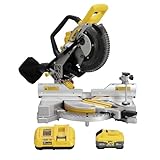
DeWalt 20V miter saw models compared
DeWalt’s 20V MAX cordless miter-saw range is relatively focused. The main buying decision is between a lightweight 7-1/4-inch saw and a larger 10-inch model. Both use DeWalt 20V MAX batteries, but neither includes the battery in the bare-tool price.
| Model | Blade size | Bevel range | Typical 90-degree capacity | Approx. bare-tool weight | Best use |
|---|---|---|---|---|---|
| DCS361 | 7-1/4 in. | Up to 47° left | About 2 x 8 in. lumber; roughly 8 in. crosscut width | About 30 lb | Trim, flooring, shelving, small framing jobs |
| DCS365 | 10 in. | Double bevel, up to 48° left and right | About 2 x 8 in. lumber | About 36 lb | Crown molding, baseboard, larger trim, frequent jobsite work |
Capacity varies slightly with the fence position, blade kerf, bevel angle, and the exact material dimensions. Check the manual before treating the published capacity as a guaranteed cut size, especially for compound cuts.
DCS361 vs. DCS365: which one fits your work?
Choose the DCS361 for portability and occasional use
The DCS361 is the more practical pick for a homeowner, punch-list contractor, flooring installer, or finish carpenter who carries the saw up stairs or works in confined rooms. Its 7-1/4-inch blade is sufficient for standard 1x and 2x trim, casing, baseboard, shoe molding, and many shelving components.
The smaller blade reduces overall size and makes the saw easier to place on a small workbench. It also tends to use less energy per cut. A compact saw is not automatically weak, however: cutting pressure, blade sharpness, and material density have a larger effect on performance than the nominal blade diameter.
The limitation is convenience. A 7-1/4-inch saw may require flipping a wide board, using a different cutting layout, or making a second pass where a 10-inch saw would complete the cut in one pass. That matters when installing long runs of baseboard or processing many pieces in succession.
Choose the DCS365 for wider trim and double-bevel work
The DCS365 earns its extra weight through a 10-inch blade, larger working envelope, and double-bevel capability. Being able to tilt the head left or right is particularly useful for crown molding and matched compound cuts because you can keep the finished face oriented consistently.
For an experienced user doing regular renovation or trim work, the DCS365 is usually the more versatile cordless choice. It is still not a substitute for a 12-inch saw when you routinely cut large crown, thick posts, or wide deck boards. Its advantage is the balance between capacity and portability, not maximum production output.
Battery runtime: what to expect in real work
DeWalt does not provide one universal runtime figure because a battery’s output depends on blade condition, material, temperature, cutting speed, and how long the tool idles. A 2Ah pack keeps the saw light but is better suited to touch-up work. A 4Ah or 5Ah pack is a more useful general-purpose choice, while a 6Ah or larger pack extends work time at the cost of additional weight.
For a planning estimate, assume one complete trim cut uses roughly 0.02 to 0.04 amp-hours under moderate conditions. A 5Ah battery therefore represents approximately 125 to 250 similar cuts before allowing for efficiency losses, startup current, and battery protection. A safer jobsite estimate is 75 to 175 cuts per charge, with dense hardwood, long compound cuts, and a dull blade reducing that figure.
For example, if a room requires 60 baseboard cuts and your working estimate is 100 cuts per 5Ah charge, one pack should cover the cutting. Bringing a second charged pack is sensible when the saw is also used for test cuts, offcuts, or framing lumber. The 20V platform becomes especially convenient if you already own compatible DeWalt batteries for drills, impact drivers, or lights.
How each saw handles common trim materials
- Primed pine and finger-jointed trim: Both models cut these materials efficiently with a sharp, high-tooth-count finish blade. Support long stock so the offcut does not twist into the blade.
- MDF baseboard: The saws have enough power for normal trim thickness, but MDF creates fine dust. Use dust collection where possible and clean the lower guard and vents regularly.
- Hardwood casing: The DCS365 offers a more comfortable margin for repeated cuts. Use a sharp 60- to 80-tooth blade and avoid forcing the head through the material.
- Crown molding: The DCS365’s double bevel is more convenient. The DCS361 can handle smaller crown, but capacity and setup angles deserve closer checking.
- Composite decking and PVC trim: Both can be cut, but material movement and melting are concerns. Use the manufacturer’s recommended blade, steady feed pressure, and adequate support.
- Framing lumber: Either model can handle ordinary 2x material within its capacity. For high-volume framing, a corded or larger 60V saw may be more productive.
Portability, performance, and operating cost
The DCS361 is easier to transport because it is about 6 lb lighter and occupies less bench space. That difference is noticeable when carrying the saw with a battery and accessories. The DCS365 is still portable, but its larger base and blade make a folding stand or dedicated support table more valuable.
Cordless convenience also changes setup time. There is no extension cord to route, which helps in occupied rooms and unfinished buildings. The trade-off is battery management and the gradual cost of replacement blades and batteries. Typical market pricing varies by kit contents and promotions, but bare tools commonly sit in the roughly $250–$450 range, while kits with a charger and battery cost more. Treat those as broad 2026 market ranges rather than fixed prices.
Decision matrix
| Your situation | Recommended choice | Reason |
|---|---|---|
| Occasional home repairs and limited storage | DCS361 | Smallest practical setup and sufficient trim capacity |
| Frequent baseboard, casing, and crown installation | DCS365 | 10-inch blade and double bevel reduce repositioning |
| Already own several 20V MAX batteries | Either; DCS361 for mobility | Lower ownership cost and easy battery interchange |
| Mostly wide or thick stock | DCS365, or a 60V 12-inch saw | More capacity; step up if the work exceeds 10-inch limits |
| High-volume framing or production cutting | 60V model or corded 12-inch model | Greater capacity and sustained cutting performance |
How the 20V saws compare with DeWalt 60V and corded models
Searches for a DeWalt 20 volt chop saw often refer to a miter saw. A chop saw normally makes straight 90-degree cuts, while a miter saw pivots for angled cuts and often bevels as well. The DCS361 and DCS365 are miter saws, not abrasive metal chop saws.
A DeWalt 60 volt chop saw may also be a description used loosely for a larger cordless cutting tool. DeWalt’s 60V MAX FLEXVOLT miter saws, such as 12-inch models in the DCS7-series, are intended for more demanding cutting than the 20V saws. They accept FLEXVOLT batteries, which can operate as 60V packs in compatible tools, but the saws are heavier and usually more expensive.
The phrase 60 volt DeWalt miter saw or 60 volt FLEXVOLT miter saw generally points to that larger class. Choose one when you need greater crosscut capacity, frequent hardwood or framing cuts, or longer production sessions. Choose 20V when carrying weight, indoor maneuverability, and compatibility with existing batteries matter more.
A DeWalt 120 volt miter saw is not the normal cordless category. DeWalt also sells corded 120V miter saws, including larger professional models, but those use an outlet rather than a 20V or FLEXVOLT battery. They can deliver consistent power without recharge time, at the cost of cords and less freedom of placement.
Ownership details that affect long-term value
The blade is usually the first consumable to affect performance. Replace it when cuts become slow, edges splinter, burning appears, or the saw begins to wander despite correct technique. Use a blade suited to the material rather than leaving a general-purpose blade installed for every task.
Fine dust can restrict the lower guard, clog the dust chute, and coat the bevel mechanism. Disconnect the battery before cleaning, brush or vacuum accumulated dust, and check that the guard returns smoothly. Do not lubricate parts unless the manual specifies an appropriate product; oily surfaces can attract more abrasive dust.
Common mistakes include cutting unsupported long stock, twisting the workpiece during a bevel cut, starting with the blade touching the material, and relying on the saw’s scale without making a test cut. Clamp short or awkward pieces, let the blade reach full speed, lower it steadily, and wait for the blade to stop before raising the head.
Bottom line
Buy the DCS361 if your priorities are low weight, small storage footprint, and dependable cutting of ordinary trim. Buy the DCS365 if you value double-bevel convenience, wider working capacity, and better comfort during repeated finish work. Move to a 60V FLEXVOLT or corded 12-inch miter saw only when the extra capacity and sustained performance justify the additional weight, battery cost, and workspace.