Milwaukee 28-Piece Hole Saw Kit: What’s Inside and What It Can Cut
What's inside
As an Amazon Associate I earn from qualifying purchases. This post may contain affiliate links at no extra cost to you.
The Milwaukee 28-piece hole saw kit (49-22-4185) is the right buy if you bore mixed-diameter holes in wood, drywall, and thin metal on a regular basis, because it puts 22 Hole Dozer bi-metal saws — spanning 3/4 in. to 4-1/4 in. — plus two quick-change arbors, two pilot bits, and the adapter hardware in one case for roughly what seven or eight of the larger cups would cost bought individually. If your work is narrower (a few electrical sizes, or wood-only rough-in), a smaller Hole Dozer trade kit or a Big Hawg set will cover it for less. Here’s exactly what’s inside and what each piece is good for.
As an Amazon Associate we earn from qualifying purchases at no extra cost to you.
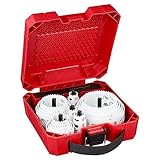


What’s in the case
The “28 pieces” break down into saw cups and arbor hardware. The exact lineup can shift slightly between production runs, but the standard case inventory is:
| Component | Count | Details |
|---|---|---|
| Hole Dozer bi-metal hole saws | 22 | 3/4 in. through 4-1/4 in. (full size list below) |
| Quick-change arbors | 2 | One small-saw arbor (cups up to ~1-3/16 in.), one heavy arbor for 1-1/4 in. and up; both on 7/16 in. hex shanks |
| Pilot bits | 2 | 1/4 in. high-speed-steel pilots, set-screw retained |
| Arbor adapter | 1 | Nests a smaller saw inside a larger one so you can enlarge an existing hole with the small saw acting as the pilot |
| Spacer plate | 1 | Drops between arbor and saw to control how deep the cup reaches |
The 22 saw sizes: 3/4, 7/8, 1, 1-1/8, 1-1/4, 1-3/8, 1-1/2, 1-5/8, 1-3/4, 2, 2-1/8, 2-1/4, 2-3/8, 2-1/2, 2-5/8, 2-3/4, 3, 3-1/4, 3-1/2, 3-3/4, 4, and 4-1/4 in. That spread is what separates this kit from the plumber’s and electrician’s kits — those are curated to trade knockout sizes, while this one covers nearly every fractional step in the range.
Both arbors are tool-free: the saw threads on and locks to the drive pins with a collar you can operate with gloves on. The 7/16 in. shanks mean you need a 1/2 in. chuck — they will not fit a 3/8 in. drill, and for saws above about 2-1/2 in. you want a high-torque 18V drill or a dedicated right-angle drill regardless, because a 4 in. cup grabbing a knot can wrench a compact drill out of your hands.
Which size does what
A large part of this kit’s value is that it already contains the diameters the trades actually reach for. The most-used cups map to standard dimensions:
| Saw size | Typical job |
|---|---|
| 7/8 in. | Knockout for 1/2 in. conduit |
| 1-1/8 in. | Knockout for 3/4 in. conduit |
| 1-3/8 in. | Knockout for 1 in. conduit |
| 1-3/4 in. | 1-1/4 in. conduit; drain and trap fittings |
| 2-1/8 in. | Standard door lockset bore |
| 2-1/2 in. | Knockout for 2 in. conduit |
| 3 in. – 3-1/2 in. | Drain and vent pipe passes, small recessed fixtures |
| 4-1/4 in. | Through-wall hole for 4 in. dryer or bath vent duct |
One gap to note: 6-1/4 in. for common recessed lighting housings is not in this kit — that’s a separate saw purchase.
Cutting depth and material performance
Hole Dozer cups cut 1-5/8 in. deep. That’s deliberate: it clears a standard 2x member (1-1/2 in.) in one pass, which covers studs, joists, and single-layer subfloor. Anything thicker — doubled plates, a joist under subfloor — means cutting from both sides or reaching for a deeper cup.
| Material | How it performs | Technique notes |
|---|---|---|
| Softwood, plywood, OSB | Fast and clean; ejects plugs through the angled side slots | Run near full drill speed on small saws, roughly 250–400 RPM on 3–4 in. cups; back out periodically on deep cuts to clear chips |
| Drywall | Effortless single-pass cuts | Moderate speed keeps dust down; check for wiring before pushing through |
| Thin steel (up to ~1/8 in.), aluminum, brass | Capable — bi-metal teeth are rated for metal | Drop to roughly a quarter of wood speed, use cutting oil, and center-punch the start so the pilot doesn’t skate |
| Nail-embedded lumber | Will survive occasional strikes but dulls noticeably faster | If demolition is the job, carbide teeth are the right answer |
| Thick steel, stainless | Not recommended | Step up to a carbide-tipped saw or annular cutter |
The tooth edge is high-speed steel electron-beam welded to an alloy body — the standard bi-metal construction — with a low-friction coating on the cup. In practice the coating reduces the heat buildup that makes generic saws scorch plywood, and the open slots in the cup wall are genuinely useful: you lever plugs out with a screwdriver instead of shaking the saw against your palm.
Hole Dozer kit vs. Big Hawg kit
Buyers cross-shopping a Milwaukee Big Hawg hole saw kit should know the two lines solve different problems. Big Hawg uses large carbide teeth and a deeper cup aimed at framing and rough-in work; Hole Dozer is the generalist.
| Hole Dozer (this kit) | Big Hawg kits | |
|---|---|---|
| Tooth type | Bi-metal, fine pitch | Carbide-tipped, aggressive coarse teeth |
| Cutting depth | 1-5/8 in. | ~2-1/4 in. (clears a 2x plus sheathing) |
| Metal | Yes — thin stock with oil | No — wood/drywall only |
| Finish quality | Cleaner edge, better for visible holes | Fast and rough; fine behind walls |
| Nail strikes | Tolerates, dulls faster | Designed for it |
| Typical kit price | Roughly $200–$300 | Roughly $100–$170 for common rough-in sets |
If your day is boring 2-9/16 in. holes through studs for plumbing runs, the Big Hawg is the better tool — faster in lumber and it shrugs off nails. If holes happen in mixed materials and the edge is sometimes visible, Hole Dozer bi-metal is the right family.
The PACKOUT question
Shoppers searching for a Milwaukee PACKOUT hole saw kit should know the 28-piece ships in a standalone red hard case with a molded insert — it does not click into the PACKOUT stack. Milwaukee does sell smaller Hole Dozer assortments in PACKOUT-compatible compact organizers, and plenty of users transfer the cups into a PACKOUT compact organizer bought separately. If system integration matters more than saw count, that route costs less and stacks with the rest of your boxes; if maximum size coverage matters, buy this kit and accept the loose case.
What wears out, and common mistakes
- Pilot bits go first. They bend on angled starts and snap when the saw grabs. Replacements are cheap — keep spares on hand and treat the two included pilots as a consumable supply, not a lifetime provision.
- Running big saws too fast. A 4 in. cup at full drill speed blue-dulls teeth in one job. Slow down as diameter climbs; heat, not force, kills bi-metal saws.
- Skipping oil on metal. Dry bi-metal teeth on steel lose their edge fast. Any cutting oil or even wax helps.
- Ignoring the adapter. To enlarge an existing hole, thread a larger saw over a smaller one through the adapter — the small saw pilots the big one. Most owners never use this and then wonder how anyone enlarges a 2 in. hole.
- Individual cups are replaceable. You don’t rebuy the kit when one size dies — Hole Dozer saws are sold singly and thread onto the same arbors.
Kit vs. buying individually: the math
Hole Dozer cups sell for roughly $8–$15 in small diameters and $20–$40 at the big end, arbors run around $15–$20 each, and pilots a few dollars. Replacing this case piece by piece works out to roughly $350–$450 depending on sizes, versus a typical street price in the $200–$300 range for the kit. The kit wins clearly if you’ll use more than about half the sizes; if you’ll only ever touch three or four, buy those individually plus a pair of arbors for around $60–$80.
| Your situation | Sensible pick |
|---|---|
| DIY, occasional holes in a few sizes | Individual saws or a 9–13 pc Hole Dozer trade kit |
| Remodeler, plumber, or electrician boring mixed sizes weekly | This 28-piece kit |
| Wood-only rough-in, nails likely | Big Hawg rough-in kit |
| Sheet-metal or HVAC work | Carbide-tipped sheet metal saw set |
Quick answers
Will it fit a 3/8 in. drill? No — the 7/16 in. hex shanks need a 1/2 in. chuck, and large saws want a high-torque drill.
Can it cut the full depth of a 2×4 wall? Through one 2x member, yes (1-5/8 in. capacity). For stud plus drywall or sheathing, finish the cut from the other side or use the deeper Big Hawg.
Are the saws the same as individually sold Hole Dozers? Yes — identical cups, so replacements and extra sizes slot into the same case and arbors.
For a remodeling or trade toolkit that has to handle whatever the next wall is made of, the milwaukee 28 piece hole saw kit earns its footprint. The size coverage is the product: once you own 22 diameters, the answer to “do I have that size?” stops being a store run.