Best DeWalt Jigsaws: Compare Cordless and Corded Models
What's inside
As an Amazon Associate I earn from qualifying purchases. This post may contain affiliate links at no extra cost to you.
Best DeWalt Jigsaws: Compare Cordless and Corded Models
The best DeWalt jigsaw depends on your power setup and workload: choose the 20V MAX DCS334 for cordless convenience with a barrel grip, the DCS335 for a top-handle cordless option, or the corded DW317 when you want a simple, lower-cost tool for occasional cuts.
For most shoppers, the deciding factors are whether you already own DeWalt 20V MAX batteries, how thick your material is, and whether you need speed adjustment and tool-free blade changes. The DCS334 and DCS335 offer those controls in cordless designs; the DW317 is a more basic corded choice. Check the exact model’s current manual before buying, since specifications and included accessories can vary by kit and market.
As an Amazon Associate we earn from qualifying purchases at no extra cost to you.

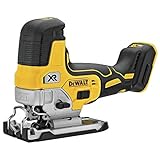


Quick comparison
| Model | Power | Handle | Stroke rate | Maximum cut capacity | Blade changes and control |
|---|---|---|---|---|---|
| DeWalt DCS334 | 20V MAX battery | Top handle | 0–3,200 strokes per minute | 3/4 in. wood; 1/2 in. aluminum; 1/4 in. steel | Tool-free blade change; variable speed; 4-position orbital action |
| DeWalt DCS335 | 20V MAX battery | Barrel grip | 0–3,200 strokes per minute | 3/4 in. wood; 1/2 in. aluminum; 1/4 in. steel | Tool-free blade change; variable speed; 4-position orbital action |
| DeWalt DW317 | 5.5 A corded | Top handle | 0–3,100 strokes per minute | 4 in. wood; 3/4 in. aluminum; 1/4 in. steel | Tool-required blade clamp; variable speed; 4-position orbital action |
Capacities are manufacturer-listed maximums, not promises of clean, easy cuts at that thickness. Blade type, material, feed rate, and workpiece support all affect results. Tool weight also varies by configuration: a cordless tool’s listed weight may exclude the battery, while a kit’s total includes it. Compare the product manual and package details for the exact figure.
Which DeWalt jigsaw fits your work?
Choose the DCS334 if you want a cordless all-rounder
The DCS334 is a practical pick for trim, plywood, shelving, and curved cuts when moving between work areas or working outdoors makes a cord inconvenient. It uses DeWalt’s 20V MAX battery platform, so an existing compatible battery can reduce the cost of adding the tool. If you’re new to the platform, compare the bare-tool price with a kit that includes a battery and charger.
Its variable-speed trigger helps you start slowly on a cut line and adjust as the material changes. Four orbital settings let you trade cut speed for finish quality: lower orbital action generally gives more controlled, cleaner cuts, while higher action removes material faster but tends to leave a rougher edge. It accepts T-shank blades and changes them without a separate blade-clamp tool.
Pick the DCS335 if grip and control matter most
The DCS335 provides similar cordless cutting features in a barrel-grip body. Some users prefer holding the tool lower and closer to the work surface, particularly when guiding curves or making detailed cuts. Grip preference is personal, so handle both styles in a shop if possible; body shape alone does not make one model more accurate.
Like the DCS334, it is a 20V MAX tool with variable speed, orbital adjustment, and a tool-free blade-change system. Choose between the two mainly by handle comfort, visibility of your cut line, and how you naturally guide a saw—not by expecting a major difference in cutting capacity.
Consider the DW317 for occasional corded work
The DW317 avoids battery charging and can be a sensible choice for a home workshop where an outlet is nearby and the saw is used intermittently. Its listed wood capacity is greater than that of the cordless models above, but maximum capacity should not be the only selection criterion: a thick cut may need a longer blade, slower feeding, and careful support to prevent blade deflection.
The trade-off is convenience. The cord can snag or limit reach, and this model uses a blade clamp that requires a tool rather than a quick, tool-free change. If you frequently switch between blade types or work in several locations, that extra step may become more noticeable than the lower purchase cost.
Match the saw to your battery, materials, and pace
| Your situation | Best fit | Why |
|---|---|---|
| You already own compatible 20V MAX batteries | DCS334 or DCS335 | A bare tool may be the economical route; choose the handle style you prefer. |
| You work mostly at a fixed bench and cut occasionally | DW317 | No battery to charge or replace; cord access is less of a drawback in a stationary setup. |
| You make frequent curved cuts or change blades often | DCS334 or DCS335 | Tool-free blade changes and cordless maneuverability make repeated setup easier. |
| You prioritize a controlled finish over fast rough cuts | Either cordless model, or DW317 | Use variable speed and a low orbital setting; fit a fine-tooth blade suited to the material. |
| You cut thick stock regularly | Compare capacity and blade requirements before choosing | Listed maximum capacity is not the same as an ideal production cut. A circular saw or band saw may suit repeated straight cuts better. |
What the specifications mean in practice
Battery platform: The DCS334 and DCS335 use DeWalt 20V MAX batteries. A higher-capacity battery can extend time between charges but adds weight. Runtime cannot be reliably reduced to a fixed number of minutes: it changes with battery condition, blade sharpness, material, thickness, and how hard the saw is pushed. For occasional short cuts, a smaller pack may keep the tool easier to handle; for longer sessions, keep a charged spare ready.
Speed and orbital action: Strokes per minute indicate how quickly the blade cycles, not how quickly every cut will finish. Slow the tool for metal, plastics prone to melting, or starts where the blade might wander. For a smoother edge in wood, use a suitable fine-cutting blade and little or no orbital action. Let the blade do the work instead of forcing it.
Blade changes: Tool-free systems save time when alternating between wood and metal blades, but they do not remove the need for safe handling. Disconnect a corded saw or remove the battery before changing blades. Wait for a recently used blade to cool, seat the new blade fully, and check that it is locked before cutting.
Ownership details that affect cut quality
Jigsaw blades are wear items. A dull or bent blade is more likely to wander, burn the material, and tempt you to push harder. Replace it when cuts become rough or slow despite choosing an appropriate speed. Keep separate blades for clean wood cuts, fast rough cuts, and metal; blade tooth pattern and material are as important as the saw itself.
Dust and chips can obscure the cut line and collect around the blade holder. After use, remove the battery or unplug the tool, brush away debris, and inspect the blade clamp and base for damage. Don’t use the base as a lever to force a turn: guide the saw gradually, support the offcut so it cannot pinch the blade, and clamp small workpieces securely.
For a first DeWalt jigsaw tool purchase, the DCS334 is a strong default if you want cordless versatility and already use 20V MAX batteries. Choose the DCS335 instead if its barrel grip suits your hand and cutting style better. If your work stays near an outlet and is infrequent, the DW317 offers a simpler corded route—provided you’re comfortable with a tool-required blade change.