Best Milwaukee Jigsaws: Cordless Models Compared
What's inside
As an Amazon Associate I earn from qualifying purchases. This post may contain affiliate links at no extra cost to you.
The best Milwaukee jigsaw for most jobsite users is the M18 FUEL D-Handle Jigsaw 2737-20 for its balance of power, low vibration, and barrel-grip or D-handle options, while the M12 FUEL Jigsaw 2545-20 is the better pick for overhead work and light workshop use where compact size matters more than maximum cutting capacity.
As an Amazon Associate we earn from qualifying purchases at no extra cost to you.


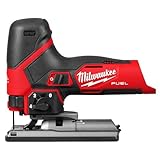
Milwaukee Jigsaw Lineup at a Glance
Milwaukee currently sells its cordless jigsaws on two battery platforms, M18 and M12, with all FUEL models using brushless motors. There is no corded Milwaukee jigsaw in the current catalog, so your choice comes down to voltage, handle style, and feature set. These are the core models you will find in 2026:
- M18 FUEL D-Handle Jigsaw (2737-20): Full-size 18V flagship with D-handle, variable speed dial and trigger, orbital action.
- M18 FUEL Barrel Grip Jigsaw (2737B-20): Same powerhead as the 2737-20 but with a barrel-grip body for scrolling and tight curves.
- M18 FUEL Jigsaw (2719-20) – Previous Generation: Still widely stocked as a budget M18 option. Brushed motor predecessor to the 2737, fewer anti-vibration features.
- M12 FUEL Jigsaw (2545-20): Compact 12V model with brushless motor, designed for one-handed use and lighter materials.
Tool-only kits are sold as -20, while -21 suffix indicates a kit with one battery and charger. All share Milwaukee’s REDLITHIUM battery system and accept standard T-shank jigsaw blades.
Head-to-Head Spec Comparison
Listing pages rarely put these numbers side by side. This table uses published Milwaukee specifications for bare tools:
| Specification | M18 FUEL D-Handle 2737-20 | M18 FUEL Barrel Grip 2737B-20 | M18 2719-20 (Gen 1) | M12 FUEL 2545-20 |
|---|---|---|---|---|
| Battery Platform | M18 REDLITHIUM | M18 REDLITHIUM | M18 REDLITHIUM | M12 REDLITHIUM |
| Motor Type | Brushless FUEL | Brushless FUEL | Brushed | Brushless FUEL |
| Stroke Length | 1 in (25.4 mm) | 1 in (25.4 mm) | 3/4 in (19 mm) | 7/8 in (22 mm) |
| Strokes Per Minute (No Load) | 0 – 3,500 SPM | 0 – 3,500 SPM | 0 – 2,800 SPM | 0 – 3,000 SPM |
| Orbital Settings | 5 positions (0-4) | 5 positions (0-4) | 4 positions (0-3) | 4 positions (0-3) |
| Bevel Capacity | 45 degrees both directions | 45 degrees both directions | 45 degrees both directions | 45 degrees both directions |
| Max Cut Capacity – Softwood | 5-1/8 in (130 mm) | 5-1/8 in (130 mm) | 4 in (102 mm) | 3-1/2 in (89 mm) |
| Max Cut Capacity – Mild Steel | 1/8 in (3.2 mm) | 1/8 in (3.2 mm) | 1/8 in (3.2 mm) | 1/16 in (1.6 mm) |
| Max Cut Capacity – Aluminum | 3/8 in (9.5 mm) | 3/8 in (9.5 mm) | 1/4 in (6.4 mm) | 1/4 in (6.4 mm) |
| Tool Weight (Bare, No Battery) | 6.2 lbs (2.81 kg) | 6.1 lbs (2.77 kg) | 5.9 lbs (2.68 kg) | 3.8 lbs (1.72 kg) |
| Weight With Battery (Common Kit Battery) | 7.6 lbs with M18 5.0Ah | 7.5 lbs with M18 5.0Ah | 7.3 lbs with M18 5.0Ah | 4.4 lbs with M12 4.0Ah |
| Blade Change | Tool-free T-shank, lever eject | Tool-free T-shank, lever eject | Tool-free T-shank, twist lock | Tool-free T-shank, lever eject |
| Key Features | LED light, dust blower, variable speed dial, soft start, counterbalance | LED light, dust blower, variable speed dial, low-profile barrel | LED light, dust blower | LED light, dust blower, hybrid grip, blade-to-shoe sightline |
The jump from 3/4-inch to 1-inch stroke on the 2737 models is the most important performance difference. Longer stroke means faster material removal in 2x framing and thicker hardwood, while the higher 3,500 SPM ceiling improves finish quality when dialed down for scrolling.
Battery Platform: M18 vs M12 in Real Use
Choosing Milwaukee jigsaw platform is primarily a weight and runtime decision, not just power.
M18 FUEL (2737 / 2737B)
The M18 models draw from the same batteries as your circular saw, Sawzall, and drill. Milwaukee rates the 2737 series for the longest continuous cutting in the lineup, and the brushless motor with REDLINK PLUS electronics prevents bogging when orbital action is set to 3 or 4 in 1-1/2-inch SPF lumber. Vibration is noticeably lower than the older 2719 due to an internal counterbalance mechanism and isolated gear case. If you already own M18 tools, staying on M18 avoids adding a second charger system.
M12 FUEL (2545)
The M12 trades 15 to 20 percent cutting capacity for a 2.5 to 3-pound weight savings. For cabinet installers, electricians cutting-in boxes overhead, or workshop users making curved cuts in 3/4-inch plywood and hardwood, that weight difference reduces fatigue more than the extra power helps. Cut speed in 2x material is slower and you will need to stay in orbital 0 or 1 to avoid deflection, but in sheet goods up to 1-1/8-inch the difference is minimal.
Worked Runtime Calculation
To estimate runtime, use usable watt-hours and average load. A M18 5.0Ah battery delivers about 90 Wh (18V x 5.0Ah), with roughly 75 Wh usable after efficiency losses. A M12 4.0Ah battery delivers about 48 Wh (12V x 4.0Ah), about 40 Wh usable.
A Milwaukee jigsaw draws approximately 180-220W under moderate load in 3/4-inch plywood at 2,500 SPM, orbital 1:
- M18 5.0Ah: 75 Wh / 200W = 0.375 hours = ~22 minutes of continuous trigger time. That equates to roughly 80 to 100 linear feet of 3/4-inch plywood ripping with a clean wood blade.
- M12 4.0Ah: 40 Wh / 170W (lower draw due to smaller motor) = 0.235 hours = ~14 minutes of trigger time, or about 50 to 65 linear feet in the same material.
- With an M18 6.0Ah High Output or M12 6.0Ah, add about 20% and 50% respectively.
For intermittent jobsite use – 30 seconds per cut, 40 cuts per day – either platform will last a full day on one charge. For production cutting of countertops or flooring, M18 has a clear endurance advantage.
Speed Control, Orbital Action, and Vibration
All current Milwaukee jigsaws offer two-stage speed control: a variable speed trigger and a separate dial that caps maximum SPM. Use the dial to set your ceiling, then feather the trigger for starts and curves.
- Finish and scrolling (0-1,200 SPM, orbital 0): Best for laminate, veneered plywood, and tight radius curves. The 2737’s soft-start prevents jump on entry, which matters for visible countertop cuts.
- General crosscutting (1,500-2,500 SPM, orbital 1-2): The sweet spot for dimensional lumber and 3/4-inch hardwoods. Dialing to orbital 2 speeds straight cuts but leaves a slightly rougher edge that needs sanding.
- Fast demolition / rough cuts (2,800-3,500 SPM, orbital 3-4): Only the 2737 models sustain this without excessive vibration. Use in 2x and engineered lumber where edge quality is not critical.
Vibration differences are not on spec sheets but affect buying. The 2737 series uses a counterbalanced crank and isolated motor mount, which reduces hand-arm vibration compared to the 2719 and 2545. The practical result is you can control a scrolling cut with less downward pressure, which improves accuracy in curves. The M12 2545 is light enough that transmitted vibration feels higher at max SPM, so keeping it under 2,200 SPM for detailed work yields cleaner lines.
Handle choice changes control more than power: D-handle (2737-20) gives better one-handed plunge control and is preferred for jobsite framing and overhead drywall cuts. Barrel grip (2737B-20) lowers the center of gravity, places your hand closer to the cut line, and improves visibility for workshop patterns and coping. There is no performance difference between them; choose based on hand size and how often you cut curves.
Decision Matrix: Which Milwaukee Jigsaw For Your Situation
| Your Situation | Recommended Pick | Why |
|---|---|---|
| Already on M18, need one jigsaw for jobsite and workshop | M18 FUEL D-Handle 2737-20 | Maximum capacity, lowest vibration, shares batteries with other M18 tools, general-purpose handle |
| Fine woodworking, templates, tight scroll cuts | M18 FUEL Barrel Grip 2737B-20 | Barrel grip improves curve control and sightline, same motor and capacity as D-handle |
| Electrician, installer, or overhead work / ladders | M12 FUEL 2545-20 | 3.8-pound bare weight saves fatigue, compact body fits between studs and cabinets |
| Already on M12 only, light DIY and occasional sheet goods | M12 FUEL 2545-20 | Avoids buying into second battery system, sufficient for plywood, MDF, aluminum trim |
| Tight budget, already own M18 batteries | M18 2719-20 if found discounted | Lower cost but shorter stroke and higher vibration; acceptable for rough carpentry, not ideal for finish scrolling |
| Small shop, limited space, noise-sensitive | M12 FUEL 2545-20 | Smaller footprint, lower noise at low SPM, adequate dust blower without vacuum |
Durability and Ownership Realities
Milwaukee jigsaws are durable, but consumables and maintenance determine ownership cost more than the motor.
- What wears first: The shoe (base plate) and anti-splinter insert. The aluminum shoe on all models will scuff and nick if dragged across concrete or metal. The clear plastic anti-splinter insert on the 2737 / 2545 cracks if you force bevel cuts without loosening the bevel lock fully. Replacement inserts and shoes are available as service parts.
- Blade clamp: Milwaukee’s tool-free lever is reliable, but sawdust packing in the clamp is the number one cause of blade slippage. Blow out the clamp with compressed air after each session and eject the blade while the clamp is still warm to prevent resin buildup.
- Roller guide: The lower blade roller collects pitch, especially cutting pine or MDF. Clean it with isopropyl alcohol and a brass brush; a seized roller causes angled cuts even with a new blade.
- Common mistakes: Pushing forward instead of letting the blade feed, using wood blades in metal (which strips teeth and overheats the shoe), and leaving orbital on 3-4 for finish cuts. Forcing a curve with a 10 TPI framing blade will bend the blade and score the shoe.
- Consumables to budget: T-shank blades (expect 5-15 blades per project depending on material), splinter inserts, and for jobsite use, a vacuum adapter if you connect to dust extraction. Blade cost per linear foot is more relevant than tool price for frequent users; bi-metal blades for metal cost two to three times wood blades but last longer in mixed materials.
- Cleaning: Disconnect battery, retract the dust blower nozzle, vacuum the motor vents, and wipe the base with a dry cloth. Never use water on the base where the bevel lock sits. Store with orbital set to 0 to relieve spring tension.
General market range in 2026 places Milwaukee jigsaw bare tools around the entry-level cordless price tier for the M12 and mid-to-upper tier for M18 FUEL models, with kits adding the cost of one or two batteries and a charger. If you are comparing across brands, the M12 often prices close to compact 18V jigsaws from other makers, while the M18 FUEL models price in line with other full-size brushless pro jigsaws.
Setup for Accurate Cuts
A new Milwaukee jigsaw will not cut square until you verify shoe square and guide alignment:
- Set bevel to 0 degrees, lock it, and check with a small square against the blade body (not the teeth) on both sides of the blade.
- Install a new 14 TPI or finer blade for the test cut; used blades introduce drift.
- Set orbital to 0, speed dial to 2,500 SPM, and make a 6-inch cut in 3/4-inch birch plywood clamped to a bench. Measure front and back of cut with a square. Adjust bevel Micro-adjust if needed before cutting workpieces.
- For splinter-free tops, install the anti-splinter insert, apply painter’s tape on the cut line, and cut with the good face down when using standard up-cut blades.
Frequently Asked Questions
Can I use M18 batteries on the M12 jigsaw or vice versa?
No. M18 and M12 batteries are different form factors and voltages and are not interchangeable. Adapters exist from third parties but are not supported by Milwaukee and can bypass safety electronics.
Do Milwaukee jigsaws come with blades?
Bare tools typically include one general-purpose wood blade for demonstration. Kits may include two or three blades, but you will need to buy a blade assortment for hardwood, metal, and laminate. All use standard T-shank blades.
Which blade TPI should I use?
Use 6-10 TPI for fast cuts in softwood, 10-14 TPI for hardwood plywood and general purpose, 14-24 TPI for metal and thin aluminum, and reverse-tooth or down-cut blades for laminate where top-face chipping matters.
Is the barrel grip harder to use for beginners?
It feels different for the first few cuts because you guide from the top rather than pulling a handle. Most users adapt within one session. If you primarily make straight plunge cuts on a jobsite, D-handle remains more intuitive.