What Does a Jigsaw Look Like? Parts and Styles Explained
What's inside
As an Amazon Associate I earn from qualifying purchases. This post may contain affiliate links at no extra cost to you.
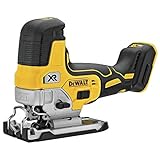
A jigsaw looks like a compact handheld power tool with a grip on top, a motor housing behind the blade, a flat base plate underneath, and a narrow blade that moves up and down through the workpiece.
That basic outline stays consistent across corded, cordless, barrel-grip, and top-handle models. The differences in shape reveal how a jigsaw is meant to be controlled, how much power it has, and whether it suits occasional DIY work or frequent cutting in a workshop.
As an Amazon Associate we earn from qualifying purchases at no extra cost to you.



The Four Parts That Define a Jigsaw
1. Handle
Most jigsaws have a top-mounted D-handle, also called a top-handle design. It arches over the motor and gives your hand a familiar drill-like grip. The trigger is usually located inside the handle, while a lock-on button may sit near the trigger for longer cuts.
A top-handle jigsaw is often the easiest style for beginners to recognize and control. You hold the tool from above, keep the base plate flat on the material, and guide the blade along the cut line. The handle may include a rubberized surface to reduce slipping and vibration.
Barrel-grip jigsaws look different because they have a cylindrical grip behind or above the motor rather than a large loop handle. The power switch is commonly positioned on the side or front. This design lets experienced users place their hand lower and closer to the cutting line, which can improve control for curved or detailed cuts, although it may feel less natural at first.
2. Motor housing
The motor housing is the bulky section behind the blade. On a corded tool, it contains the electric motor and connects to a power cord. On a cordless model, the motor housing is joined to a battery mount, usually at the rear or underneath the handle.
Compact jigsaws have shorter housings and are easier to maneuver in tight spaces. Larger brushless models generally have more substantial housings, stronger internal gearing, and better efficiency under load. The housing may include ventilation slots, but these should not be covered by your hand or packed with sawdust.
The motor housing also contains the mechanism that converts the motor’s rotation into the blade’s vertical stroke. Many jigsaws add orbital action: the blade moves slightly forward on the upstroke and backward on the downstroke. Higher orbital settings cut wood faster but usually leave a rougher edge.
3. Base plate
The base plate, or shoe, is the flat metal plate beneath the motor. It rests on the workpiece and keeps the blade at a controlled angle. When you look at a jigsaw from the side, the base plate is the broad horizontal platform surrounding the blade.
Basic shoes are stamped steel. More rigid models may use cast aluminum, which resists bending and can remain flatter during heavy use. Some shoes have a plastic or low-friction cover to reduce marks on finished surfaces.
A bevel adjustment allows the base plate to tilt, commonly to 15, 30, or 45 degrees. That turns a normal vertical cut into a sloped cut for tasks such as fitting trim or making angled joinery. A positive stop at 45 degrees is convenient, but the angle should still be checked with a square when accuracy matters.
4. Exposed blade
The blade is the thin, toothed strip visible below the front of the base plate. It travels rapidly up and down through the material, so a jigsaw always has an exposed cutting area. A blade guard or small transparent shield may surround part of it, but the lower teeth remain visible while cutting.
Most modern jigsaws use T-shank blades. The T-shaped end locks into the blade clamp without requiring a separate screw or tool. Some older or specialty tools accept U-shank blades, so check compatibility before buying replacements.
Blade length is commonly about 75 to 100 mm, although the useful cutting depth is lower than the total blade length. A jigsaw rated for 65 mm of wood capacity, for example, is not intended to cut a 65 mm-thick board quickly with every blade.
What Common Jigsaw Styles Look Like
| Jigsaw style | Typical appearance | Typical wood capacity | Typical weight | Best suited to |
|---|---|---|---|---|
| Compact corded, top-handle | Small D-handle, rear power cord, narrow body | 55–65 mm | 1.8–2.3 kg | Occasional DIY and workshop use |
| Full-size corded | Larger motor housing, adjustable speed and orbital control | 80–135 mm | 2.3–3.0 kg | Frequent cutting and thicker stock |
| Compact cordless | D-handle or short barrel body with a slide-on battery | 65–90 mm | 2.0–3.0 kg with battery | Installation work and mobile projects |
| Brushless cordless | Longer, heavier housing with electronic controls | 90–135 mm | 2.5–3.5 kg with battery | Regular use and demanding cuts |
| Barrel-grip | Cylindrical low-profile grip and side-mounted switch | 80–135 mm | 2.2–3.4 kg | Detailed curves and controlled positioning |
These are representative ranges rather than universal specifications. Actual capacity depends on the model, blade type, battery, and the material being cut.
How to Choose by Situation
| Your situation | Most practical choice | Why |
|---|---|---|
| Lowest upfront cost and infrequent use | Compact corded top-handle jigsaw | No battery investment and enough capacity for common boards and plywood |
| Beginner cutting shelves, flooring, or craft shapes | Top-handle model with variable speed | The familiar grip and slower speed make it easier to follow a line |
| Frequent work away from outlets | Brushless cordless jigsaw | Convenient mobility and better battery efficiency during repeated cuts |
| Very tight curves or flush positioning | Barrel-grip jigsaw | The lower grip can give more precise control close to the shoe |
| Clean cuts in finished plywood or laminate | Variable-speed tool with fine-tooth or reverse-tooth blade | Blade selection matters more than maximum motor power for edge quality |
If you use a jigsaw only a few times per year, corded power is often the economical choice. If the tool must be carried between rooms, used on a roof, or shared with other cordless tools, a battery model can justify its higher general market price, commonly about $100–$350 depending on whether a battery and charger are included.
What the Controls Tell You About the Tool
A useful jigsaw usually has a variable-speed trigger or dial, a lock-on function, and an orbital-action selector. Variable speed helps match the blade to the material: slower settings reduce melting in plastic and can give more control in metal, while higher settings are productive in ordinary softwood.
A dust blower clears sawdust from the cut line. Some models also have a dust-extraction port, although extraction is rarely as complete as it is with a track saw or circular saw. A built-in work light can make the line easier to see, but it does not replace adequate workshop lighting.
For accuracy, look for a rigid shoe, a blade guide close to the workpiece, low vibration, and a blade-change system that does not leave noticeable side-to-side play. A laser guide is less important than a stable base and a suitable blade.
Blade Choice Changes What the Jigsaw Can Do
- Coarse wood blade: removes material quickly but leaves a rougher edge.
- Fine wood blade: produces cleaner edges in plywood, hardwood, and trim.
- Reverse-tooth blade: cuts on the downward stroke and can reduce splintering on the top face.
- Metal blade: uses fine teeth and requires slower speed, firm support, and cutting lubricant when appropriate.
- Flush-cut or specialty blade: useful for particular access problems, but it may be less stable than a standard blade.
For a clean plywood cut, place painter’s tape over the cut line, support the sheet close to the cut, and use a sharp fine-tooth blade. Tape is not a substitute for the correct blade; a dull or overly aggressive blade can still chip the veneer.
Ownership Details That Product Photos Do Not Show
The first parts to wear are usually the blade, blade-clamp components, carbon brushes on brushed motors, and the shoe’s adjustment hardware. Blades are consumables and should be replaced when the tool begins wandering, cutting slowly, or requiring excessive pressure. Forcing a dull blade can overheat the motor and distort the cut.
After use, unplug the tool or remove its battery, then brush or blow sawdust away from the shoe, blade guide, vents, and switch area. Do not direct high-pressure air into sealed bearings unless the manufacturer permits it, because dust can be driven deeper into the mechanism.
Common mistakes include lifting the jigsaw before the blade stops, pushing faster than the blade can remove material, using orbital action for a delicate finish, and allowing the shoe to tip at the edge of a board. Keep both hands clear of the blade path, clamp the work securely, and let the tool do the cutting rather than forcing it.
Bottom Line
When asking “what does a jigsaw look like,” identify the top handle or barrel grip, the motor housing behind it, the flat base plate underneath, and the exposed reciprocating blade at the front. For most first-time buyers, a variable-speed top-handle model with a rigid shoe and widely available T-shank blades is the safest all-purpose shape. Choose a cordless or barrel-grip design when mobility or close control matters more than the simplest purchase and operating cost.