Best Trouble Board Game
What's inside
As an Amazon Associate I earn from qualifying purchases. This post may contain affiliate links at no extra cost to you.
Finding the right trouble board game for your household means balancing age-appropriate rules, replay value, and the kind of chaotic fun that keeps a five-year-old engaged past their third turn. The classic pop-and-race format has spawned dozens of variants over the years, and the current market in 2026 ranges from bare-bones reissues to themed editions with bonus dice mechanics that change how the game actually plays.
What separates a worthwhile purchase from a shelf ornament comes down to three things: component durability (the popper mechanism is the single point of failure on every trouble board game), rule depth that matches your child’s attention span, and whether the edition adds anything beyond a new paint job. Owner feedback consistently highlights that the base game holds up well, but certain variants frustrate families with confusing add-on rules or flimsy extra pieces that break within weeks.
As an Amazon Associate we earn from qualifying purchases at no extra cost to you.




Our Top Picks
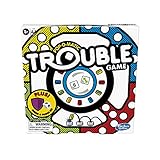
 Hasbro Gaming Trouble Board Game for Kids Ages2.0 H x 11.0 L x 11.0 W1.61 x 10.5 x 10.5 inches0.85 poundsCheck on Amazon
 Hasbro Gaming Trouble: Bluey Edition Board Game for1 unit1.6 x 10.5 x 10.5 inches0.79 poundsCheck on Amazon
 Sonic the Hedgehog Pop Up Board GameSonic Game for Birthday Party10 x 10 x 0.1 inches0.6 PoundsCheck on Amazon
Quick Picks
| Product | Best for | Price |
|---|---|---|
| Hasbro Trouble (Standard) | First-time buyers wanting the original formula | $9.84 |
| Winning Moves Classic Trouble | Collectors and retro design fans | $20.90 |
| Hasbro Trouble (Amazon Exclusive) | Families who want extra strategic layers | $14.99 |
| Sorry! | Players ready for more competitive rule depth | $8.98 |
| Trouble: Bluey Edition | Bluey fans who need a branded gateway game | $17.99 |
| Sonic the Hedgehog Pop Up | Sonic enthusiasts wanting a different mechanic | $15.50 |
| Tic Tac Toe | Toddlers or players wanting minimal rules | $5.97 |
| Trouble: One Fish, Two Fish | Seuss-lovers and preschool classrooms | $15.78 |
How We Picked
We evaluated every edition against four criteria: mechanism reliability (how owners report the popper or equivalent component holding up after repeated play), rule clarity for the stated age range, value relative to price given the number of included pieces, and replay value as reported in owner feedback threads. Editions that earned top marks delivered the same core race-and-bump loop but added meaningful variety without introducing components that break quickly.
The 8 Best Trouble Board Game in 2026
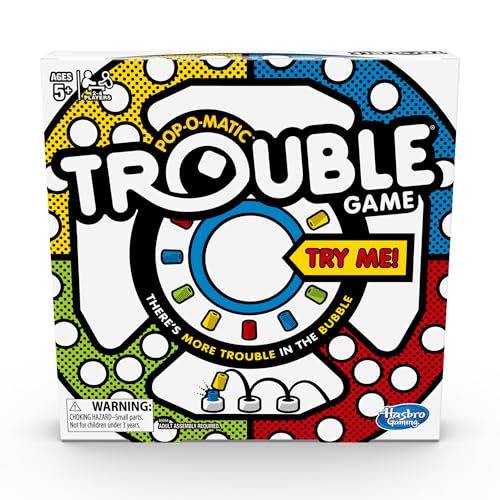
Hasbro Gaming Trouble Board Game for Kids Ages 5 and Up
The baseline against which every other trouble board game is measured. Four pawns per player, a six-sided popper die, and a color-coded track that requires no reading ability. This is the edition to hand to a child playing their first structured board game.
- Pro: Lowest entry price at $9.84 makes it a low-risk gift or classroom staple.
- Pro: Rules match the stated age floor almost perfectly; owners report five-year-olds grasping the turn sequence within one play.
- Con: The plastic popper dome can develop a sticky spot after heavy use, requiring a quick wipe-down to restore smooth rolling.
Skip this if your household already owns the original and wants something with added strategic texture.
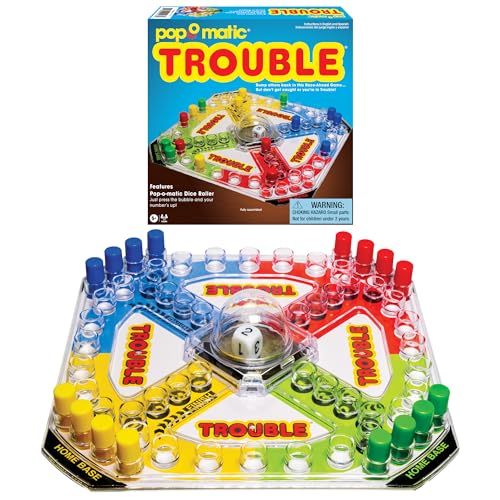
Winning Moves Classic Trouble with Retro Art and Pop-O-Matic Popper
A visually distinct reissue that trades Hasbro’s modern packaging for bold retro illustration. The gameplay loop is identical to the standard edition, but the presentation appeals to adults who remember the 1970s original and want to share that aesthetic with their kids.
- Pro: The Pop-O-Matic mechanism uses a larger-diameter dome, and owners note it feels sturdier than the Hasbro version over time.
- Pro: Box art doubles as a conversation starter, which helps reluctant players engage before the first turn.
- Con: At $20.90 it costs more than double the standard edition while playing the same game mechanically.
Skip this if price matters more to you than visual presentation.
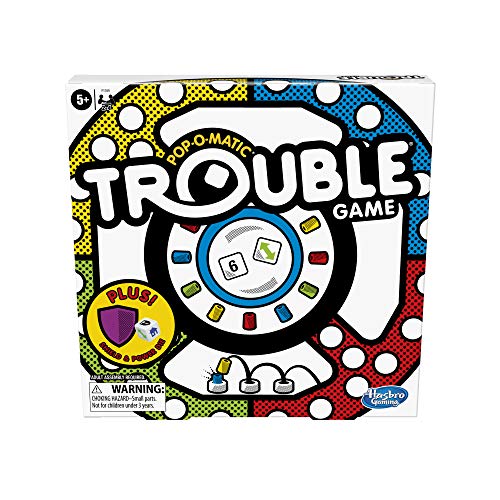
Hasbro Gaming Trouble with Bonus Power Die and Shield (Amazon Exclusive)
The most rule-heavy trouble board game currently available. A second die introduces power actions like shield tokens that protect a pawn for one round, giving older siblings a reason to stay engaged alongside younger players.
- Pro: The power die adds genuine decision-making; owners with mixed-age groups report fewer complaints of the game feeling “just luck.”
- Pro: Amazon-exclusive status means it is often stocked reliably when Hasbro’s standard edition sells out seasonally.
- Con: The extra rules add explanation time that can lose a five-year-old before the game actually starts.
Skip this if your youngest player is right at the age-5 floor and you want the simplest possible ruleset.
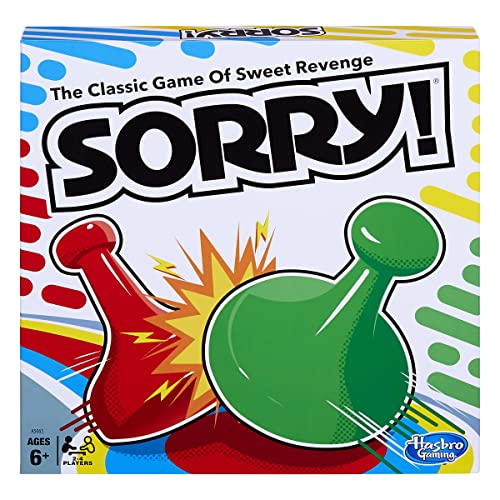
Sorry! Board Game for Kids Ages 6 and Up
Not technically a trouble board game, but it shares the same race-home-and-knock-back-opponents DNA. Players draw cards that move pawns by fixed amounts, slide shortcuts, and send rivals to the Start line. The card-draw mechanic replaces the popper entirely.
- Pro: More strategic depth than any Trouble variant; owners cite it as the game that bridges pop-and-race titles toward card-driven classics.
- Pro: At $8.98 it undercuts most Trouble editions while offering longer per-game engagement.
- Con: The stated age floor is 6, and younger siblings may struggle with card values and the slide-abbreviation rules.
Skip this if you specifically want the popper mechanism that defines the trouble board game experience.
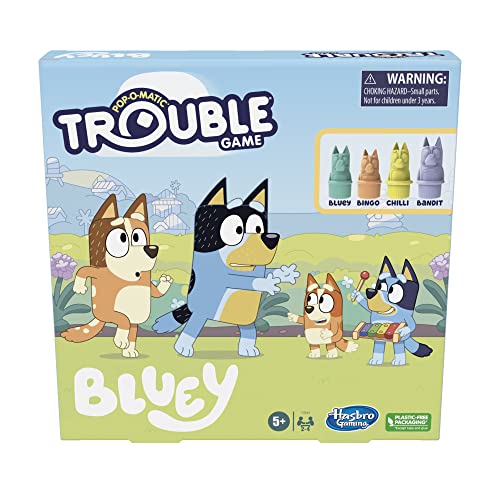
Hasbro Gaming Trouble: Bluey Edition
Branded characters replace the standard color-coded pawns. Bluey, Bingo, Bandit, and Chilli each occupy a pawn track. Rules are unchanged from the base game, so this is purely a visual upgrade aimed at households where the show is already the primary entertainment.
- Pro: Character branding gives reluctant players a strong motivation to sit down and play, per numerous parent reviews.
- Pro: Amazon-exclusive packaging includes a slightly sturdier board than some retail versions.
- Con: You pay a $8.15 premium over the standard edition for artwork alone.
Skip this if your child has not yet watched Bluey; without that context the branding adds no gameplay value.
Sonic the Hedgehog Pop Up Board Game
A different popper format entirely. Instead of rolling a die into a dome, players pop up a central mechanism that reveals Sonic-themed outcomes. The bundle includes stickers and a separate mini game, pushing it toward party favor territory rather than structured family play.
- Pro: The pop-up reveal mechanic creates a visible moment of suspense that younger kids find highly entertaining.
- Pro: Bundle contents (stickers, extra game) add perceived value beyond the main board.
- Con: Rule structure differs enough from the trouble board game formula that owners seeking the classic experience feel misled by the category listing.
Skip this if you want the specific pop-and-race loop that defines the genre.
Tic Tac Toe Board Game, Classical Family Board Game
A grid-based match-three game at the lowest price point in this roundup. No popper, no track, no pawns beyond X and O markers. Included here because budget-conscious buyers sometimes search for a trouble board game and land on generic family titles.
- Pro: At $5.97 it is the cheapest option and teaches basic turn-taking without any reading required.
- Pro: One game plays in under two minutes, making it ideal for waiting rooms or short attention spans.
- Con: Replay value drops off quickly once a child grasps the optimal blocking pattern.
Skip this if you are specifically after the popper mechanic or a race-track format.
Hasbro Gaming Trouble: One Fish, Two Fish, Red Fish, Blue Fish
Dr. Seuss character art wrapped around the standard Trouble rules. The pawns feature fish designs and the track uses the book’s signature color palette. No additional mechanics beyond what the base game provides.
- Pro: Licensed Seuss art appeals to parents who want literacy-adjacent branding on a game their child already enjoys.
- Pro: Owners report the board print quality holds up well to repeated handling from small hands.
- Con: At $15.78 you pay a licensing premium over the $9.84 standard edition for artwork and nothing else.
Skip this if your household does not already have a Seuss attachment; without that the game is mechanically identical to the cheaper base version.
Buying Guide
Popper Mechanism Quality
The dome-and-die assembly is the component that fails first on any trouble board game. Look for editions where the popper uses a larger-diameter dome (the Winning Moves version explicitly does) and a die with rounded, weighted edges that settle cleanly. Owner feedback across brands consistently flags sticky or wobbly domes as the number-one complaint, so read recent reviews that mention the mechanism specifically rather than general satisfaction scores.
Rule Complexity vs. Age Floor
The standard game requires zero reading: match your color, pop, move. The Amazon-exclusive adds a second die with shield and power rules that demand a parent explain two new mechanics before play. If your child is at the stated age floor, the simpler edition wins. If your group includes players aged seven or older, the power-die version keeps everyone engaged for a second and third round.
Component Count and Spare Parts
Four pawns per player means sixteen pieces minimum in a full game, plus the die, popper, and sometimes a shield token set. Lost pawns are the most common frustration in owner feedback. Editions that include extra spare markers or that use molded plastic tokens (rather than thin cardboard chips) will still be complete a year after purchase.
Our Verdict
Top pick: Hasbro Gaming Trouble (Amazon Exclusive) at $14.99. The power-die layer adds enough strategic variety to justify the modest price bump, and owner feedback confirms it extends the game’s shelf life in mixed-age households. Budget pick: the standard Hasbro Trouble at $9.84 delivers the exact pop-and-race experience that made the genre durable. Condition for another winner: if your child is a dedicated Bluey viewer, the Bluey Edition’s branding will generate more immediate buy-in from a reluctant player than any mechanical difference could.
FAQ
Is Trouble suitable for a four-year-old?
The stated age floor is five, and most parents in review threads confirm that four-year-olds struggle with turn patience and color-matching under time pressure. A five-year-old who has played one or two rounds typically handles the full game independently.
Can you play Trouble with only two players?
Yes. The game accommodates 2-4 players, and the two-player configuration actually reduces blocking opportunities, making each race feel more linear. Owner feedback notes that two-player games finish faster than three- or four-player rounds.
What is the difference between the power-die version and standard?
The power-die version includes a second die with symbols that grant a shield (protecting one pawn from being sent home for a single round) and a bonus-move action. Rules are otherwise unchanged; you simply roll the power die after the popper each turn.
Do themed editions change gameplay at all?
No. Bluey, One Fish Two Fish, and the standard Hasbro release all play identically. The only edition with added mechanics is the Amazon-exclusive with the bonus power die. Themed art is purely cosmetic and carries a licensing price premium.