Best Value Router Bit Set for Beginner Woodworkers
What's inside
As an Amazon Associate I earn from qualifying purchases. This post may contain affiliate links at no extra cost to you.
For a beginner, the best-value router bit set is not the one with the most pieces. A useful starter set has the profiles you will actually use, carbide cutters, a 1/4-inch shank that matches your router, and a case that keeps edges from being damaged. In most cases, spending about $40 to $80 on a reputable 12- to 15-piece set is smarter than buying a 50-piece kit for $25.
As an Amazon Associate we earn from qualifying purchases at no extra cost to you.


What a beginner really needs
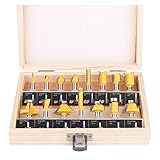
Start with bits that cover basic joinery, edge treatment, and sign or template work. A straight bit removes material and cuts grooves. A flush-trim bit follows a template or bearing edge. Round-over and chamfer bits soften exposed edges. A rabbeting bit cuts a step for a cabinet back or box joint. A cove bit adds a decorative inside curve.
A practical first set usually includes 1/4-inch and 1/2-inch straight bits, a 1/2-inch flush-trim bit, 1/4-inch and 3/8-inch round-over bits, a 45-degree chamfer bit, and one rabbeting bit. A 12- or 15-piece set may add several sizes of these profiles. That is enough for shelves, boxes, trim, signs, simple cabinets, and general repairs.
For a first purchase, compare 1/4-inch carbide router bit sets from established tool brands rather than choosing by piece count alone. The 1/4-inch shank is common on compact and trim routers, but it is not interchangeable with a 1/2-inch shank. Never force a 1/2-inch bit into a 1/4-inch collet.
Best-value set types compared
| Set type | Typical price | Best for | Main compromise |
|---|---|---|---|
| 8- to 12-piece budget carbide set | $20-$40 | Occasional home projects and learning | Bearings, cases, and cutter consistency may be weak |
| 12- to 15-piece mid-range set | $40-$80 | Most beginner workshops | Some included profiles may go unused |
| 20- to 30-piece value set | $70-$130 | Frequent users who want variety | Higher cost and more duplicate or specialty bits |
| Individual premium bits | $15-$45 each | Heavy use and exact profiles | Poor value when building a complete starter collection |
The mid-range set is usually the sweet spot. It costs more than a no-name assortment but avoids paying premium prices for bits you may use twice a year. If your work is limited to rounding shelf edges and cutting a few grooves, the cheaper 8- to 12-piece option is fine. Replace individual bits as they become dull instead of replacing the entire set.
Where cheap sets fail
The most common problem is not immediate breakage. It is poor cutting performance. Low-cost bits may arrive with uneven brazing, a rough carbide edge, or a bearing that feels gritty. A bit can still cut wood, but it may leave burn marks, chatter, or a profile that is not consistent around the workpiece.
Bearings are another weak point. A flush-trim or rabbeting bit with a loose bearing can wander and ruin a template edge. Spin the bearing by hand before use. It should turn smoothly without side-to-side movement. Replacement bearings are inexpensive, but a cheap set is less attractive if several need replacing.
Heat is a warning sign. A clean, sharp bit used at the correct speed should not smoke during a normal pass. Burning usually means the bit is dull, the feed rate is too slow, the cut is too deep, or the router speed is too high for the diameter. A larger bit has a higher rim speed, so it generally needs a lower router setting.
Do not expect budget bits to survive nails, screws, or dirty reclaimed lumber. One hidden fastener can chip carbide. Inspect used boards with a metal detector and remove hardware before routing. Also avoid cutting the full depth in one pass. For a 1/2-inch groove, two or three passes are safer and usually produce a cleaner result.
Brand value and buying criteria
Brand value matters most in carbide quality, bearing availability, consistency, and quality control. A respected mid-priced set is often a better buy than a premium set if you are still learning, while an unbranded bargain set is only worthwhile for occasional light work. Look for clearly marked bit sizes, solid carbide tips rather than steel cutting edges, and a shank that is straight and free from visible damage.
Sets with a plastic case are easier to organize, but the case should hold each bit securely. Loose bits can hit one another and chip their edges. A wooden box looks better but does not automatically indicate better cutting quality.
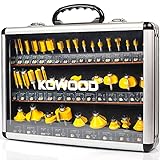
Also check whether the listed price is for a full set or a small subset in a larger product image. Marketplace listings sometimes advertise a low sale price that applies only to a less complete configuration. Read the included-bit list, not just the headline count.
If your router accepts both sizes, a 1/2-inch shank router bit set is generally the better choice for large profiles and heavier cuts. The thicker shank reduces flex, but the bits are not suitable for a router that only accepts 1/4-inch accessories. Compact routers also have less power, so large-diameter bits may be inappropriate even when the collet fits.
When to buy and when to wait
Router bit sets are commonly discounted during major holiday sales, spring workshop promotions, and Father’s Day tool events. A 15-piece set that normally sells for $60 may drop to $40 or less. That is a meaningful saving, but only if the set contains useful profiles and the price is not based on an inflated list price.
Check prices for several weeks before a sale if possible. Sets are also frequently bundled with a router, clamps, or a trim guide. A bundle can be good value when the included bits match your planned projects, but do not accept a large assortment of unknown quality just because the package appears cheap.
For a narrower selection, look at router bit starter sets with straight, flush-trim, and round-over bits. Buying only those profiles can cost less than a larger kit and leaves room in the budget for a quality bit you will use often.
A sensible first purchase
For most beginners, buy a 12- to 15-piece carbide set in the correct shank size, then add individual bits as your projects demand them. Spend extra on a flush-trim bit if you make templates, or on a straight bit if you cut dados and grooves regularly. Keep the bits clean, store them separately, and stop using any bit that shows chipped carbide, a bent shank, or a bearing that will not run smoothly.
The cheapest set is acceptable for occasional softwood work and basic edge rounding. The best value is the set that gives you reliable results without paying for profiles that remain in the case. A modest, well-chosen kit will teach you more—and create fewer ruined workpieces—than a large bargain assortment.