6 Best Cordless Angle Grinders for Fabrication (October 2026) Expert Picks
Our Top Picks
 DEWALT 20V MAX XR Brushless Cordless Angle GrinderSTANDARD13.3 x 6.5 x 5.7 Inches4.74 PoundsCheck on Amazon

What's inside
As an Amazon Associate I earn from qualifying purchases. This post may contain affiliate links at no extra cost to you.
For fabrication work, the DEWALT 20V MAX XR brushless DCG410VSB is the best overall pick on this list: it takes 4-1/2 to 5 inch wheels, runs at 9,000 RPM with variable speed and has a paddle switch, so it handles cutting, weld grinding and blending without a cord. Fabrication means shaping, cutting and finishing metal, so you want enough wheel size, speed control and battery platform depth for a full shift. The Milwaukee M18 pair suits shops already on that battery system, while the corded DEWALT is included here only as a runner-up.
Quick List
- AOBEN 21V Brushless Grinder Kit – best for a complete kit with two batteries and a charger in one box
- DEWALT DWE4011 (corded) – best as a corded runner-up for bench work with unlimited run time
- Milwaukee 2880-20 M18 FUEL – best for M18 shops that want a no-lock paddle for safety
- Milwaukee 2888-20 18V Variable Speed – best for M18 shops that need speed control for different wheels
- Mini 16.8V Grinder Kit (19,500 RPM) – best as a light-duty accessory for small cuts and detail work
- DEWALT 20V MAX XR DCG410VSB – best overall for variable speed, brushless power and 4-1/2 to 5 inch wheels
Which One Is Right for You?
| If you… | Choose |
|---|---|
| want one tool for cutting, weld grinding and blending | DEWALT 20V MAX XR DCG410VSB |
| already own M18 batteries and want a dead-man paddle | Milwaukee 2880-20 M18 FUEL |
| already own M18 batteries and need to slow the wheel for finishing | Milwaukee 2888-20 18V Variable Speed |
| need everything in one box, including batteries and a charger | AOBEN 21V Brushless Grinder Kit |
| work at a fixed bench and can use a power outlet | DEWALT DWE4011 (corded) |
| only need a small tool for tight, light cuts | Mini 16.8V Grinder Kit |
Fabrication puts steady demand on a grinder: long weld seams, repeated cuts and awkward angles. Brushless motors, a paddle switch that stops the wheel when you let go and a battery platform you can scale all matter more than raw RPM. Choose a battery ecosystem first if you already own one, because bare-tool listings only make sense with compatible batteries and a charger.
All 6 Picks in Detail
1. AOBEN 21V Brushless Grinder Kit – Best for an all-in-one kit with two batteries
As an Amazon Associate we earn from qualifying purchases at no extra cost to you.
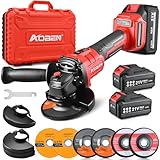
AOBEN is a lesser-known cordless tool brand, and this listing is a 4-1/2 inch cordless angle grinder kit with a brushless motor, two 4.0Ah batteries and a charger. It suits a home garage, a hobbyist metal shop or a mobile repair setup where you want the grinder ready out of the box without buying batteries separately. The listing also describes it as a power cut-off tool, so it covers both grinding and cutting.
The trade-off is platform depth. A brand that sells only a few tools offers fewer batteries and accessories than the major names, and long production days at heavy load are not what a value kit is designed for. Check the listing for the disc size and RPM, which the name does not state.
In a fabrication context, a kit like this works well as a second grinder: keep one loaded with a cutting wheel and one with a flap disc, so you are not stopping to swap wheels all day. Two batteries let you charge one while you work with the other. Because the platform is less common, plan on buying spare discs and batteries from the same brand, and check how easily replacement packs can be found before you commit.
- 4-1/2 inch size named in the listing
- 21V battery platform with two 4.0Ah batteries
- Brushless motor named in the listing
- Charger included in the kit
- No-load speed and switch type not stated; confirm on listing
Pros
- Complete kit, so batteries and charger come together
- Brushless motor for better runtime efficiency
Cons
- Smaller battery ecosystem than the big brands
- Heavy production use may outpace a value tool
It bundles more than the DEWALT or Milwaukee bare tools, but it cannot match their platform depth.
2. DEWALT DWE4011 (corded) – Best as a corded runner-up for bench work

This listing is for the DWE4011, a 4-1/2 inch angle grinder with a one-touch guard. It is a corded tool, so it does not belong in a strict cordless roundup, and we include it only as a runner-up. For fixed-position bench work or long grinding passes where an outlet is nearby, a corded grinder offers unlimited run time and no batteries to charge.
The one-touch guard lets you adjust the guard position without tools, a useful feature when switching between cutting and grinding. From our research, this model is commonly described as a 7-amp grinder with an 11,000 RPM no-load speed in its spec class; confirm the exact figures on the listing, as the name does not state them.
A corded grinder also makes sense as a dedicated tool for one job, such as a bench setup for deburring or a station used for long cutting runs. Pair it with a heavy-duty extension cord rated for the amperage, keep the cord behind you and away from sparks, and unplug it before changing wheels. For field work, welding trailers or any job without power, it is the wrong tool, and a cordless model takes over.
- 4-1/2 inch wheel size
- One-touch guard for quick adjustments
- Corded power, not cordless
- Amperage and RPM not stated in the name; confirm on listing
- Switch type not stated; confirm on listing
Pros
- Unlimited run time with a power outlet
- Tool-free guard adjustment
Cons
- Corded, so it does not meet the cordless brief
- Cord can snag on work or get cut by sparks
It is the only corded grinder here, so compare it to the DCG410VSB if you want the same brand without the cord.
3. Milwaukee 2880-20 M18 FUEL – Best for M18 shops that want a no-lock paddle

Milwaukee’s M18 FUEL line is a staple in metal shops and on job sites. This 2880-20 is a brushless 4-1/2 inch and 5 inch cordless small angle grinder with a no-lock paddle switch, sold as a bare tool. A no-lock paddle means the grinder stops when you release it, so it cannot run away if you drop it. For fabrication, that is a meaningful safety feature.
Retailer pages for this model list a 8,500 RPM no-load speed, a 5/8-11 spindle thread, a tool-free guard and FIXTEC tool-free accessory changes. Some pages describe a braking feature and electronic clutch for kickback; confirm the brake on the listing, since pages differ. You will need to buy batteries and a charger if you do not already own the M18 system.
The M18 system covers a huge range of tools, which is why many metal shops standardize on it. If your cutoff saw, drill and impact driver already run on M18 packs, adding this grinder costs only the bare tool. A no-lock paddle suits anyone who values predictable shut-off over convenience, such as teams with several people sharing tools in the same bay.
- 4-1/2 inch and 5 inch wheel capacity
- No-lock paddle switch
- Brushless motor, bare tool only
- Retailers list 8,500 RPM no-load; confirm on listing
- 5/8-11 spindle thread per retailer pages
Pros
- Dead-man paddle stops the wheel when released
- Large M18 battery and accessory ecosystem
Cons
- Bare tool, so batteries and a charger cost extra
- No variable speed named for this model
Next to the 2888-20, this one prioritizes a no-lock paddle while the other emphasizes speed control.
4. Milwaukee 2888-20 18V Variable Speed – Best for M18 shops that need speed control

The 2888-20 is another M18-platform grinder in 4-1/2 and 5 inch sizes, and its listing highlights variable speed, sold as tool only. Speed control matters in fabrication because different wheels and materials want different surface speeds. Slower speeds suit polishing, wire wheels, sanding discs and stainless steel, where heat can discolor the metal.
The listing name does not state the switch type, RPM range or brake behavior. Because Milwaukee sells several grinders with similar names, verify the exact model number and switch style against the product page, especially if you want a no-lock paddle. As a bare tool, it needs M18 batteries and a charger.
Variable speed also helps with the finish. Dropping the wheel speed when blending a weld toe into a plate gives more control and less gouging. On stainless and aluminum, lower speeds with the right abrasive reduce loading and heat. Use dedicated wheels for stainless so you do not transfer iron particles that can cause rust spots later.
- 18V M18 platform, tool only
- 4.5 inch and 5 inch wheel capacity
- Variable speed named in the listing
- Switch type and brake not stated; confirm on listing
- No-load RPM range not stated; confirm on listing
Pros
- Variable speed expands the range of accessories
- Works with existing M18 batteries
Cons
- Bare tool only
- Switch and brake details need checking
It offers speed control, which the 2880-20 does not name, but the safety switch design should be verified on the listing.
5. Mini 16.8V Grinder Kit (19,500 RPM) – Best as a light-duty accessory for small cuts

This listing is a cordless angle grinder kit rated at 19,500 RPM, with two 16.8V 2000mAh batteries and six cutting discs, described as a mini handheld power tool. It is a different class of tool from the 4-1/2 inch grinders above, and it does not really suit heavy fabrication. We treat it as a light-duty accessory for small cuts, trimming thin metal and tight spaces.
High RPM on a small wheel is normal, because surface speed depends on wheel diameter. The listing does not state the wheel size, so confirm it and never fit a disc with a lower maximum RPM rating than the tool. For shop use, expect a smaller battery capacity and shorter runtime than the full-size tools.
A mini grinder shines when a full-size body will not fit: inside a frame, along a tube or under a fender. Keep expectations realistic. The cutting discs included are thin, and thin discs wear quickly and can shatter if bent or pinched, so use a guard if the design allows, clamp the work and let the disc cut without forcing it. Read the manual for the maximum disc diameter and thickness.
- 19,500 RPM named in the listing
- Two 16.8V 2000mAh batteries included
- Six cutting discs included
- Mini form factor; wheel size not stated, confirm on listing
- Brushless motor and switch type not stated; confirm on listing
Pros
- Light and easy to maneuver in tight spots
- Comes with batteries and discs
Cons
- Not built for heavy fabrication
- Small battery capacity limits runtime
It is a supplement to a 4-1/2 inch grinder like the DCG410VSB, not a replacement.
6. DEWALT 20V MAX XR DCG410VSB – Best overall for fabrication

DEWALT’s DCG410VSB brings together everything a fabricator wants in a cordless grinder: a brushless motor, variable speed, a paddle switch and the ability to use 4-1/2 to 5 inch wheels. Retailer specs list a 9,000 RPM no-load speed and a 5/8-11 UNC thread arbor. It includes an Anti-Rotation system that shuts the tool down if the motion becomes excessive, as when a wheel binds, and an E-Brake that stops the wheel quickly.
As a tool-only listing, it relies on the 20V MAX battery platform, which is widely supported. It is a strong choice if you cut, grind welds and blend in a single job and want to change speed as the task changes. Retailers disagree on weight, so check the product page.
For a one-person shop that wants a single cordless grinder, this is the safest recommendation. Variable speed, shutdown protection and the 20V MAX batteries many tradespeople already own make it flexible. Tool Connect chip readiness and wireless dust extractor control appear on retailer pages, but those are extras; the core value is brushless power and control you can adjust as the job changes.
- 4-1/2 to 5 inch wheel capacity
- Brushless motor, variable speed
- Paddle switch with lock-off per retailer pages
- 9,000 RPM no-load per retailer pages
- Anti-Rotation shutdown and E-Brake per retailer pages
Pros
- Variable speed plus safety features in one tool
- Large 20V MAX battery ecosystem
Cons
- Tool only, so batteries and charger add to the cost
- Weight figures vary between retailer pages
Compared with the Milwaukee 2880-20, it adds variable speed, while the Milwaukee gives the stricter no-lock paddle.
Specs Compared
| Grinder | Power | Wheel size | Motor | No-load speed | Included |
|---|---|---|---|---|---|
| AOBEN 21V Kit | 21V battery | 4-1/2 in | Brushless | Confirm on listing | 2x 4.0Ah batteries, charger |
| DEWALT DWE4011 | Corded | 4-1/2 in | Confirm on listing | Confirm on listing | Tool with one-touch guard |
| Milwaukee 2880-20 | M18 battery | 4-1/2 / 5 in | Brushless | Confirm on listing | Tool only |
| Milwaukee 2888-20 | 18V battery | 4.5 / 5 in | Confirm on listing | Variable; confirm on listing | Tool only |
| Mini 16.8V Kit | 16.8V battery | Confirm on listing | Confirm on listing | 19,500 RPM | 2x 2000mAh batteries, 6 discs |
| DEWALT DCG410VSB | 20V MAX battery | 4-1/2 to 5 in | Brushless | Variable; confirm on listing | Tool only |
How We Chose These
This list comes from desk research. We began with listings that name a cordless angle grinder and then separated true cordless models from corded or mini tools. We compared the wheel sizes, battery platforms, motor type, switch design and kit contents that each listing names, and we read retailer specification pages for the DEWALT and Milwaukee models to check no-load speed, arbor thread and safety features. When a listing name does not state a figure, we say to confirm it rather than guess. Because fabrication calls for full-size wheels, we placed the corded DEWALT and the mini kit as runners-up and kept all products in the order listed.
What to Look For
Wheel size and speed
Most fabrication grinders use 4-1/2 inch wheels, with 5 inch wheels as an upgrade on some models. A 4-1/2 inch cutting or grinding wheel is rated for a maximum RPM, often around 13,000 or higher for thin wheels, and the grinder’s no-load speed must stay below that rating. Variable speed lets you drop to a lower RPM for sanding discs, wire brushes and stainless steel, where excess heat causes discoloring. Always match the wheel’s maximum RPM to the tool, and never use a wheel that is damaged or past its expiry date.
Switch type and safety features
A paddle switch must be held to run, so the wheel stops when you let go. A slide switch can lock on, which is convenient but riskier if the tool is dropped. Anti-rotation, electronic clutches and brakes reduce kickback and stop the wheel quickly. Guards are not optional: use the correct guard for the task, wear safety glasses or a face shield, hearing protection, gloves and a respirator when grinding. Keep sparks away from flammables, and remove the battery before changing a wheel.
Battery platform and runtime
Choose the platform before the tool. A grinder is a high-draw tool, so a 4.0Ah to 6.0Ah battery is a sensible minimum for fabrication; smaller packs fade fast under load. Brushless motors generally run more efficiently, which stretches runtime. If you already own batteries from a brand, buying a bare tool is the economical path. If you do not, a kit saves you from piecing together batteries and a charger.
Weight and ergonomics
A grinder that weighs a pound more can feel much heavier over a four-hour shift. Look at body diameter, side handle position and balance with the battery attached. Compact grinders reach into tight corners, while a larger body gives better control for heavy grinding. Retailers sometimes disagree on weight, so rely on the manufacturer’s page when it matters.
Wheel types for fabrication. Thin cut-off wheels, often around 1/16 inch thick, slice sheet and tube quickly but must never be used for side grinding because they are not designed for side loads. Type 27 depressed-center grinding wheels remove material and level welds. Flap discs blend and finish in one step and are popular for weld cleanup, while wire cups and sanding discs handle rust and paint. Match each accessory to the task, check the maximum RPM stamped on it and inspect for cracks before mounting. Let the wheel reach full speed before touching the work.
A worked example
Suppose you build steel trailers: you cut 1/4-inch plate, grind weld beads and clean up edges. You want a 4-1/2 inch grinder with variable speed, a paddle switch and two 5.0Ah batteries. The DCG410VSB plus two batteries fits. If you already own M18 batteries, the Milwaukee pair becomes the cheaper path, and the 2880-20 suits you if you value the no-lock paddle.
Questions
Is a cordless angle grinder powerful enough for fabrication?
Yes for most cutting and grinding on typical shop jobs, particularly with brushless motors and a 4.0Ah or larger battery. Very long production grinding sessions may still favor a corded tool.
What size angle grinder is best for metal work?
A 4-1/2 inch grinder is the most common size because it balances control and material removal. Moving to 5 inch wheels gives a bit more reach and speed, but the weight rises slightly.
Do I need variable speed?
If you only cut and grind, a fixed-speed tool is fine. Variable speed becomes useful with sanding discs, wire brushes and polishing, where lower RPM prevents heat damage.
Why choose a paddle switch?
A paddle switch stops the tool as soon as you release it, which reduces the risk if you lose control or drop the grinder. It is a safer default for fabrication.
Are mini grinders good enough for shop work?
They suit small cuts and tight spots but lack the wheel size and battery capacity for heavy fabrication. Treat them as a second tool, not a main one.
Can I use any wheel on any grinder?
No. The wheel’s maximum RPM must meet or exceed the grinder’s no-load speed, the arbor size must match and the guard must suit the wheel type.
Update History
- October 20, 2026 – Initial publication; product set drawn from current catalog listings.
- Check the product page for current specifications and availability before buying.
Sources
- Retailer and distributor specification pages for the DEWALT DCG410VSB and Milwaukee 2880-20 models
- Retailer listing titles and specification fields for all six grinders above
- Brand names and product descriptions as they appear in the listings for AOBEN, DEWALT and Milwaukee