Best 18V Reciprocating Saws in 2026: Cordless Picks
What's inside
- Quick Comparison of the Best 18V Reciprocating Saws
- A Note on 18V vs 20V
- Best Overall: Milwaukee M18 Fuel Sawzall
- Best for Makita Owners: Makita 18V LXT Brushless
- Best for DeWalt Owners: DeWalt 20V MAX DCS382B
- Best Budget: Ryobi ONE+ 18V Brushless
- Best for Control: Bosch 18V GSA18V-125
- Best One-Handed Saw: Milwaukee M18 Fuel Hackzall
- How Long Will the Battery Last? A Worked Example
- How to Choose: Specs That Matter
- Decision Matrix
- Blades and Ownership Realities
- Frequently Asked Questions
As an Amazon Associate I earn from qualifying purchases. This post may contain affiliate links at no extra cost to you.
The best 18 volt reciprocating saw for most people is the Milwaukee M18 Fuel Sawzall: it combines a 1-1/4 inch stroke, up to 3,000 strokes per minute and a brushless motor with the deepest 18V battery platform on the market. If you want a lower price, the Ryobi ONE+ 18V brushless saw is the best budget pick, and Makita’s 18V LXT brushless saws are the best choice if you already own Makita batteries.
A reciprocating saw is a demolition and rough-cut tool: it cuts nails in framing, trims pipe, prunes branches and opens up walls. For a woodworker, it is the tool that rips through a stubborn pallet, trims an old beam or cuts an opening before the precision tools come out. This guide compares the main 18V options by stroke length, speed, weight and platform, then gives you a worked runtime estimate and a decision matrix.
As an Amazon Associate we earn from qualifying purchases at no extra cost to you.



Our Top Picks
Quick Comparison of the Best 18V Reciprocating Saws
| Pick | Best for | Key specs | Price range |
|---|---|---|---|
| Milwaukee M18 Fuel Sawzall 2821-20 | Best overall | Brushless, up to 3,000 SPM, 1-1/4 in stroke, 18V M18 platform | Upper-mid |
| Makita 18V LXT brushless XRJ06Z | Best for Makita owners | Brushless, 1-1/4 in stroke, tool-less blade change, 18V LXT platform | Upper-mid |
| DeWalt 20V MAX DCS382B | Best for DeWalt owners | Brushless, up to 3,000 SPM, 1-1/8 in stroke, 20V MAX (18V nominal) | Mid-range |
| Ryobi ONE+ 18V brushless | Best budget | Brushless, about 1 in stroke class, 18V ONE+ battery family | Budget |
| Bosch 18V GSA18V-125 | Best for control | Brushless, 18V, vibration-reduction design | Mid-range |
| Milwaukee M18 Fuel Hackzall | Best one-handed compact saw | One-handed, 18V, short stroke, light body | Mid-range |
Specifications are approximate and based on manufacturers’ published spec sheets; weights and speeds vary between bare-tool and kit versions, so confirm on the current listing.
A Note on 18V vs 20V
“18V” and “20V MAX” mostly describe the same thing. Many brands rate a battery at 20V MAX based on the initial peak voltage, while the nominal voltage is 18V. Makita, Milwaukee, Ryobi and Bosch use 18V labels, and DeWalt uses 20V MAX. They are not interchangeable between brands: you must match the battery platform to the tool, not the number on the label.
Best Overall: Milwaukee M18 Fuel Sawzall
The Sawzall is the saw that gave the category its name, and the M18 Fuel version is the one most professional roundups put first. It runs at up to 3,000 strokes per minute with a 1-1/4 inch stroke, which means each pass removes more material than shorter-stroke saws. The brushless motor extends runtime, and the platform offers batteries from compact to high-capacity.
The trade-off is cost and weight. The bare tool is not cheap, and published weights cluster around six pounds before you attach the battery. It also commits you to the M18 system, though that system is among the largest in the industry.
Best for Makita Owners: Makita 18V LXT Brushless
Makita’s 18V LXT reciprocating saws, such as the XRJ06Z, use brushless motors and a 1-1/4 inch stroke with tool-less blade change. They are known for smoother operation than some rivals and good balance. If you already own LXT batteries and chargers, the bare tool is a strong value. Makita also offers a sub-compact model that sits closer to six pounds with battery for overhead work.
Best for DeWalt Owners: DeWalt 20V MAX DCS382B
The DCS382B is DeWalt’s brushless 20V MAX reciprocating saw, with a variable-speed trigger, a pivoting shoe and a four-position blade clamp that lets you mount the blade in several orientations. It is a well-rounded mid-priced tool, and it makes sense if your shop already runs on DeWalt batteries. Its stroke is shorter than the Milwaukee, so it removes slightly less material per stroke.
Best Budget: Ryobi ONE+ 18V Brushless
Ryobi’s ONE+ platform has one of the broadest tool lineups of any budget brand, and the brushless reciprocating saw is the logical cutting tool for that ecosystem. It is lighter-duty than the Milwaukee or Makita, but it handles pruning, pallet breakdown and occasional demolition well. If you cut once a month rather than every day, this is the best use of your budget.
Best for Control: Bosch 18V GSA18V-125
Bosch’s 18V brushless reciprocating saw is built around a reduced-vibration design. It is a good option for people who value smoothness and accuracy, such as plumbers cutting pipe in tight spots. Bosch’s battery platform is smaller than Milwaukee’s or Ryobi’s, so factor in the cost of building out a kit.
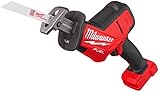
Best One-Handed Saw: Milwaukee M18 Fuel Hackzall
The Hackzall is a compact, one-handed recip saw. It has a shorter stroke than a full-size saw, which means slower cutting in thick material, but it fits in tight spaces and weighs less. It is a good second saw for overhead cuts, pipe and branch trimming, not a replacement for a full-size demolition tool.
How Long Will the Battery Last? A Worked Example
Battery energy is amp-hours times nominal volts. An 18V battery of 5.0 Ah stores about 90 watt-hours (5.0 x 18), and an 8.0 Ah or 9.0 Ah battery stores about 144 to 162 watt-hours. A saw drawing an average of 300 watts while cutting uses a 90 Wh battery in around 18 minutes of continuous cutting (90 / 300 = 0.3 hours). Real work is intermittent, so expect a full day of light demolition from two 5.0 Ah batteries and one hour of heavy continuous cuts from a single battery. These are estimates based on the arithmetic of battery capacity, not measured figures.
- Doubling battery capacity roughly doubles runtime but adds weight.
- A dull or wrong blade draws more current, which shortens runtime more than any other factor.
- Cold weather reduces available battery output; keep batteries inside until needed.
How to Choose: Specs That Matter
- Stroke length: 1-1/4 inch strokes cut faster than 1 inch or 1-1/8 inch strokes in the same material.
- Strokes per minute: up to 3,000 SPM is standard for full-size 18V saws. Variable speed matters more than the headline number.
- Brushless motor: more efficient, longer-lasting and typically more runtime.
- Weight: five to seven pounds with battery. Under six is easier overhead.
- Blade change: a tool-less clamp saves time. Look for one that will not release on its own.
- Orbital action: a few saws offer an orbital setting for faster wood cuts.
- Platform: choose a brand whose battery covers the other tools you want to own.
Decision Matrix
| Your situation | Best choice | Reason |
|---|---|---|
| Professional demolition, daily use | Milwaukee M18 Fuel Sawzall | Longest stroke, wide battery options |
| You own Makita 18V tools | Makita XRJ06Z | Shares batteries and chargers |
| You own DeWalt 20V MAX tools | DeWalt DCS382B | Shares batteries |
| Homeowner, occasional use | Ryobi ONE+ brushless | Lowest total cost |
| Overhead or tight spaces | Hackzall or a sub-compact Makita | Lighter and shorter |
Blades and Ownership Realities
The saw is only as good as its blade. Use a 6 to 9 inch wood-cutting blade with 5 to 8 teeth per inch for framing and demolition, and a bi-metal blade with a higher tooth count for metal. A pruning blade with large teeth is best for green wood. Blades are the main consumable and cost more over the life of the tool than the tool does. Keep the shoe pressed against the work to reduce vibration and blade breakage, and let the blade cut rather than force it.
- Brush and blow out dust from vents after each job.
- Keep batteries between roughly half and full charge for storage.
- Check the blade clamp for wear, since a loose clamp ruins accuracy.
Frequently Asked Questions
What is the best 18V reciprocating saw?
The Milwaukee M18 Fuel Sawzall is the most commonly recommended thanks to its 1-1/4 inch stroke, 3,000 SPM top speed and large battery system. Makita’s 18V LXT brushless saws are close, especially if you already own Makita batteries. Choose by platform if you own tools.
Is an 18V reciprocating saw powerful enough for demolition?
Yes, modern brushless 18V saws handle framing, nail-embedded wood, pipe and light metal. Very heavy, continuous demolition may still favor corded saws or larger-voltage platforms, but most users will find 18V sufficient.
What is the difference between 18V and 20V MAX?
They have the same nominal voltage. A 20V MAX rating reflects the initial peak voltage, while 18V describes the nominal. The practical difference is the battery connector, which means you cannot swap batteries between brands.
Do I need a brushless reciprocating saw?
Brushless motors run cooler, last longer and give more cutting per charge. For occasional use a brushed saw works, but the price gap has narrowed, so brushless is usually worth it.
What blade should I use to cut wood with embedded nails?
Use a bi-metal demolition blade, typically 6 TPI and 6 to 9 inches long. It cuts wood and tolerates nails without losing teeth the way a pure wood blade would.
How heavy should a cordless reciprocating saw be?
Most full-size saws weigh five to seven pounds with a battery. Lighter models around five and a half pounds are more comfortable overhead, while heavier ones tend to absorb more vibration.