
Key takeaways
- Compare five belt and disc combination sanders for woodworking by belt size, disc diameter, motor power, table tilt, and dust collection features.
What's inside
As an Amazon Associate I earn from qualifying purchases. This post may contain affiliate links at no extra cost to you.
- Top Pick: WEN 6502T Belt and Disc Sander
- Runner-up: BUCKTOOL BD4801 Bench Belt and Disc Sander
- Also consider: RIKON 50-151 Belt and Disc Sander
A belt and disc combination sander puts two of the most useful shaping tools in a woodshop on a single benchtop footprint. The belt handles long edges, end grain, and fast stock removal, while the disc, paired with a tilting table and miter gauge, squares ends and dials in precise angles. For most home and small-shop woodworkers, the best all-around choice is the WEN 6502T, which pairs a 4 x 36 inch belt with a 6 inch disc on a cast iron base. Shops that want a larger disc and a maintenance-free drive should look at the BUCKTOOL BD4801, while detail work points to the compact RIKON 50-151 or the narrow-belt KFMK combo. The JET J-41002 sits at the premium end with cast iron tables and a heavier build.
As an Amazon Associate, we earn from qualifying purchases.
Quick Picks
- Best overall: WEN 6502T — a 4 x 36 inch belt, 6 inch disc, and cast iron base cover the widest range of everyday woodworking tasks in the budget tier.
- Best direct drive: BUCKTOOL BD4801 — a 3/4 HP direct-drive motor turns an 8 inch disc with no internal belts or gears to service.
- Best for small parts: RIKON 50-151 — a compact 1 x 30 inch belt and 5 inch disc sized for craft work, models, and small repairs.
- Best for detail and contour work: KFMK 2 x 42 Belt and Disc Combo — a narrow belt that reaches into tight curves, with a 6 inch disc for flat faces.
- Best premium build: JET J-41002 — cast iron work tables, a removable platen, and a deluxe miter gauge in a 60 pound bench machine.
Table of Contents
- Quick Picks
- WEN 6502T Belt and Disc Sander
- BUCKTOOL BD4801 Bench Belt and Disc Sander
- RIKON 50-151 Belt and Disc Sander
- KFMK 2 x 42 Belt and Disc Sander Combo
- JET J-41002 Bench Belt and Disc Sander
- How to Choose a Belt and Disc Combination Sander
- FAQ
- Conclusion
- Product and ASIN Reference
WEN 6502T Belt and Disc Sander
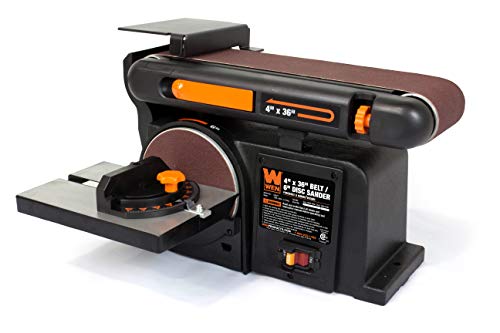
The WEN 6502T is the machine most woodworkers picture when they think of a benchtop combination sander, and its specification sheet explains why. A 4.3 amp motor rated at 1/2 HP drives both stations, spinning the disc at up to 3,600 RPM and running the belt at 1,900 surface feet per minute. The 4 x 36 inch belt is wide enough to flatten board edges and long enough to keep a workpiece stable, and the belt bed tilts from 0 to 90 degrees, so the same station works flat for edge sanding or upright for shaping ends against a stop.
The 6 inch disc handles end grain and outside corners, and the whole machine sits on a cast iron base that keeps vibration down on the bench. A tension release lever makes belt swaps simple, which matters because combination sanders earn their keep when switching grits is fast. A 2-1/4 inch dust port connects to a shop vacuum. At roughly 41 pounds, the 6502T stays put during normal work yet can still be moved when bench space is needed. It sits in the budget tier and carries a two-year warranty, which makes it the default recommendation for a first combination sander.
Specs
- Motor: 4.3 amp, 1/2 HP, 120V
- Belt size: 4 x 36 inches
- Disc size: 6 inches
- Disc speed: 3,600 RPM
- Belt speed: 1,900 SFPM
- Belt tilt: 0 to 90 degrees
- Base: cast iron
- Dust port: 2-1/4 inch
- Weight: about 41 pounds
- Warranty: 2 years
BUCKTOOL BD4801 Bench Belt and Disc Sander

The BUCKTOOL BD4801 takes a different engineering approach from most machines in this class. Instead of driving the belt and disc through an internal cog belt or pulley system, its 3/4 HP motor is direct drive, so the abrasives mount straight to the motor shaft. BUCKTOOL positions this as a maintenance-free design, since there are no internal drive belts to adjust, wear out, or replace over the life of the machine.
The format is a step up in disc size: the 4 x 36 inch belt pairs with an 8 inch disc, giving noticeably more disc surface for squaring wider stock. The disc runs at 3,450 RPM and the belt at 2,161 feet per minute. The cast aluminum work table tilts from 0 to 45 degrees for bevel work, the belt can run horizontally or vertically, and two dust ports let a collector draw from both stations. A miter gauge is included for repeatable angles on the disc table. This mid-range machine suits woodworkers who sand often enough that the larger disc and simpler drivetrain justify stepping up from the entry tier.
Specs
- Motor: 3/4 HP direct drive, 5.0 amp
- Belt size: 4 x 36 inches
- Disc size: 8 inches
- Disc speed: 3,450 RPM
- Belt speed: 2,161 FPM
- Table: cast aluminum, tilts 0 to 45 degrees
- Belt orientation: horizontal or vertical
- Dust collection: dual dust ports
- Included accessory: miter gauge
RIKON 50-151 Belt and Disc Sander

Not every shop needs a full-size combination sander, and the RIKON 50-151 is built for the work that smaller machines do better. Its 1 x 30 inch belt and 5 inch disc are scaled for small parts: craft projects, dollhouse and model work, jewelry-size pieces, tool touch-ups, and quick repairs. A 1/3 HP motor spins the disc at 3,450 RPM, which is plenty of speed for the light stock removal this format is designed for.
The metal work table tilts to 45 degrees, so bevels and chamfers on small pieces stay accurate, and the compact footprint leaves room on a crowded bench for the project itself. RIKON backs the 50-151 with a five-year warranty, the longest coverage in this roundup. Woodworkers who mainly sand small parts will find the compact format easier to control than a big belt, and the budget-tier positioning keeps it accessible as a dedicated detail station.
Specs
- Motor: 1/3 HP
- Belt size: 1 x 30 inches
- Disc size: 5 inches
- Disc speed: 3,450 RPM
- Table: metal, tilts to 45 degrees
- Warranty: 5 years
- Best for: small parts, crafts, models, and light repairs
KFMK 2 x 42 Belt and Disc Sander Combo
The KFMK combo pairs a 2 x 42 inch belt with a 6 inch disc, a format that splits the difference between the narrow 1 inch belts used for detail work and the wide 4 inch belts used for flat stock. The 2 inch belt is narrow enough to follow inside curves and reach into openings, yet wide enough to stay stable on edges, which makes this machine a flexible choice for mixed woodworking, sharpening support, and general shaping.
A 3.5 amp motor rated at 1/2 HP drives both stations. The package is well equipped for a mid-range machine: a miter gauge for the disc table, a work rest for the belt station, three hex keys, and a flat wrench are all in the box, and the belt ships with 80 grit abrasive fitted. For woodworkers whose projects mix flat faces with curved profiles, the 2 x 42 format covers detail work that a 4 inch belt cannot reach while still handling everyday edge sanding.
Specs
- Motor: 3.5 amp, 1/2 HP
- Belt size: 2 x 42 inches
- Disc size: 6 inches
- Model number: KFBD6242
- Included belt grit: 80
- Included accessories: miter gauge, belt work rest, 3 hex keys, flat wrench
- Best for: contour work, tight curves, and mixed shaping tasks
JET J-41002 Bench Belt and Disc Sander

The JET J-41002 is the premium option in this group, built around cast iron rather than stamped steel and aluminum. Both work tables are cast iron and tilt from 0 to 45 degrees, and the machine weighs 60 pounds, so it stays planted on the bench without clamping during heavy stock removal. A 3/4 HP, 115V single-phase motor drives the 2 x 42 inch belt at 3,100 surface feet per minute and the 8 inch disc at 3,450 RPM.
Two details separate the JET from the rest of the field. The platen behind the belt is removable, which exposes a slack section of belt for sanding outside curves and odd shapes freehand. The deluxe miter gauge turns and locks at 45 degrees in both directions. Dust is handled by two 1-1/2 inch chutes with adjustable deflectors, and JET backs the J-41002 with a two-year warranty. Woodworkers who sand daily, or who want the heaviest and most rigid benchtop combo in this size class, are the audience for this machine.
Specs
- Motor: 3/4 HP, 115V, single phase
- Belt size: 2 x 42 inches
- Belt speed: 3,100 SFPM
- Disc size: 8 inches
- Disc speed: 3,450 RPM
- Tables: cast iron, tilt 0 to 45 degrees
- Platen: removable for slack-belt contour sanding
- Miter gauge: deluxe, locks at 45 degrees left and right
- Dust collection: two 1-1/2 inch chutes with deflectors
- Weight: 60 pounds
- Warranty: 2 years
How to Choose a Belt and Disc Combination Sander
Start with belt width. Belt width decides what the machine does well. A 4 inch belt flattens edges and faces quickly and supports wide stock, a 2 inch belt balances flat work with contour access, and a 1 inch belt is a detail tool for small parts and tight curves. Match the belt to the workpieces that fill the shop most weeks, not the occasional oversize project.
Check the disc diameter. Discs handle end grain and mitered ends, and diameter sets the largest face that can be sanded in one pass against the table. A 5 or 6 inch disc suits small parts and trim ends, while an 8 inch disc covers wider boards and bigger components. Remember that only the downward-moving half of the disc should be used, so usable width is roughly half the diameter.
Compare motor ratings honestly. Manufacturers state power in amps or horsepower, and either figure only tells part of the story. For light hobby work, a 1/3 HP motor is adequate. Frequent hardwood shaping calls for 1/2 HP or more, and the 3/4 HP machines hold speed better under pressure. Direct-drive designs, such as the BUCKTOOL BD4801, remove internal drive belts from the maintenance list.
Look at tables, tilt, and accessories. A table that tilts to 45 degrees and a miter gauge that locks at common angles turn a sander into an accuracy tool for bevels and miters. Cast iron tables add rigidity and weight. A removable platen, found on the JET, opens up slack-belt contour sanding.
Plan for dust. Combination sanders produce dust at two stations at once. Single-port machines need the hose moved or split, while dual-port designs draw from both stations together. Any of these machines should be paired with a shop vacuum or dust collector and a respirator, and spare PSA discs and belts in a range of grits should be budgeted as ongoing supplies.
FAQ
What is a belt and disc combination sander used for in woodworking?
It shapes and smooths wood at two stations: the belt removes stock quickly, flattens edges, and can tilt for vertical or horizontal work, while the disc squares ends and, with a tilting table and miter gauge, produces accurate bevels and miters. One machine covers most of the shaping sanding in a small shop.
Which belt size is best for a first combination sander?
The 4 x 36 inch belt is the most versatile starting point because it supports wide stock and is a common size with wide abrasive availability. Woodworkers focused on small parts or curved work are better served by a 1 x 30 or 2 x 42 inch belt, which reaches tighter contours.
Can a combination sander replace a random orbital sander?
No. Belt and disc stations are shaping tools that remove material aggressively and leave a scratch pattern that still needs refinement. Finish sanding for paint or clear coats still calls for a random orbital or hand sanding with finer grits after the combination sander has done the shaping.
How long do belts and discs last on these machines?
Abrasive life depends on grit, wood species, resin content, and pressure. Coarse belts used for heavy stock removal wear fastest, and loading from pitch-heavy softwoods shortens life further. Abrasive cleaning sticks extend usable life, and keeping spare belts and PSA discs in several grits avoids downtime mid-project.
Conclusion
For most woodworking benches, the WEN 6502T is the right first combination sander: a versatile 4 x 36 inch belt, a 6 inch disc, and a cast iron base in the budget tier. The BUCKTOOL BD4801 is the step up for frequent use, adding an 8 inch disc and a direct-drive motor. Small-part specialists should choose between the compact RIKON 50-151 and the contour-friendly KFMK 2 x 42 combo, while the JET J-41002 serves woodworkers who want cast iron tables and a removable platen. Match belt width and disc size to the work that fills the shop, and any of these five machines will earn its bench space.
Related guides
More from Amazon
Programs that pair well with the guide above. Offers and eligibility are set by Amazon and may change.
A free business account with business pricing and bulk-buying tools for work, shop or home office.
Create a business accountFree shipping on eligible items, Prime Video and more. Eligible new members can start with a free trial.
Start a Prime free trialAudiobooks and podcasts to listen to on the go. Eligible new members can start with a free trial.
Try Audible freeAd-free music streaming. Eligible new subscribers can start with a free trial.
Try Music Unlimited freeAs an Amazon Associate we earn from qualifying purchases.
Write Your Review
No reviews yet. Be the first to share your experience!