Angle Grinder Safety Checklist: Equipment, Guard Setup and Pre-Start Checks
What's inside
As an Amazon Associate I earn from qualifying purchases. This post may contain affiliate links at no extra cost to you.
The essential angle grinder safety equipment is impact-rated safety glasses plus a full face shield, hearing protection, work gloves suited to the task, a dust mask or respirator, and non-synthetic long-sleeve clothing, combined with the tool’s own safety parts: the correct guard, the side handle and a disc rated for the grinder’s speed. Personal gear alone is not enough; most serious grinder injuries come from a disc that shatters or binds, so the checklist below covers the tool, the disc and the work area as well as what you wear.
As an Amazon Associate we earn from qualifying purchases at no extra cost to you.


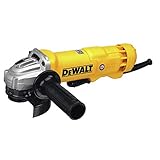

PPE table: what to wear and what rating to look for
| Equipment | Minimum standard / spec | Why it matters | Typical cost |
|---|---|---|---|
| Safety glasses | ANSI Z87.1+ (the “+” marks high-impact rating) | Fragments leave the wheel at very high speed | $8–$25 |
| Face shield (worn over glasses) | ANSI Z87.1+ rated shield | Protects face and throat from sparks and disc fragments | $15–$40 |
| Hearing protection | Earmuffs or plugs, NRR about 25 dB or higher | Grinding commonly reaches roughly 95–105 dBA | $5–$35 |
| Respiratory protection | N95 minimum for metal dust; P100 half-mask for heavy grinding, painted or galvanized metal | Fine metal, paint and abrasive dust | $2–$45 |
| Gloves | Leather or cut-resistant (ANSI/ISEA 105 A3 or higher), snug fit | Heat, sharp edges and sparks; loose gloves can snag | $12–$35 |
| Clothing | Cotton, wool or flame-resistant; long sleeves, no loose cuffs | Synthetic fabrics can melt onto skin when hit by sparks | Varies |
| Footwear | Leather boots, ASTM F2413 safety toe for heavy work | Falling workpieces and sparks | $60–$180 |
For crystalline silica materials such as concrete, brick or stone, grinding produces respirable silica dust. Use a shroud with dust extraction or water suppression plus a properly fitted respirator; a basic dust mask is not adequate. Anyone with breathing conditions should get advice from a medical professional before doing this kind of work.
Tool checks before you plug in
- Guard installed and positioned. The guard must be between the disc and your body, covering the half of the wheel nearest you. Rotate it so sparks and fragments are directed away from you and the side handle hand.
- Side handle fitted. Thread it into the side opposite your dominant hand (or on top for some tasks). Two hands on the tool is the main defense against kickback.
- Cord and plug intact. No cuts, exposed conductors or damaged strain relief. Use a GFCI outlet outdoors or in damp areas.
- Switch works and returns to off. Paddle switches with a lock-off and dead-man release are the safest choice for beginners.
- Flanges clean and matched. Use the inner and outer flanges supplied for that type of disc; a flange in the wrong orientation can let a thin disc flex and break.
Disc checks: the most important step
| Check | Rule | Example |
|---|---|---|
| Speed rating | Disc max RPM must equal or exceed the grinder’s no-load RPM | A 4-1/2 in grinder at 11,000 RPM needs a disc rated 11,000 RPM or higher (many are rated 13,300 RPM) |
| Diameter | Never fit a larger disc than the tool and guard are designed for | No 5 in disc on a 4-1/2 in grinder with the guard removed |
| Arbor and type | Match arbor size (commonly 7/8 in for 4-1/2 in discs) and disc type to the guard | Type 27 depressed-center for grinding; Type 1 or Type 41 cut-off discs need a closed cut-off guard |
| Condition | No cracks, chips, moisture damage or warping | Discard any disc that was dropped |
| Expiry | Resin-bonded discs age; check the date stamped on the metal center ring | Many manufacturers stamp a use-by date roughly three years after manufacture |
After mounting a new disc, run the grinder at full speed for about one minute with the guard in place, pointed away from people and with you standing to the side. A defective disc is most likely to fail during this run-up, not in your hands mid-cut.
Guard and handle rules
- Never remove the guard to fit a larger disc or to reach a tight spot. If the guard is in the way, the tool or disc is wrong for the job.
- Cutting with a thin cut-off disc in a grinding guard is common but not ideal; a dedicated cut-off guard that encloses both sides of the disc is the correct setup.
- Do not grind with the face of a Type 1 cut-off disc. Side loading is what shatters thin wheels.
- Keep the side handle on for all work. Removing it to save weight trades a small convenience for losing control during a bind.
- Never use wood-carving chain discs or toothed saw blades on an angle grinder unless the manufacturer specifically allows them with the right guard; they are a leading cause of severe kickback injuries.
Work area checklist
- Clamp the workpiece in a vise or to a bench. Do not hold small parts by hand.
- Remove flammables within about 35 feet of the spark stream, or cover them with fire-resistant blankets. Sparks travel farther than most people expect.
- Keep a fire extinguisher (ABC type) within reach, and check the area for smoldering debris for 30 minutes after hot work.
- Make sure bystanders, children and pets are out of the spark and fragment path.
- Position the cord behind you, away from the disc.
- Good lighting and stable footing; avoid working overhead or on ladders.
Operating habits that prevent injuries
- Let the disc reach full speed before contact and let the grinder’s weight do the work; forcing it overheats the disc and increases binding.
- Grind at a shallow angle (about 15–30 degrees) with Type 27 discs.
- Watch the rotation direction. Pinching the disc in a cut makes the tool jump back toward you. Support both sides of a cut so the gap opens rather than closes.
- Wait for the disc to stop before setting the grinder down, and unplug it before changing discs.
- Take breaks. Vibration and fatigue reduce grip strength over long sessions; anti-vibration gloves help with comfort but do not replace rest.
Grinder features that add safety
| Feature | What it does |
|---|---|
| Paddle switch with lock-off | Tool stops as soon as you release grip |
| Electronic kickback or anti-bind control | Cuts power when the disc suddenly binds |
| Electric brake | Stops the disc in a few seconds instead of coasting |
| No-volt / anti-restart protection | Prevents restart when power returns with the switch locked on |
| Soft start | Reduces the jerk at start-up |
Many current corded and cordless grinders from brands such as DeWalt, Milwaukee, Makita, Bosch and Metabo offer these features on at least some models. If you are buying a grinder mainly for occasional home use, prioritize a paddle switch and kickback protection over raw power.