Best Battle Ropes for Home Workouts
What's inside
- Quick picks by home-workout situation
- How to choose the right battle-rope length
- Diameter, weight, and training difficulty
- Material and construction: what lasts outdoors
- Anchor requirements: the part many listings understate
- Decision matrix: match the rope to your routine
- A simple space calculation before buying
- Ownership, cleaning, and common mistakes
- Final recommendation
- Quick picks by home-workout situation
- How to choose the right battle-rope length
- Diameter, weight, and training difficulty
- Material and construction: what lasts outdoors
- Anchor requirements: the part many listings understate
- Decision matrix: match the rope to your routine
- A simple space calculation before buying
- Ownership, cleaning, and common mistakes
- Final recommendation
As an Amazon Associate I earn from qualifying purchases. This post may contain affiliate links at no extra cost to you.
The best battle ropes for home workouts are usually a 30–40 ft rope with a 1.5 in diameter: that length suits most garages and patios, while the diameter provides a useful balance of grip challenge, weight, and price.
As an Amazon Associate we earn from qualifying purchases at no extra cost to you.
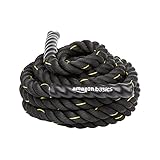


Quick picks by home-workout situation
| Situation | Recommended rope | Why it fits | Typical market range |
|---|---|---|---|
| Small room or short patio | 20 ft × 1.5 in | Needs roughly 10 ft of working space from the anchor | $35–$75 |
| Most beginners | 30 ft × 1.5 in | Manageable wave resistance without excessive floor coverage | $45–$90 |
| General conditioning | 40 ft × 1.5 in | More rope mass and a longer wave path for intervals | $60–$120 |
| Experienced users or outdoor training | 50 ft × 2 in | Heavy, demanding, and better suited to a permanent anchor | $100–$220 |
| Frequent commercial-style use | 30–50 ft × 2 in, three-strand rope | More durable construction, but significantly harder to handle | $130–$300 |
How to choose the right battle-rope length
Length determines both the amount of space required and how much rope mass you must move. A battle rope is normally folded around an anchor, so a 30 ft rope gives you two approximately 15 ft working sides. Your usable training distance is therefore about half the stated rope length, with additional clearance needed for the anchor and your body.
For example, if the anchor is 3 ft from a wall, a 30 ft rope may require approximately 13–15 ft of clear space in front of it. A 40 ft rope generally needs around 18–20 ft, and a 50 ft rope can need 23–25 ft. Measure the straight-line distance, not just the room’s longest wall. Furniture, garage doors, low shelves, and nearby vehicles can make an apparently large area impractical.
20 feet: compact but limited
A 20 ft rope is useful when space is the deciding factor. It is easier to store and responds quickly, but the short length provides less rope mass and a shorter wave. It can work well for alternating waves, slams, and short intervals, although advanced users may find it less challenging.
30 feet: the safest starting point
A 30 ft rope is the most versatile choice for a home gym. It fits many single-car garages and outdoor areas while offering enough length for effective waves. Choose this size if you are unsure whether you will train regularly or if several people with different experience levels will share the equipment.
40–50 feet: more resistance and more commitment
Longer ropes create more drag and require more space. They are valuable for longer conditioning intervals, but they are not automatically better. In a confined area, a 50 ft rope may force the user too close to walls or equipment. It can also be tiring to coil and move after every session.
Diameter, weight, and training difficulty
Diameter changes more than grip comfort. It affects total rope weight, resistance, hand fatigue, and the amount of force needed to create a consistent wave.
| Diameter | Approximate weight per foot | Weight of 30 ft rope | Best suited to |
|---|---|---|---|
| 1.0 in | 0.20–0.30 lb | 6–9 lb | Smaller hands, beginners, light conditioning |
| 1.5 in | 0.35–0.55 lb | 10.5–16.5 lb | Most home users and general fitness |
| 2.0 in | 0.60–0.90 lb | 18–27 lb | Advanced users and short, hard intervals |
These are useful buying estimates rather than universal specifications; braid density and core construction vary by manufacturer. A 1.5 in rope is usually the best compromise because it provides a secure grip without making every set a test of forearm endurance. A 2 in rope can be too demanding for new users, especially when it is 40 or 50 ft long.
Do not judge difficulty by diameter alone. A long 1.5 in rope may weigh more than a short 2 in rope. If you want a rope for repeated 20- to 30-second work intervals, prioritize a manageable total weight. If your goal is brief, high-effort sets, a heavier rope can be appropriate.
Material and construction: what lasts outdoors
Nylon
Nylon ropes are common because they are flexible, relatively affordable, and comfortable to handle. They can work indoors or outdoors, but prolonged sunlight, rain, and damp storage eventually weaken synthetic fibers. A nylon rope should be dried fully before storage.
Polyester
Polyester generally resists ultraviolet exposure and moisture better than nylon. It is often a sensible choice for a rope kept on a covered patio or in a garage with temperature changes. It may feel slightly stiffer, particularly when new.
Poly Dacron and blended synthetic ropes
Poly Dacron-style constructions are widely used in fitness ropes because they balance flexibility, abrasion resistance, and cost. They are a practical choice for frequent home use. The exact blend matters less than the quality of the braid, the protective sleeve, and the end caps.
Look for heat-shrunk or firmly secured end handles, a tightly braided body, and a sleeve that does not slide excessively during use. Molded rubber handles can improve grip, while textured synthetic handles may dry faster after outdoor sessions. Avoid a handle that is so thick that your fingers cannot wrap around it comfortably.
Anchor requirements: the part many listings understate
A battle rope can generate substantial repeated pulling force. The anchor must be attached to structural material, not merely to drywall, thin paneling, or a decorative fence board. Suitable options include a purpose-built wall or floor anchor fastened into framing, a heavy steel post, or a tree with a smooth, protected section of trunk.
Check the anchor’s rated capacity and installation instructions. The rating should account for dynamic loading rather than only a static hanging weight. Use the supplied hardware where possible, identify studs or structural members accurately, and inspect bolts before every session.
If drilling is not possible, a heavy outdoor post or a purpose-built strap around a suitable structural object may be practical. Do not loop the rope around sharp metal, rough concrete, a hot pipe, or anything that can abrade the sheath. A protective sleeve or anchor strap can reduce wear at the contact point.
Decision matrix: match the rope to your routine
| Your priority | Recommended specification | What to avoid |
|---|---|---|
| Lowest cost and occasional use | 20–30 ft × 1.0–1.5 in synthetic rope | Oversized 2 in ropes that remain unused |
| Beginner training two or three times weekly | 30 ft × 1.5 in | 50 ft ropes with no measured training area |
| Small indoor workout area | 20–30 ft × 1.0–1.5 in, preferably flexible | Rigid, heavy ropes that strike walls or furniture |
| Frequent outdoor sessions | 30–40 ft polyester or blended rope with protective sleeve | Permanent exposure to sun and rain |
| Advanced short intervals | 40–50 ft × 1.5–2.0 in | Choosing by diameter without checking total weight |
A simple space calculation before buying
Measure from the proposed anchor to the nearest obstacle. Subtract about 2 ft for a safety buffer, then compare the result with half the rope’s length. For example:
- Available clear distance: 17 ft
- Recommended buffer: 2 ft
- Usable working distance: 15 ft
- Maximum practical rope length: approximately 30 ft
That calculation makes a 30 ft rope a better choice than a 40 ft model, even if the larger rope appears more capable on paper. Keep enough room behind your heels to step, stabilize, and stop without contacting a wall.
Ownership, cleaning, and common mistakes
The anchor-contact area usually wears first, followed by the handles and the rope ends. Inspect for flattened braid, fuzzy fibers, cuts, separated heat-shrink tubing, or a handle that rotates independently of the rope. Retire the rope if the core is exposed or if damage is spreading rapidly.
After outdoor use, shake out grit and wipe the rope with mild soap and clean water. Allow it to dry completely in a ventilated area before coiling it loosely. Do not store it wet in a sealed bin, leave it permanently in direct sunlight, or drag it over concrete. Keep the coil off the floor when possible.
Common setup mistakes include anchoring too low, standing so close that the rope cannot form a wave, and choosing a rope too heavy to control. Start with 15–20 second intervals, rest adequately, and focus on consistent waves rather than maximum speed. If a movement causes pain or you have a relevant injury or medical concern, stop and seek advice from a qualified health professional.
Final recommendation
For most home users, buy a 30 ft × 1.5 in synthetic battle rope and install it at a structurally sound anchor with at least 15 ft of clear working distance. Choose 20 ft if space is tight, 40 ft if you have a larger garage and want more resistance, and 2 in diameter only when your grip and conditioning level justify the added weight. The best battle ropes for home workouts are the ones that fit your available space, can be anchored safely, and are light enough that you will use them consistently.