Best Kettlebell Sets for Home Gyms
What's inside
As an Amazon Associate I earn from qualifying purchases. This post may contain affiliate links at no extra cost to you.
The best kettlebell sets for home gyms, by situation
The best kettlebell set for a home gym is a small cast-iron set if you have room and want simple, durable weight options; choose an adjustable kettlebell if storage space matters more than quick weight changes. For most beginners, two or three fixed weights are easier to use safely and consistently than a single adjustable bell.
| Set type | Typical useful range | Handle and feel | Storage footprint | Best fit |
|---|---|---|---|---|
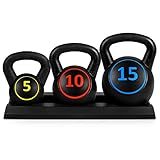
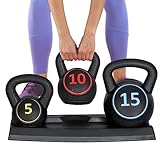
| Cast-iron set of 3 | 8, 12, and 16 kg (about 18, 26, and 35 lb) | One-piece bell; feel varies by model and size | Three bells, roughly 1–2 sq. ft. of floor space when grouped | Beginners who want distinct weights and uncomplicated changes |
| Cast-iron set of 4 | 8, 12, 16, and 20 kg (about 18, 26, 35, and 44 lb) | Consistent grip within a brand; heavier bells need more room around the handle | Four bells, commonly 2–3 sq. ft. grouped together | Regular training and a wider range for different movements |
| Adjustable competition-style bell | Often about 12–32 kg (26–70 lb), model dependent | Competition-style handle; internal plates change the load | One bell, generally about 1 sq. ft.; allow extra space to change plates | Limited storage and lifters who need several loads in one bell |
| Adjustable compact bell | Often about 8–18 kg (18–40 lb), model dependent | Handle and balance can differ from a fixed bell | One bell, compact, with plates or selector mechanism to store | Light-to-moderate training in a small room |
These are practical example ranges, not standards: check the product’s actual increments, dimensions, and maximum load before buying. Weight conversions are rounded.
As an Amazon Associate we earn from qualifying purchases at no extra cost to you.


Cast iron vs. adjustable: what changes in daily use?
Cast iron: better for fast changes and repeated practice
A cast-iron bell is ready as soon as you pick it up. That matters for circuits, interval sessions, or workouts that alternate between two weights. A solid, one-piece bell also has fewer parts to loosen, misplace, or inspect. A basic set often costs roughly $60–$180, depending on the number and total weight of bells, finish, and handle quality.
The trade-off is space and the upfront cost of buying multiple weights. Bells take up room even when they are not in use, and a set with large jumps may leave you between loads as you get stronger. For a first purchase, three weights with manageable steps are generally more useful than one very heavy bell paired with a light one.
Adjustable: better when space or budget is tight
An adjustable bell can provide several training loads without filling a corner with separate bells. Many models use removable plates secured inside the shell; others use a selector mechanism. Depending on capacity and construction, adjustable models commonly fall around $100–$300. Compare the price with the equivalent fixed weights you would realistically buy—not with the maximum range printed on the box.
Weight changes take longer, and the bell may feel different from a traditional cast-iron kettlebell. Plate movement, locking parts, and the handle shape can affect comfort and balance. Before buying, confirm how the plates are secured, whether the bell can be set down firmly between exercises, and whether its adjustments are suitable for the movements you plan to do. Avoid dropping an adjustable bell unless the manufacturer explicitly permits it.
Choose by your space, experience, and training habits
| Your situation | Better starting choice | Why |
|---|---|---|
| New to kettlebells; training once or twice a week | Two or three fixed bells | Simple changes make it easier to focus on technique; add weight as your needs become clear. |
| Very limited floor space; several loads needed | Adjustable bell with a suitable range | One main unit replaces several bells, though plate storage still needs a designated spot. |
| Frequent circuits with little rest between exercises | Fixed bells in the weights you use most | No adjustment pause or plate handling during a workout. |
| Experienced lifter building toward heavier swings or squats | Fixed set with smaller useful jumps, or a high-capacity adjustable | Choose based on whether fast changes or compact storage matters more; verify the upper limit. |
| Shared room with delicate flooring | Either type, plus a stable mat or platform | Floor protection depends on placement and impact, not just whether the bell is fixed or adjustable. |
Think about progression before paying for a large set. As a simple example, a four-bell set at 8, 12, 16, and 20 kg gives you four fixed options and 4 kg jumps. If your current training only calls for 8 and 12 kg, buying all four immediately may leave two bells unused. Start with the loads you can control, then add the next weight when you can perform your planned work with consistent form. If a 4 kg jump feels too large, look for closer increments or use a coach to plan an appropriate progression.
Details that are easy to overlook
Handle comfort depends on the movement
Look for a smooth handle without sharp casting seams, raised logos, or rough spots where your hand contacts the metal. The handle should leave enough room for your grip without forcing your fingers against the bell. A wider handle can suit a two-handed swing, while a competition-style bell typically has a standardized body size across weights; that consistency can help with technique but may not suit every hand. If possible, inspect or handle the size you plan to buy. A comfortable handle matters more than a decorative coating.
Protect the floor—and the bell
Rubber-coated bases or a rubber training mat can reduce scuffs and noise when setting a bell down. They do not make a bell safe to drop: heavy impacts can damage flooring, the bell, or nearby items. Keep the exercise area clear, set bells down under control, and use a mat that lies flat and does not slide. Check whether a coating covers only the base or the full bell; a coating can chip with repeated impacts, exposing metal and creating rough edges.
Plan the storage footprint, not just the listed dimensions
Measure the spot where the bells will live and leave room to pick them up without scraping walls or reaching around other equipment. A compact adjustable unit still needs space for plates, selector parts, or the adjustment process. Fixed bells need a wider footprint, but can be stored together on a low, stable rack or mat. Keep them on a level surface where they cannot roll or tip.
Ownership realities: what to check over time
On cast-iron bells, the most common annoyances are chipped coating, rust from damp storage, and rough handle seams that wear on the hands. Wipe off sweat after training and store bells somewhere dry. If a handle is rough, address it carefully according to the maker’s guidance rather than sanding without checking: removing a coating can expose bare metal or affect the finish.
On adjustable bells, inspect the locking system and plate seating before each session. Keep adjustment parts clean, tighten or secure them as specified, and stop using the bell if a plate shifts or a lock is damaged. Lost or incompatible parts can make a specialized model difficult to maintain, so check whether the manufacturer sells replacements. For either type, avoid using a bell with cracks, loose components, or a damaged handle.
Bottom line
Choose cast iron if you want quick transitions, a traditional feel, and durable individual weights—and can spare the storage space. Choose adjustable if one compact footprint is the deciding factor and you are comfortable stopping to change loads. The best kettlebell sets for home gyms are not necessarily the largest: they are the sets with comfortable handles, useful weight steps, secure construction, and a footprint you can live with.