Best Inflatable Pools for Backyards
What's inside
As an Amazon Associate I earn from qualifying purchases. This post may contain affiliate links at no extra cost to you.
The best inflatable pools for backyards are usually rigid-wall-style family pools from Intex or Bestway: choose a compact 8–10 ft pool for children and small yards, a 12–14 ft reinforced pool for mixed adult-and-child use, or a deeper 15–18 ft model with a filter pump when regular swimming matters more than quick setup.
The right choice depends less on the biggest advertised diameter than on usable space, water capacity, filtration, and how often you are prepared to drain, clean, and store it. A large pool can cost more to fill and take longer to maintain, while a small splash pool may be frustrating for adults.
As an Amazon Associate we earn from qualifying purchases at no extra cost to you.
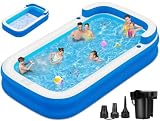


Best inflatable pools by backyard situation
| Backyard need | Recommended pool type | Typical size | Typical capacity | Why it fits |
|---|---|---|---|---|
| Small patio or occasional children’s play | Inflatable splash or low-wall pool | 6–8 ft diameter, 18–24 in deep | 250–700 gal | Fast setup, low filling cost, simple to empty and store |
| Several children or one reclining adult | Inflatable ring pool | 8–10 ft diameter, 24–30 in deep | 600–1,200 gal | Good compromise between footprint and capacity |
| Family cooling and supervised play | Reinforced side-wall pool with filter pump | 12–14 ft diameter, 30–36 in deep | 1,500–2,800 gal | More comfortable for adults; filtration reduces full drain-and-refill frequency |
| Frequent summer use | Large frame-supported inflatable pool | 15–18 ft diameter, 36–48 in deep | 3,500–6,000 gal | Most usable space, but needs a level base, pump, cover, and substantial storage |
Capacities vary with the fill line and shape, so treat these figures as planning ranges rather than exact specifications. A rectangular pool with the same nominal length may hold more water than a round model, but it also needs more clearance around its walls.
Our top choices by use case
Best all-around choice: a 12–14 ft reinforced pool with filtration
For a household that wants adults and children to use the pool, this is the most balanced format. Models from established manufacturers such as Intex and Bestway commonly use multi-layer PVC or polyester-reinforced PVC, an inflatable upper ring or supported wall, a drain valve, and a cartridge filter pump. The approximately 30–36 in water depth is enough for cooling off and sitting, without the excessive water consumption of a very large pool.
Look for a pump rated for the pool’s volume, two or more hose connections, replaceable filter cartridges, and a ground cover included or available in the correct size. A cover is particularly valuable because leaves and dust can otherwise turn the filter into the primary cleaning system.
Best for children: a shallow 6–10 ft play pool
A shallow inflatable pool is easier to supervise, fill, empty, and dry. It is also more forgiving when the yard has limited flat space. Choose a broad floor, rounded edges, and a depth appropriate for the children’s ages and abilities. Children should remain within arm’s reach of a supervising adult around any amount of water; a shallow pool is not a substitute for supervision.
Many small pools do not include filtration. That is acceptable for short sessions if the water is emptied after use, but it becomes inconvenient when the same water is left standing for several days. Avoid choosing a deep family pool merely because it has a lower price per inch of diameter: children may have less usable floor area and more difficult supervision.
Best for adults: a deep 15–18 ft frame-supported pool
Adults need both water depth and floor space. A large inflatable ring pool can work, but its upper ring and flexible walls reduce usable room as people lean against them. Frame-supported models, including larger Intex and Bestway designs, generally hold their shape better and offer more practical seating and movement.
These pools require a serious setup area. Allow at least 2 ft of unobstructed space around the pool, and confirm that the fully filled weight is appropriate for the ground. Four thousand gallons of water weighs roughly 33,400 lb before adding the pool, occupants, and equipment. A deck, balcony, or questionable slope is not an appropriate installation surface without professional confirmation.
Materials: what lasts and what wears first
Most quality inflatable pools use PVC, often with polyester mesh reinforcement between layers. Single-layer vinyl is inexpensive and light but is more vulnerable to punctures, sun exposure, and stretching around fittings. Reinforced PVC costs more and is heavier, but it is the better choice for repeated seasonal use.
- Inflatable ring: convenient and quick to assemble, but the ring can develop leaks, sag in heat, or become damaged by pets and sharp objects.
- Side-wall seams: often experience more stress than the floor, especially when the pool is overfilled or installed on a slope.
- Drain valve and hose fittings: seals and plastic threads may wear before the main body of the pool.
- Filter cartridges: consumable parts that collect fine debris and gradually restrict flow.
- Bottom surface: abrasion from gravel, sticks, and rough concrete can cause slow leaks that are difficult to locate.
Do not drag a filled or partly filled pool. Clear the site, sweep it, and place a properly sized ground cloth or protective mat underneath. Store the pool completely dry and loosely folded; trapped moisture encourages mildew and can make vinyl stick to itself.
Setup time, filtration, and ownership effort
| Pool category | Typical setup time | Filter included? | Likely upkeep | Storage footprint |
|---|---|---|---|---|
| 6–8 ft splash pool | 10–20 minutes | Usually no | Empty after use; rinse and dry | Small bag, roughly 1–3 cu ft when packed |
| 8–10 ft inflatable ring pool | 20–40 minutes | Sometimes | Skim debris; replace water frequently without filtration | About 2–4 cu ft |
| 12–14 ft filtered pool | 45–90 minutes | Commonly included | Run pump as directed; clean or replace cartridge; cover when unused | About 4–7 cu ft plus pump and hoses |
| 15–18 ft frame-supported pool | 2–4 hours | Usually included | Regular filtration, water testing, skimming, and seasonal disassembly | About 6–12 cu ft plus frame and accessories |
Setup times assume a prepared, level surface and an electric air pump where inflation is required. They do not include filling. A garden hose may take several hours to fill a large pool, depending on local water pressure and hose diameter. Never leave a filling pool unattended, and stop at the marked fill line rather than using wall height as a target.
How to calculate the real water and storage commitment
For a rough cost estimate, multiply the pool’s gallons by your local combined water and sewer rate per gallon. For example, a 2,000-gallon pool at a combined rate of $0.012 per gallon costs about $24 for one fill: 2,000 × $0.012 = $24. A second full refill doubles that water charge, before considering treatment products and drainage rules.
Filtration does not mean the water can be ignored. Remove leaves daily, check the manufacturer’s water-care instructions, and replace or rinse cartridges as specified. If the water becomes cloudy, develops an odor, or cannot be maintained with the prescribed care, draining and cleaning may be safer than repeatedly adding chemicals. Follow local rules for where pool water may be discharged.
What to check before buying
- Measure the usable, level area—not just the advertised pool diameter—and add clearance for the pump, hoses, and walking space.
- Confirm the filled weight and avoid slopes, retaining-wall edges, septic covers, and elevated structures.
- Choose a model with a repair patch, a drain valve positioned for your yard, and replacement filters that are readily available.
- Check whether the pump uses a standard electrical connection and whether outdoor ground-fault protection is required locally.
- Budget for a cover, ground protection, a skimmer, and an air pump if the pool does not include them.
- Inspect for sharp toys, branches, pet access, and abrasive surfaces before every setup.
Bottom line
For most backyards, a 12–14 ft reinforced inflatable pool with a cartridge filter offers the best balance of adult comfort, children’s play space, manageable water capacity, and reasonable storage. Choose a 6–10 ft shallow pool when quick setup and low ownership effort matter most. Move up to a 15–18 ft frame-supported model only when the yard, water budget, drainage plan, and storage space can support it.